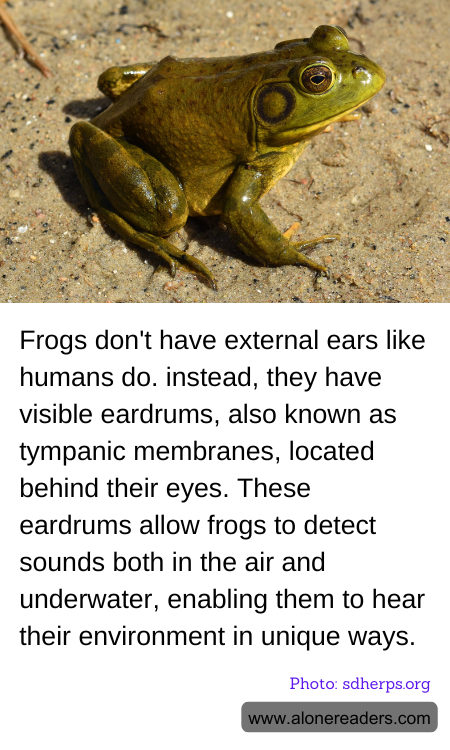
Frogs possess a fascinating auditory system that differentiates them from many other animals, including humans. Unlike humans, who have external ears, frogs feature visible eardrums, or tympanic membranes, prominently placed behind their eyes. These membranes are crucial for their survival, as they provide the frogs with the ability to detect sounds in their environment, both in the air and underwater.
The placement and structure of the tympanic membranes in frogs play a vital role in their ability to hear. Since frogs do not have external ear structures to funnel sound waves towards the inner ear, the tympanic membranes are exposed directly to the environment. This direct exposure allows the membrane to pick up vibrations in the air or water, which are then transmitted to the inner ear where they are processed as sounds.
This auditory system is especially advantageous for frogs as it supports their communication and predation habits. Frogs often communicate through a variety of sounds, such as croaks, chirps, and ribbits. The ability to hear these sounds clearly is crucial for mating calls, territorial disputes, and alerting others to potential threats. Moreover, being able to hear underwater is beneficial for frogs, particularly aquatic species, as it enhances their ability to detect predators and prey in a submerged environment.
The sensitivity of a frog's tympanic membranes can vary between species, often in correlation with their specific habitat and lifestyle needs. For instance, some species have larger tympanic membranes, which makes them more sensitive to lower frequencies, a feature that can be crucial for detecting the calls of other frogs over longer distances. On the other hand, species with smaller membranes may be more attuned to higher frequencies, which could be advantageous in dense vegetation or flowing streams where such sounds are more common.
Overall, the auditory capabilities of frogs, facilitated by their unique tympanic membranes, are a remarkable example of evolutionary adaptation. These capabilities not only allow frogs to survive but also to thrive in their respective environments by finding mates, locating food, and avoiding predators through an acute sense of hearing.
