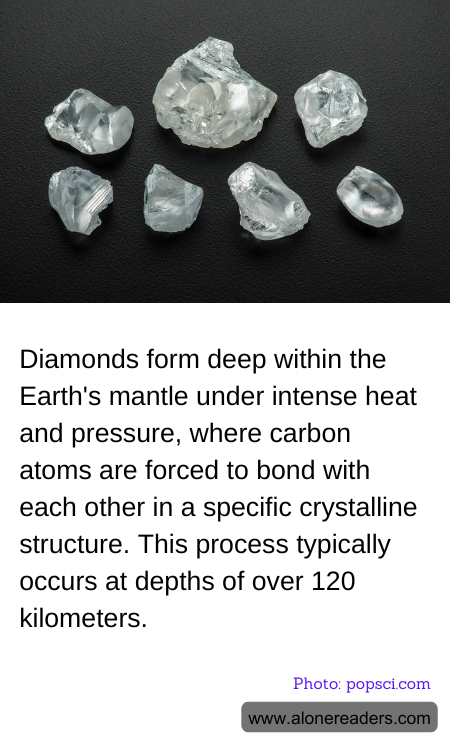
Diamonds, some of earth’s most coveted and admired natural creations, are formed under remarkably harsh conditions. Deep within the Earth's mantle, often at depths exceeding 120 kilometers, extreme heat and pressure work in concert to transform carbon atoms into stunningly beautiful and incredibly hard crystals. This environment, where temperatures soar above 1,000 degrees Celsius and pressures reach over 50,000 times Earth's surface atmosphere, forces each carbon atom to bond in a unique way, leading to the formation of diamonds.
The process begins with carbon in its simpler form, and through immense geothermal activity, these atoms are coerced into a rigid crystalline structure known as the diamond cubic. Each carbon atom bonds to four other carbon atoms in a tetrahedral configuration, contributing to diamond’s famed strength and brilliance. It is this precise, uniform arrangement that gives diamonds their renowned properties, including their spectacular ability to refract light and their unmatched hardness.
Over millions of years, these crystalline structures slowly accumulate to form rough stones. The journey from their fiery cradle deep within the Earth up to the surface involves violent volcanic eruptions through kimberlite or lamproite pipelines, which are conduits unique to diamond-bearing rocks. As the magma rushes towards the surface, it catches diamond deposits along its path and cools swiftly upon reaching the cooler upper layers of the Earth, thereby preserving the diamonds in their iconic gem-like state.
Once brought close to the Earth’s surface, diamonds are typically mined in places where these ancient volcanic eruptions have exposed the gems within reach of modern extraction techniques. Following mining, diamonds are carefully cut, polished, and crafted into various shapes, enhancing their natural splendor. These gems are not only used in jewelry but also in various industrial applications, leveraging their hardness and thermal conductivity properties.
The creation of a diamond from a simple carbon atom under extreme conditions is a testament to the formidable and precocious powers of our planet. Each stone's passage from the depths of the Earth to a finished piece of extraordinary mineral art is a profound reminder of the dynamic processes continually at play beneath our feet.
