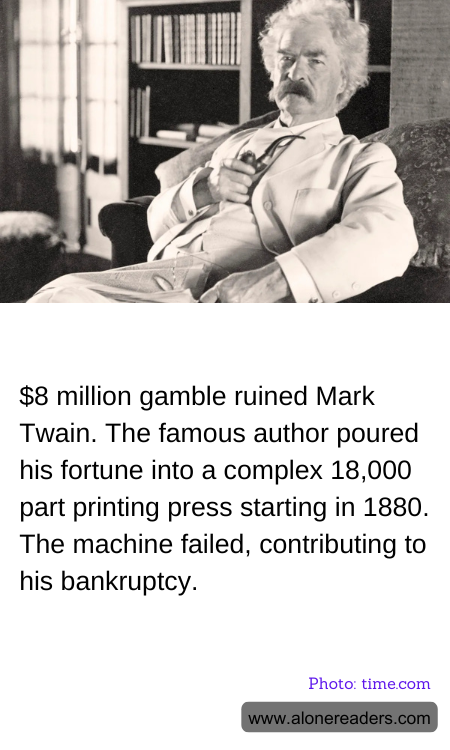
Mark Twain, best known for his rich tapestry of narratives that capture the essence of American life, faced significant financial hardship due to his ambitious foray into technological entrepreneurship. In 1880, Twain invested heavily in an advanced typesetting machine, envisioned by James W. Paige. Twain believed that this 18,000-part contraption, known as the Paige Compositor, would revolutionize the printing industry by automating the placement of type more efficiently than any existing method.
Fascinated by scientific inventions and always eager to back potentially lucrative breakthroughs, Twain poured more than $300,000 (equivalent to roughly $8 million today) into the development of the Paige Compositor. This colossal financial commitment eventually drained his wealth, as the machine was plagued by complexities and constant malfunctions. Despite its innovative design, which aimed to replace the labor-intensive process of manual typesetting, the machine was overly intricate and prone to errors, making it impractical for widespread use.
Twain's unyielding faith in the project's success blinded him to its ongoing issues and mounting costs. His investment became increasingly burdensome, siphoning funds from his other ventures and earnings. By the early 1890s, the financial strain contributed significantly to Twain's bankruptcy. The failure of the Paige Compositor was a devastating blow, not only financially but also personally, as Twain had staked his reputation and a substantial portion of his fortunes on the venture.
Despite this setback, Twain's resilient spirit shone through. He undertook a series of international lecture tours, which were successful and helped him recover financially. These lectures, rich with his signature wit and wisdom, helped restore his finances and allowed him to pay off his creditors fully, reaffirming his ethical commitment despite his earlier financial misjudgments.
Twain's experience with the Paige Compositor is a poignant reminder of the risks inherent in innovation and investment. It also underscores the unpredictable nature of pioneering technological ventures, a reality that perseveres in modern times. His story is a testament to the complexities of balancing creative genius with business acumen, and a reflection on the personal resolve required to overcome profound setbacks.
