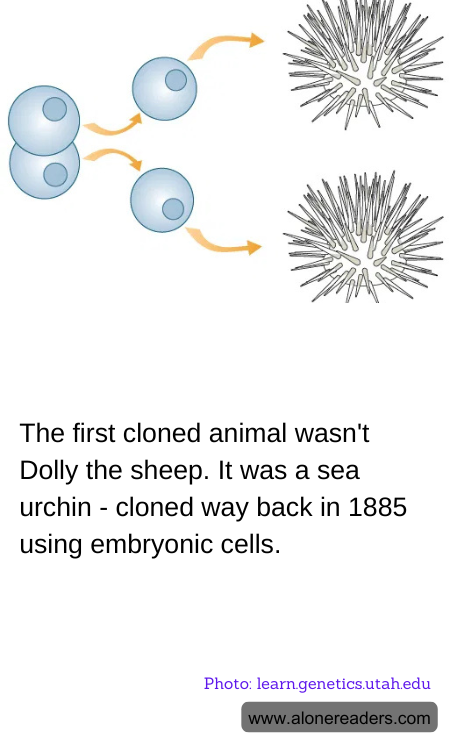
The common narrative surrounding the history of cloning often highlights Dolly the Sheep as the first cloned animal, yet this overlooks an earlier, pioneering experiment that shifted the paradigms of biological science. In 1885, decades before Dolly, the first successful animal cloning was performed using a sea urchin. This groundbreaking experiment was conducted by the German embryologist Hans Adolf Eduard Driesch. Driesch's work with sea urchins marked a significant departure from previous biological experiments and set the stage for the development of modern cloning techniques.
Driesch's approach was simple yet revolutionary for its time. He separated the two cells of a developing sea urchin embryo, allowing each cell to grow independently. To his astonishment, each cell developed into a complete, fully-functional sea urchin, defying the then-prevailing belief that embryonic cells at early stages were already predestined for specific developmental paths. This experiment provided the first concrete evidence that each cell in the early embryo has the potential to develop into a full organism, a concept now known as totipotency.
Comparatively, Dolly’s cloning in 1996 involved a different and more complex technique known as somatic cell nuclear transfer (SCNT). Here, scientists transferred genetic material from a mature somatic cell into an egg cell from which the DNA had been removed. This egg then developed into a clone of the adult animal, providing a breakthrough model for understanding how the cells of mature organisms can be reprogrammed to an embryonic-like state.
Despite being less well-known than Dolly, the cloning of the sea urchin by Driesch was equally monumental. It not only challenged existing dogmas about developmental biology but also paved the way for future explorations into genetic engineering and cloning technologies. Today, as we navigate the ethical and practical implications of cloning and genetic manipulation, remembering the full scope of cloning's history, including its origins with the humble sea urchin, is essential. This broader understanding helps in appreciating the complexities and capabilities of scientific advancements in both the past and the present.
