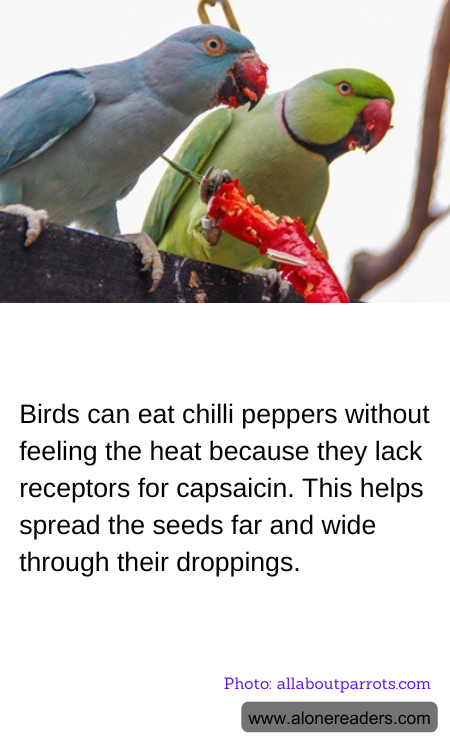
Birds have a unique relationship with chili peppers that illustrates a fascinating aspect of evolutionary biology and ecological interdependence. Unlike humans and many mammals, birds are unaffected by the heat of chili peppers. This is because they do not have the receptors necessary to respond to capsaicin, the chemical that gives chili peppers their intense heat. Capsaicin targets a specific pain receptor in mammals, the TRPV1 receptor, which triggers the sensation of spiciness or burning when activated. Birds, lacking this receptor, can consume even the hottest peppers without discomfort.
This evolutionary trait benefits both the birds and the chili plants. For the plants, birds serve as effective dispersers of seeds. When birds consume chili peppers, the seeds pass through their digestive system unharmed and are then deposited over a wide area in their droppings. This scattering of seeds helps the chili plants to colonize new areas, thus expanding their range and increasing their chances of reproductive success. From the bird’s perspective, chili peppers represent a plentiful and reliable food source, especially since many mammals avoid eating these spicy fruits. This reduced competition for peppers means that birds often have exclusive access to a food resource that replenishes each season.
The fact that birds can eat chili peppers without feeling the heat has implications for conservation and agricultural practices as well. In areas where native bird populations are thriving, the natural dispersal of seeds can contribute to the health of the ecosystem. Conversely, in regions where bird populations are threatened, the reduction in seed dispersal can impact plant diversity and ecosystem stability. Additionally, understanding bird-plant interactions, like that between birds and chili peppers, can help in designing more effective strategies for managing natural resources and developing sustainable agricultural practices.
Thus, the ability of birds to eat chili peppers and not feel the heat is a clear example of how evolutionary adaptations are shaped by the needs of survival and ecological balance. It highlights the intricate connections within ecosystems and the importance of each species in maintaining the health of the environment.
