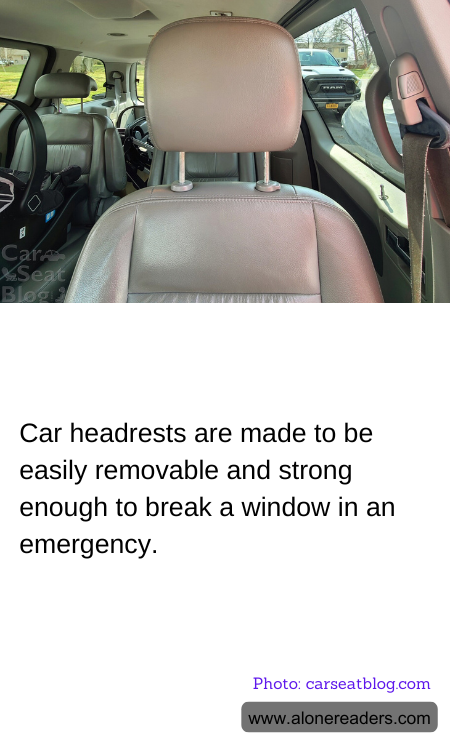
Car headrests, often overlooked as mere comfort features, are actually designed with dual purposes in mind. The primary function, of course, is to provide support for the head and neck during a ride, helping to prevent fatigue and increase comfort. However, a secondary, less-known purpose is tied to passenger safety in emergency situations.
In an emergency where the car doors are inoperable due to an accident, submersion in water, or a fire, the windows might be the only exit route. It is here that the removable headrests come into play. These headrests are engineered to be detachable with considerable ease and are constructed from sturdy materials capable of shattering automotive glass.
The metal prongs that secure the headrest to the top of the seat are intentionally strong and pointed, which makes them effective tools for breaking glass. To use a headrest for this purpose, one would need to pull the headrest completely out of the seat, hold it by the end where the prongs are inserted into the seat, and then use the other end to strike the glass near the edge of the window. It is crucial to aim for the edges because automotive glass is designed to be tougher at the center.
This feature is not commonly advertised by car manufacturers, primarily due to its secondary nature and partly because awareness might encourage misuse or over-reliance on headrests as escape tools. Nevertheless, understanding that your car's headrest can be used in this way could be vital in a life-threatening situation. It is a testament to how vehicle design considers multiple facets of passenger safety, extending beyond simple accident prevention to include proactive escape mechanisms.
