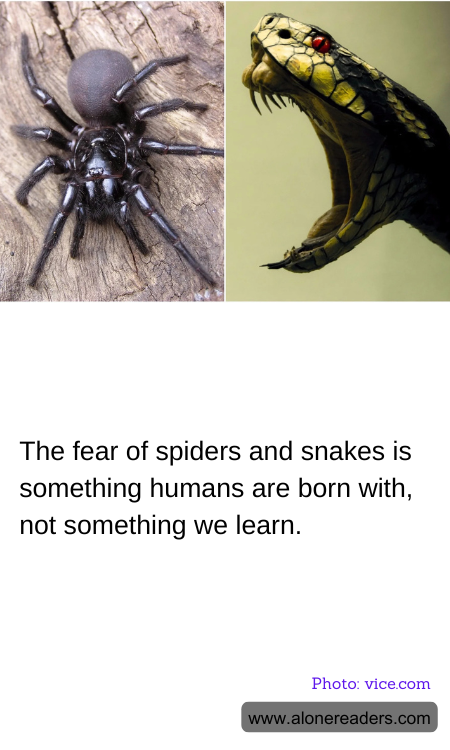
The fear of spiders and snakes, known scientifically as arachnophobia and ophidiophobia respectively, can seem almost primal in its intensity for many people around the world. However, the notion that we are born with these fears is a topic of considerable debate among scientists and psychologists. Evolutionary psychologists argue that this fear is innate, a part of our hardwired survival instinct, because spiders and snakes have been threats to human safety throughout our evolutionary history. The fear would have naturally aided our ancestors in avoiding potentially dangerous encounters.
Research often supports this view by showing that people can identify images of snakes and spiders more quickly than those of non-threatening animals, suggesting a built-in mechanism for spotting potentially dangerous creatures. Such studies imply that fear of these animals is more readily developed than that of less dangerous animals, indicating a predisposition facilitated by evolutionary pressures.
On the other hand, some experts believe that while there may be an evolutionary basis for recognizing these animals as threats, the actual fear itself is largely learned through societal influence and personal experiences. Children who are frequently exposed to spiders and snakes in non-threatening contexts, for instance, tend to develop less fear towards these animals. Cultural attitudes also play a significant role; in some societies, snakes are revered or considered sacred, which can diminish fear among those populations.
Moreover, modern psychological studies also consider the impact of media and parental reactions. How parents respond to spiders and snakes can greatly influence a child's perception of these animals. Exaggerated fearful reactions from parents or media portrayals of spiders and snakes as inherently dangerous or villainous can enhance the development of phobias in children.
Therefore, while there might be a biological readiness to recognize and perhaps react to spiders and snakes due to evolutionary factors, this fear is substantially shaped by individual experiences and cultural contexts. This interplay suggests that fear of these creatures is not simply a matter of innate programming but a combination of biological predispositions and learned behavior. Addressing these fears effectively, therefore, requires an understanding of both evolutionary backgrounds as well as personal and cultural histories.
