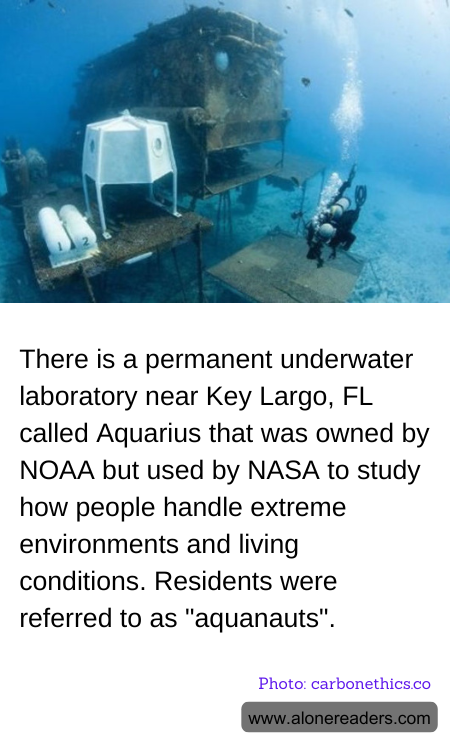
Nestled about 60 feet under the ocean's surface near Key Largo, Florida, lies Aquarius, the world's only undersea research station that provides a unique and critical platform for marine science, technology testing, and human physiology research. Originally owned by the National Oceanic and Atmospheric Administration (NOAA), Aquarius has played a crucial role in how various agencies, including NASA, understand and adapt to extreme environments, reminiscent of space missions.
Aquarius is particularly renowned for its role in simulating the isolated and confined conditions of space travel. NASA utilized the facility extensively through its NEEMO missions (NASA Extreme Environment Mission Operations), where astronauts would live and work underwater for weeks at a time. This underwater setting provides a realistic analog for the microgravity of space, where astronauts can conduct experiments and test equipment that might be used in future space missions. Residents of the laboratory, commonly called aquanauts, experience many of the challenges faced in outer space, such as limited mobility, delayed communication, and the need for meticulous conservation of resources.
The habitat itself is equipped with living quarters, labs, and a docking station for submersibles, making it effectively a submerged space station. Life as an aquanaut involves conducting scientific research which often includes studying coral reefs, fish populations, and the effects of climate change on oceanic environments. The insights gained from these underwater missions contribute significantly to our understanding of both oceanic and space environments, thereby bridging the gap between sea and space exploration.
Beyond NASA’s utilization, Aquarius serves academia, government, and even commercial enterprises interested in the ocean's depths. It has fostered an interdisciplinary approach to research, opening doors to discoveries related not only to environmental and marine sciences but also to biomedical and behavioral sciences. By providing a controlled environment that mimics the stressful conditions of remote environments, Aquarius allows researchers to not only observe marine life up-close but also study human responses to long-term isolation and confinement.
The convergence of these diverse but interrelated research areas encapsulates the critical importance of Aquarius, enhancing our preparedness for future ventures into unknown territories, be it deep oceans or distant planets. Aquarius remains a beacon of interdisciplinary research and a testament to the ingenuity and adaptability of human pursuit.
