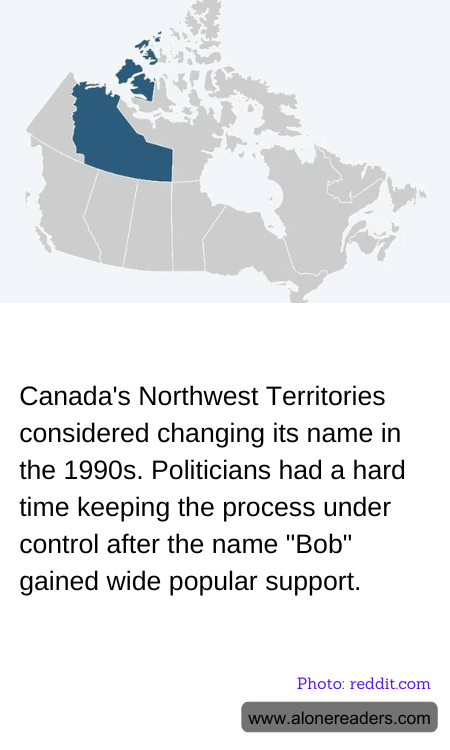
In the 1990s, Canada’s Northwest Territories faced a proposed name change that led to an unusual turn of events, marked by both humor and political challenge. As part of the process of decentralization and division, which eventually led to the creation of Nunavut in 1999, there was significant discussion about rebranding the remaining portion of the Northwest Territories to better reflect its unique cultural and geographical identity.
During this period, a call for public suggestions on a new name was made, setting the stage for an unexpected outcome. Among the myriad of suggestions, which ranged from serious to cultural, was the name "Bob." Surprisingly, what may have started as a joke caught the fancy of the public, gaining a momentum of its own. The name "Bob" quickly became a popular choice, reflecting a unique blend of whimsical humor and an opportunity for the residents to express a more lighthearted view amidst serious political discussions.
This phenomenon threw politicians and officials into a tough spot. They had intended for the process to engage the public but had not anticipated a non-traditional name gaining such traction. The popularity of "Bob" underscored a broader point about public engagement and the unpredictable nature of open calls for participation in governmental processes. It highlighted how public input can veer into unpredicted territories, sometimes bordering on the satirical, which can complicate formal political proceedings.
Ultimately, the suggestion to rename the Northwest Territories to "Bob" was not adopted. The name change debate did, however, boost public interest and engagement in the political process surrounding the reformation of the territories. This incident remains a colorful footnote in the history of the Northwest Territories, illustrating the unpredictable nature of public involvement in governance and the power of a collective, albeit humorous, voice in shaping discussions around identity and representation. This quirky episode continues to serve as a reminder of the surprises that can arise when politics and public whims collide.
