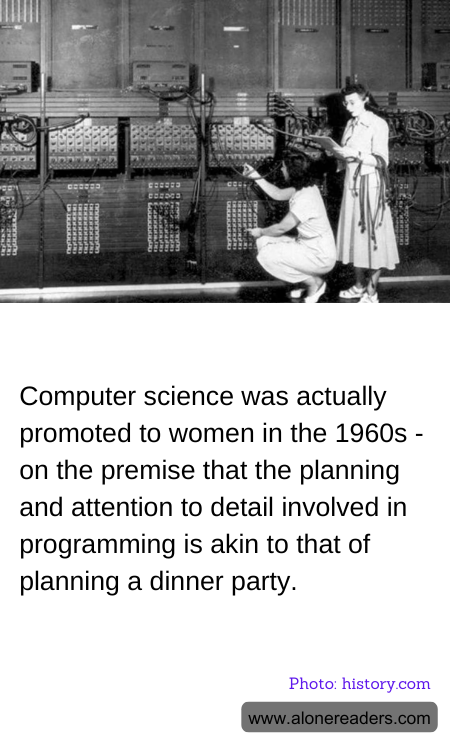
In the 1960s, the burgeoning field of computer science presented unique opportunities for workforce diversification, often promoting itself to women by drawing parallels between programming and planning a dinner party. This comparison was grounded in the idea that both activities required meticulous planning and attention to detail. Such analogies were reflective of the era's gender norms and societal expectations of women's roles primarily being in the domestic sphere. It was thought that women's presumed natural skills in organization and multitasking in managing a household would translate well into the programming and debugging required in computer science.
Moreover, during this period, the tech industry was not yet seen as the male-dominated field it is perceived as today. The work of programming was considered akin to secretarial tasks, often undervalued in its complexity and importance, which also led to it being pushed as suitable for women. Trailblazers like Grace Hopper, an influential computer scientist and U.S. Navy Rear Admiral, exemplified and advocated for the role of women in computing during these early years. Hopper's work included developing the first compiler for a computer programming language, reinforcing that women could contribute significantly to the field's evolution.
However, as technology and its societal implications evolved during the late 20th and early 21st centuries, the demographic dynamics shifted. The perception of computer science transformed into a high-status, lucrative field, attracting more men and leading to a gender imbalance that persists today. Currently, efforts to involve more women in STEM fields, including computer science, confront barriers like gender bias, a lack of role models, and in some cases, unsupportive educational or professional environments. Yet, there is a growing recognition of the need for diverse perspectives in technological development, thus advancing initiatives aimed at increasing the participation and retention of women in computer science.
This historical context not only highlights the changing perceptions and roles within computer science but also underscores the ongoing challenges and importance of diversity within technological and scientific disciplines. Reflecting on such dynamics not only helps understand the shifts in the industry but also propels ongoing efforts to create inclusive, innovative environments that draw on the talents of all individuals, irrespective of gender.
