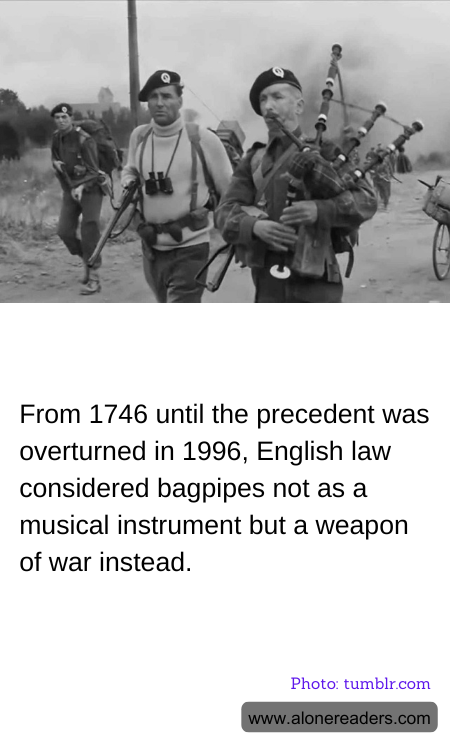
The history of the bagpipes, particularly within the context of English law, unveils an intriguing narrative that traversed centuries before culminating in a significant legal reinterpretation in 1996. Originally, from 1746, following the Battle of Culloden, English authorities, driven by a desire to suppress Scottish culture and quell any potential uprisings, implemented numerous measures. Among these was the classification of the bagpipes as a weapon of war, rather than a musical instrument. This classification was part of the Act of Proscription, which aimed to assimilate the Scottish Highlands into the broader realm of British governance by banning traditional Highland dress and the carrying of arms, under which bagpipes were surprisingly included.
This peculiar categorization primarily stemmed from the bagpipes' historical and cultural significance, rather than from any lethality as a physical weapon. The bagpipes had been commonly used in military contexts to signal troops and boost morale during battles, a testament to their metaphorical power as a symbolic 'weapon' against demoralization and disorder in the ranks. The sounds of bagpipes would often precede Scottish warriors into battle, embodying a form of psychological warfare intended to inspire fear and awe in opponents.
However, this view persisted unchallenged for centuries, ingraining itself in the fabric of legal and cultural perceptions within the United Kingdom. It wasn't until the late 20th century that movements toward cultural recognition and renewal spurred reconsideration of numerous antiquated laws and perceptions surrounding cultural symbols and artifacts. The legal reclassification in 1996, which acknowledged bagpipes purely as musical instruments, marked a significant turning point. This change did not merely reflect a legal amendment but also symbolized a broader recognition and respect for Scottish culture and heritage within the United Kingdom.
Today, the bagpipes are celebrated as an instrument of profound cultural significance and are no longer associated with the connotations of warfare and weaponry that once defined their legal status. This shift underscores a broader cultural integration and acceptance of the diverse traditions and histories that compose the modern United Kingdom, showcasing the dynamic and evolving nature of cultural interpretation and legal recognition.
