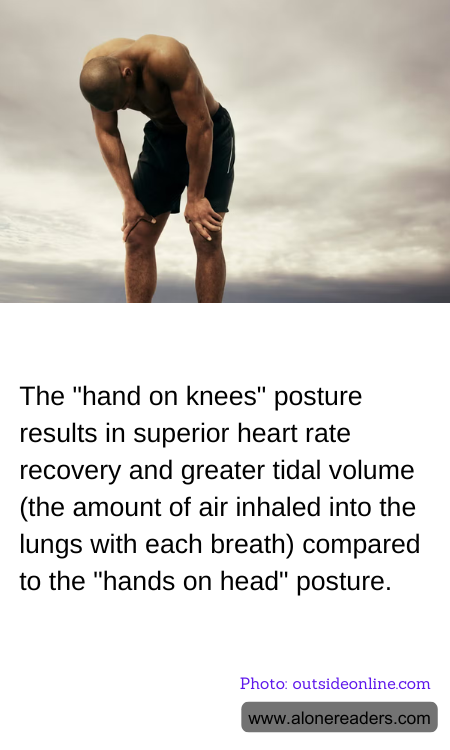
The posture a person adopts after intense physical exertion can significantly impact their recovery process, particularly in terms of heart rate and breathing efficacy. The "hand on knees" posture, often seen as a sign of fatigue or defeat in sports, is actually associated with more effective recovery compared to the "hands on head" posture, which is frequently recommended during rests.
When athletes stop activity and put their hands on their knees, this action supports the body mechanically, reducing the load on the muscles and the effort required to sustain the upper body. This allows the muscles in the abdomen and diaphragm to relax more effectively, enabling deeper and more controlled breathing. Tidal volume, which refers to the amount of air inhaled and exhaled with each breath, increases as a result. More air per breath means that the body can move more carbon dioxide out and obtain oxygen more efficiently, which is crucial during the recovery phase following intense physical activity.
Furthermore, adopting a hands-on-knees posture aids in heart rate recovery. When the breathing is deeper and more effective, the heart does not need to work as hard to pump oxygenated blood to the various body systems. This reduces cardiovascular strain, leading to a faster decrease in heart rate. This rapid recovery in heart rate helps in stabilizing the body quicker and prepares the athlete for subsequent physical exertion.
By contrast, the "hands on head" posture is less optimum despite its popularity. While intuitively it seems to reason that elevating the arms would open up the chest and help in taking in more air, this position can actually generate unnecessary strain on the shoulder muscles, which can indirectly constrict chest movements. Physical effort required to keep the arms overhead additionally diverts blood flow to these muscles, rather than focusing on lowering the heart rate and cooling down, which in turn can result in slightly less effective ventilation compared to the hands-on-knees posture.
Research and assessments by sports science experts confirm that athletes, from amateur to elite, can benefit from understanding and utilizing more efficient recovery postures. By favoring the hand-on-knees position during recovery periods, athletes can improve their overall performance and increase their resilience during workouts or competitions. The emergence of such findings challenges old paradigms and myths in sports, emphasizing the importance of science-based approaches in athlete training and recovery strategies.
