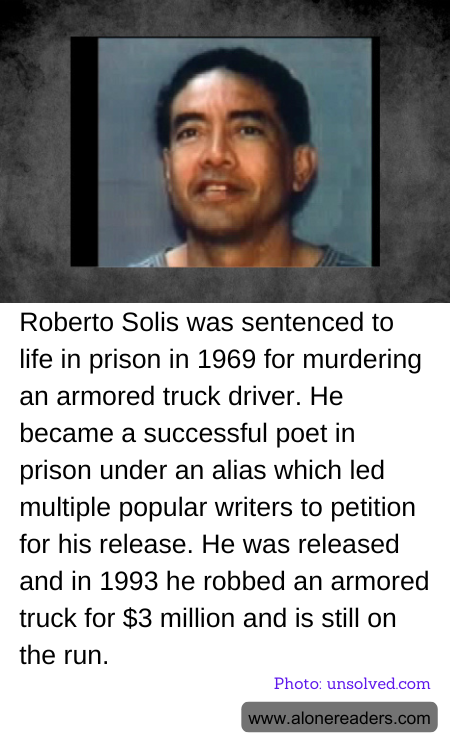
Roberto Solis's life is a stark illustration of how paths can veer into unexpected directions. Initially convicted in 1969 for the murder of an armored truck driver, Solis was sentenced to life in prison. It was behind bars that he began to explore his abilities in writing, adopting the pseudonym "Pancho Aguila." As Aguila, he became a recognized poet, his works reflecting themes of freedom, justice, and transformation, which resonated with many beyond prison walls. His literary talent garnered the attention of prominent writers and intellectuals who eventually advocated for his release. Their efforts bore fruit when Solis was granted parole in 1992, after serving nearly 24 years.
However, the narrative took a dark turn post-release. In 1993, barely a year after his freedom, Solis masterminded another crime involving an armored truck. This time, he and his accomplice, Heather Tallchief, executed a heist in Las Vegas, absconding with over $3 million. The audacity and execution of the robbery stunned both law enforcement and those who had supported his release. After assisting Tallchief in securing a job with the armored car company, the pair vanished, pulling off one of the most infamous heists in Las Vegas history.
The aftermath saw Tallchief resurfacing in 2005, after 12 years on the run, surrendering to U.S. authorities and serving a reduced sentence for her part in the crime. Solis, however, has remained elusive, with his whereabouts still unknown. The robbery not only marked him a fugitive but also cast a long, dark shadow on the debates surrounding rehabilitation, redemption, and the nature of human character. Critics argue that his actions post-release suggest a manipulation of those who had supported him, exploiting his literary talent as a means to an end.
Roberto Solis’s story raises complex questions about the capacity for change, the potential for recidivism, and the mechanisms of support for reintegrating former prisoners. While his poetry earned him a second chance at life outside prison walls, his subsequent choices led to a renewed life of crime, perpetuating his legacy as a figure marked by both literary talent and notorious criminality.
