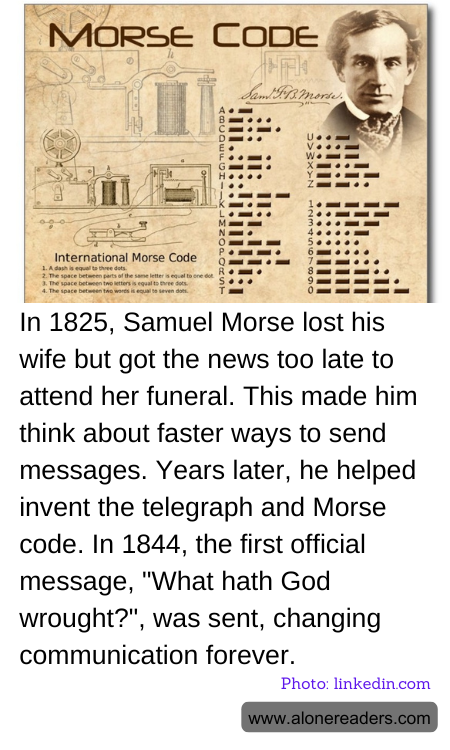
In the early 19th century, communication across distances was a slow and unreliable process. It took days, or even weeks, for messages to travel from one place to another, often resulting in tragic delays. This reality struck painfully for Samuel Morse in 1825, when he received the devastating news of his wife’s sudden illness and subsequent death. By the time Morse received the message and rushed back from his work in Washington, D.C., to his home in New Haven, Connecticut, his wife had already been buried. This heart-wrenching experience profoundly impacted Morse, sparking his determination to develop a faster means of long-distance communication.
This personal tragedy sowed the seeds for the invention that would revolutionize the world: the telegraph. Morse, originally a painter by profession, threw himself into the study of electromagnetism. Collaborating with his partners, including Alfred Vail and scientist Joseph Henry, Morse developed an early model of an electric telegraph in the early 1830s. By 1838, he had devised a system of dots and dashes that would become known as Morse code. This code assigned sets of these signals to represent individual letters and numbers, which could be transmitted over wires using a telegraph key.
The significance of Morse’s invention was dramatically underscored on May 24, 1844, when he sent the first official telegram from the U.S. Capitol in Washington, D.C., to his assistant in Baltimore, Maryland. The message, “What hath God wrought?”—a biblical phrase from the Book of Numbers selected by Morse’s friend Annie Ellsworth—perfectly captured the awe and wonder of the moment.
This milestone event marked the beginning of a new era in communication. With the ability to send messages quickly over long distances, the world suddenly became much smaller. Information could be disseminated with unprecedented speed, reshaping fields from journalism to diplomacy and beyond. The telegraph not only altered everyday communications but also had profound military and strategic implications, as evidenced during conflicts such as the Civil War.
The legacy of Morse’s invention extends far into the modern digital age, influencing the development of various technologies, including the fax, the internet, and mobile telephony. The concept of instant communication, first made possible by Morse’s telegraph, continues to underpin contemporary global communications networks, illustrating the lasting impact of his work initiated by a deeply personal loss.
