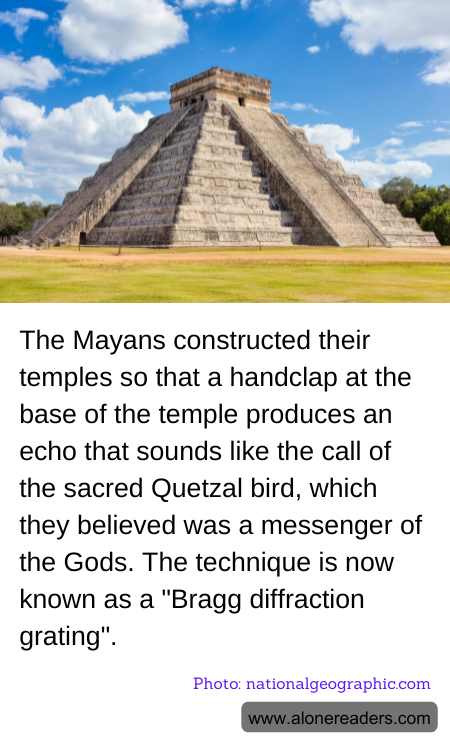
The ancient Mayans, known for their sophisticated culture and advanced knowledge of astronomy and architecture, built temples that were not only majestic but also technologically marvelous in their acoustic effects. One of the most fascinating features of these structures is their ability to produce distinct acoustical effects. For instance, at the base of the pyramid known as El Castillo at Chichen Itza, when a person claps their hands, the echo that ricochets off the step-like terraces of the temple resembles the chirp of the Quetzal bird. This bird, admired for its vibrant plumage and considered divine, was believed to be a messenger between the Mayans and their gods.
This phenomenon is an example of what is sometimes referred to in popular descriptions as a "Bragg diffraction grating" effect, although this term originates from a different, specific scientific context related to the diffraction of waves through crystals. The sound effect at the Mayan temples arises from the architecture functioning akin to an acoustic filter; the structure of the pyramid with its terraced steps creates a series of echoes that transform the original handclap sound into a chirp-like echo. This acoustic property likely was not accidental, as the Mayans are known to have designed their ceremonial centers with astronomical alignments and sound effects that enhanced their religious ceremonies and rituals.
This precise understanding and manipulation of sound, combined with the spiritual significance of the Quetzal bird, suggest a deliberate architectural intent to connect the physical with the divine. Echoes at other Mayan sites have also been studied and show that acoustical engineering was a consistent element of Mayan temple architecture, reflective of their broad and intricate understanding of both science and mythology. The enduring nature of these structures and their acoustical wonders stand as a testament to the Mayan civilization's ingenuity and their deep integration of cultural, spiritual, and scientific knowledge.
