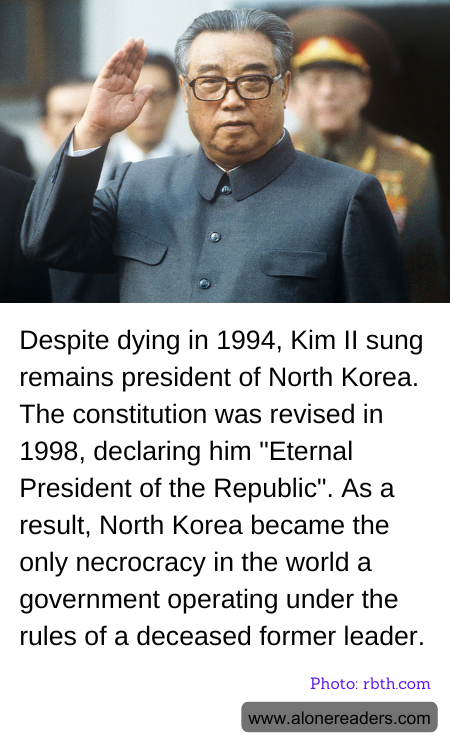
North Korea's political landscape is unique for many reasons, not least of which is its designation of Kim Il Sung as the "Eternal President of the Republic." Despite his death in 1994, Kim Il Sung continues to hold this title due to a constitutional amendment made in 1998. This amendment has effectively made North Korea the world's only necrocracy, a term that means a government that still operates under the guidelines and policies established by a deceased leader.
Kim Il Sung, born in 1912, was the founding father of North Korea, having established the Democratic People's Republic of Korea in 1948 following the end of Japanese occupation. His leadership is marked by the creation of a highly centralized and dictatorial government based around his own personal ideology, known as Juche, or self-reliance. This principle has continued to be the cornerstone of North Korean political and economic life, deeply influencing the country's national identity and international relations.
The decision to continue recognizing Kim Il Sung as president reflects a deep-seated veneration for him, akin to a political deity, which is systematically perpetuated through state propaganda, education, and the extensive cult of personality meticulously crafted around him and his family. His son, Kim Jong Il, and grandson, Kim Jong Un, continued and continue to rule the country, thus keeping the leadership within the family, adding a dynastic element to the necrocratic governance structure.
This unusual political practice has significant implications for how North Korea interacts with the rest of the world. The eternal presidency of Kim Il Sung symbolizes a commitment to continuity in policy and ideology. This continuity, however, also inhibits political and economic reforms, keeping the country isolated and its people in a state of nationalistic fervor and economic hardship. The ideological rigidity serves as a tool for the regime to maintain control, stave off foreign influence, and justify its autocratic practices.
Moreover, this arrangement highlights the challenges of change within such a rigid political system. Any deviation from the path laid out by Kim Il Sung is not only seen as a policy failure but as an almost sacrilegious move against North Korea’s eternal leader. Therefore, the current and future leaders are bound to operate within the parameters set during his regime, ensuring that his legacy indelibly shapes every aspect of North Korean life for the foreseeable future. This necrocratic system underscores the complexities of governance in North Korea, where political symbolism and the preservation of legacy play critical roles in the country's administration and its dealings with the international community.
