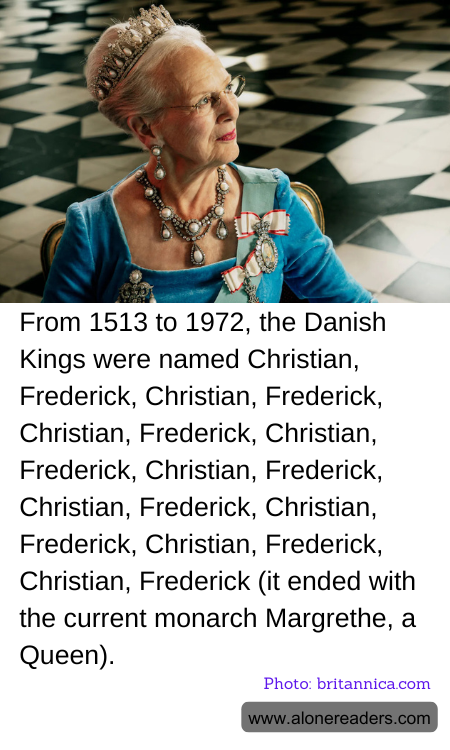
For centuries, the Danish monarchy exhibited a remarkably strict pattern in the naming of its kings, alternating almost exclusively between the names Christian and Frederick from the early 16th century until the late 20th century. This tradition began with King Christian I, who reigned from 1448 to 1481, and was followed by Frederick I. This set the precedent for the royal naming sequence.
The pattern highlights a time when the choice of names for royalty was not merely a personal or familial preference but often carried political, religious, and symbolic significances. Christians and Fredericks alternately ruled, reflecting each monarch’s attempt to ornament their reign with the legacy and reputed virtues of their namesakes. Each "Christian" or "Frederick" was not just a continuation of a familial line but a reinstantiation of values and policies associated with those names within the Danish context.
This naming practice facilitated a sense of continuity and stability within the Danish monarchy. Such consistency in naming simplified the royal lineage for the subjects and reinforced a connection across generations of kings. The names Christian and Frederick came to signify more than personal identity; they represented the enduring presence of the monarchy itself in the daily lives and the national imagination of the Danish people.
However, this centuries-old tradition came to an end when Margrethe II ascended the throne in 1972 after the death of her father, King Frederick IX, as she had no brothers to continue the male line. This marked not only a significant change in the gender of the reigning monarch but also broke the longstanding alternation between the two names. Queen Margrethe II’s reign introduced a new era in the Danish monarchy, one that reflected modern perspectives on leadership and the role of women in governance.
This break from tradition was both a symbol and a catalyst for broader social changes and the modernization of the monarchy, aligning with the evolving norms and values of Danish society. It showed a move away from strictly adhered-to traditions towards a more flexible understanding of the monarchy’s role in contemporary Denmark. As of the last update in 2023, Queen Margrethe II continues to reign, thus fostering her own legacy that complements the historic string of Christians and Fredericks but is distinctively her own.
