More About This Card
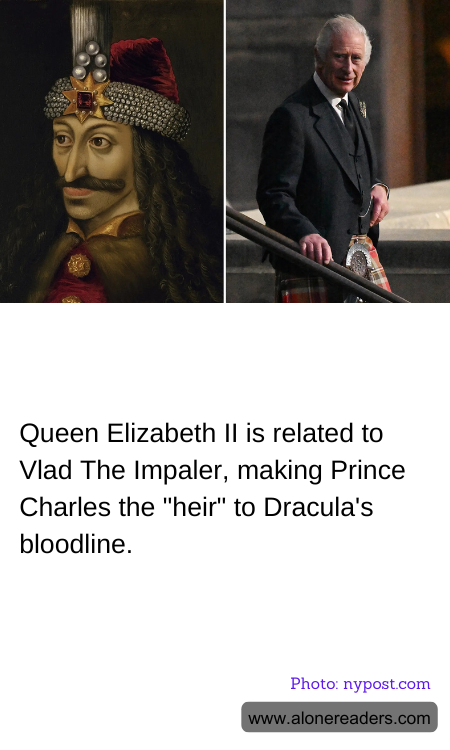
The often surprising pathways of royal lineage and genealogy bring to light connections between many of Europe’s royal families, some of which are quite unexpected. One intriguing link is between Queen Elizabeth II and Vlad III, Prince of Wallachia, more notoriously known as Vlad the Impaler. This connection indeed suggests that members of the British royal family, including Prince Charles, are distant relatives of the medieval ruler who was a partial inspiration for Bram Stoker's iconic vampire, Dracula.
Vlad the Impaler ruled Wallachia in the 15th century and was known for his exceptionally cruel punishments imposed on his enemies, which is where his nickname originates. His reputation for impalement and his patronymic, Dracula (meaning “son of the dragon” or “son of the devil” in medieval Romanian due to his father’s induction into the Order of the Dragon), helped inspire Stoker’s novel.
The link to the British royal family comes through the lineage of Queen Mary, consort of King George V, and a great-grandmother of Queen Elizabeth II. Queen Mary was herself a member of the House of Hohenzollern, a dynasty that intermarried among various European royal houses, including the House of Basarab, to which Vlad III himself belonged. Genealogical traces through these intermarriages reveal that Queen Elizabeth II and her descendants share blood ties with Vlad the Impaler.
Prince Charles has not only acknowledged but also seems to embrace this unusual ancestral connection. In various instances, he has expressed interest in Romania, the homeland of Vlad the Impaler, and has involved himself in preservation efforts in the region, specifically in Transylvania, which is both a region steeped in environmental beauty and rich history. Additionally, he has joked in interviews about his lineage claiming him as the 'heir' to Dracula's bloodline.
Not only does this ancestral connection spotlight the tangled and interesting web of European royalty, but it also underscores the broader narrative of how history can often seem stranger than fiction, intertwining tales of iconic literary figures with the lives of modern-day monarchs. While the connection might hold more novelty and entertainment value than practical significance, it adds yet another layer to the rich histories of Europe’s royal families and continues to spark both amusement and curiosity across the globe.