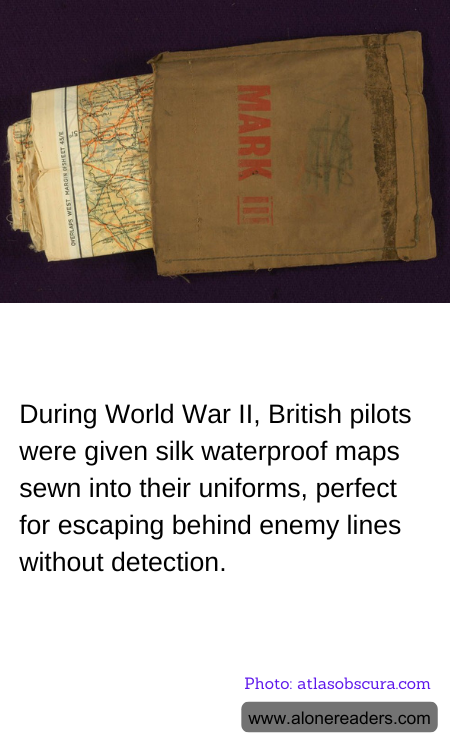
During World War II, innovative strategies and tools were crucial for survival, particularly for pilots who might find themselves stranded in hostile territory. One such ingenious tool was the use of silk maps, which British and Allied pilots were given to aid their escape and evasion efforts should they be shot down or captured behind enemy lines. These maps were made from silk because silk was durable, lightweight, and impervious to water, unlike paper which could easily disintegrate or become illegible when wet.
The practice of equipping pilots with these maps began after the establishment of MI9, a British military intelligence division, in December 1939. This division was responsible for aiding resistance fighters and helping Allied forces escape from enemy areas. Silk was the preferred material as it did not rustle, and thus could be handled silently, an advantage when stealth was vital. Its smooth texture also allowed pilots to conceal the maps easily, often sewn into the lining of their uniforms or hidden in other parts of their clothing.
These maps typically featured detailed topographical data, showing safe houses, escape routes, and key geographic landmarks. They were also color-coded to denote different types of terrain and boundaries. Moreover, the ink used in printing the maps was also specially formulated to remain legible and unfading regardless of the environmental conditions.
Apart from maps, other essential items sewn into a pilot’s uniform or hidden in covert compartments included miniature compasses and tools useful for survival and escape. The usage of silk maps extended to other branches of the military over time and proved invaluable not only in Europe but in various theaters of war around the globe.
The legacy of these silk maps is a testament to the creativity and ingenuity of wartime intelligence efforts. Today, they are considered valuable collectibles and respected as significant artifacts from an era where such clever innovations could mean the difference between captivity and freedom. Their existence highlights the extent of planning and preparation undertaken by military intelligence to equip their personnel with the means not just to fight, but also to survive and escape as necessary.
