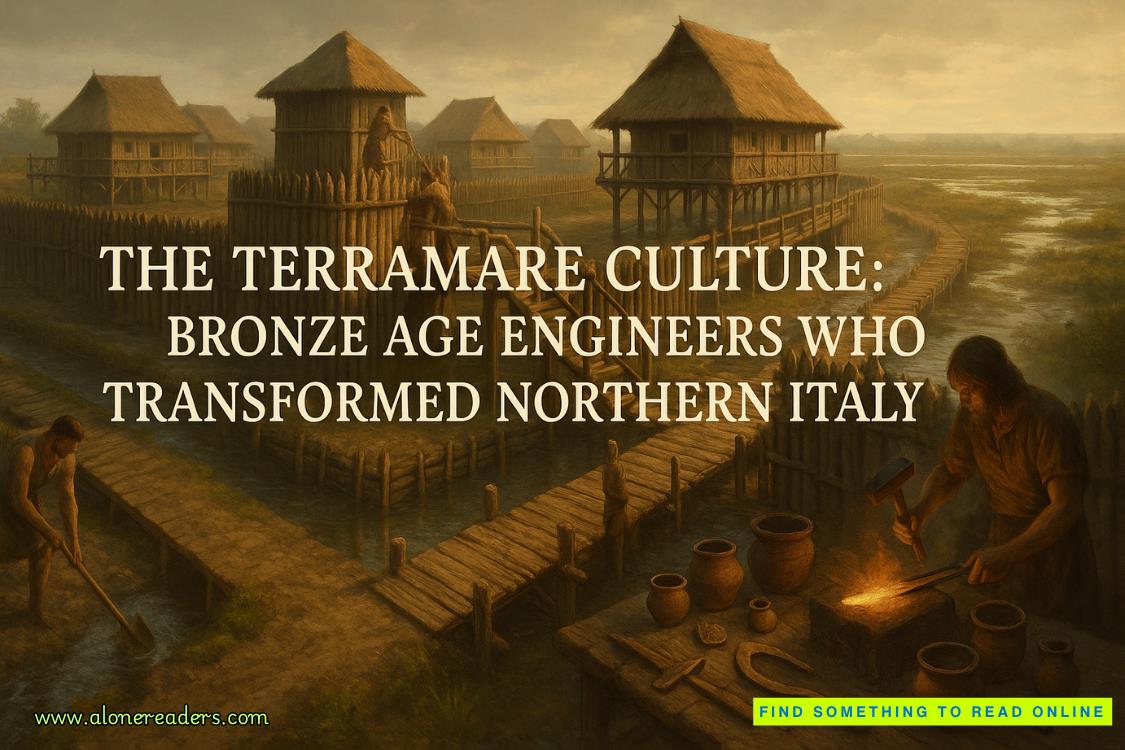
The Terramare culture stands today as one of the most remarkable yet often overlooked Bronze Age civilizations, flourishing in the Po Valley of northern Italy between approximately 1700 and 1150 BCE. Although overshadowed by more widely celebrated ancient societies, the Terramaricoli developed an intricate technological and social system that rivaled their contemporaries across Europe. Their mastery of hydrological engineering, planned urban layouts, metallurgical expertise, and sophisticated adaptation to wetlands reveal a civilization that was far ahead of its time. Yet despite their innovations, they vanished mysteriously, leaving behind engineered landscapes and mounds of black earth that puzzled archaeologists for centuries.
At the heart of the Terramare world stood their unique settlements, built on wooden platforms and arranged with geometric precision. These were not haphazard villages but carefully designed communities with rectangular street grids, defensive ramparts, and extensive water-management systems. The very name Terramare refers to the dark, fertile earth found in the remnants of their settlements, often enriched with organic matter from centuries of occupation and deliberate landfill building. For generations, farmers in the region used this black soil as fertilizer, unknowingly dispersing traces of an advanced Bronze Age culture across their fields.
What makes the Terramare culture extraordinary is how they transformed an environment that was inherently unstable. The Po Valley’s swampy regions required a nuanced understanding of flooding, groundwater levels, and soil dynamics. The Terramare people responded with innovations that demonstrate a high degree of environmental engineering. Their settlements were typically surrounded by moats, not merely as defensive barriers but as part of an integrated hydraulic system. Water channels were constructed to regulate the flow around and within the settlement, ensuring stability, sanitation, and agricultural support. These engineered systems show an intentionality that feels almost modern: the ability to reshape landscapes to suit human habitation.
Their houses, built on timber stilts, reflected a deep awareness of the challenges posed by moisture and flooding. Elevated floors prevented water infiltration and improved airflow beneath structures, reducing decay and enhancing durability. Villages were enclosed by impressive fortifications of wood, earth, and ditches, revealing a culture that invested heavily in community protection and architectural resilience. These structural feats required coordinated labor and advanced carpentry skills, suggesting that Terramare society had organized leadership, social hierarchy, and possibly specialist engineers or architects.
Beyond their engineering accomplishments, the Terramare people were skilled metalworkers. Evidence from excavated sites indicates production of bronze weapons, tools, ornaments, and ceremonial items. Their bronzes exhibit standardized forms, implying controlled manufacturing processes and possibly trade networks extending far beyond the Po Valley. The Terramare culture occupied a strategic crossroads between Central Europe and the Mediterranean world, enabling them to act as intermediaries in the movement of metals, amber, salt, and crafted goods. This commerce, combined with agricultural surpluses enabled by their irrigation techniques, likely contributed to the prosperity and stability of their communities.
Daily life in Terramare settlements reveals an economy characterized by mixed agriculture, animal husbandry, and specialized crafts. They cultivated cereals, legumes, and vines, while raising cattle, pigs, and sheep. The presence of wells, granaries, and storage pits highlights their understanding of food preservation and resource planning. Bone tools, finely decorated pottery, loom weights, and spindle whorls point to thriving textile production. The layout of homes—often aligned in rows along streets—suggests a structured domestic environment where craft, trade, and household activities intertwined seamlessly.
One of the most fascinating aspects of Terramare society is their relationship with death. Burial sites often contain cremated remains placed in urns, accompanied by grave goods that hint at beliefs in an afterlife or social distinctions among individuals. The uniformity of some burial assemblages, contrasted with richer offerings in others, implies a complex social fabric where status was expressed through material culture. Their mortuary practices connect them with broader European Bronze Age traditions yet display distinct regional characteristics that reflect their unique identity.
Despite their achievements, the Terramare culture faced an abrupt decline around the 12th century BCE. Archaeologists and historians have debated the causes for decades, proposing various scenarios grounded in environmental instability, demographic pressure, economic collapse, or social upheaval. One dominant theory suggests that climate change played a critical role. The later Bronze Age experienced significant shifts in rainfall patterns, leading to severe droughts and fluctuations in water availability. A society so dependent on precise water management would have been extremely vulnerable to ecological disruption. As their engineered systems failed to adapt to the changing environment, crops may have failed, resources dwindled, and settlements became unsustainable.
Another hypothesis points toward overexploitation of natural resources. Terramare communities required enormous quantities of timber for housing, fortifications, and fuel. Centuries of deforestation could have destabilized soil, worsened flooding, and reduced the availability of essential building materials. Combined with expanding populations, the balance between people and environment may have tipped beyond recovery. Some researchers also argue that external pressures—such as incursions by migrating groups—may have contributed to societal breakdown, although evidence remains inconclusive.
What is clear is that many Terramare sites were intentionally burned or abandoned, their populations dispersing into surrounding regions. Some may have joined other Italic groups, influencing later cultures of the peninsula. Their disappearance parallels the wider Bronze Age collapse seen across Europe and the Mediterranean, a period marked by dramatic cultural transformations, disruptions in trade, and widespread population movements.
Yet even in decline, the Terramare left behind a legacy of engineering brilliance and cultural resilience. Their settlement designs influenced later Italic urban planning, particularly in how communities were structured around defensive and hydrological systems. Their techniques for land reclamation and water control foreshadowed practices later adopted in the Po Valley during the Roman era. The dark earth mounds they created became historical puzzles that eventually illuminated a sophisticated and innovative society.
Modern archaeological research continues to uncover details about Terramare life, revealing a civilization that balanced environmental challenges with innovation and determination. Their cities demonstrate controlled urban expansion, proportional design, and efficient use of space. Their metallurgical advancements reflect deep expertise in alloy production and toolmaking. Their ability to thrive in wetlands speaks to a knowledge system built on observation, adaptation, and continuous engineering problem-solving.
Today, the Terramare culture stands as a powerful reminder that some of the most transformative ancient civilizations are not always the most famous. Their story is a testament to the creativity and ingenuity of societies that faced environmental adversity with bold architectural solutions. They were, in every sense, Bronze Age engineers, crafting a world that mirrored their understanding of water, wood, earth, and metal.
In remembering the Terramare people, we acknowledge a chapter of human history where innovation shaped survival. Their settlements—gridded, fortified, elevated, and irrigated—represent the culmination of centuries of experimentation and communal effort. Their legacy may not include monumental stone temples or sprawling empires, but it lives on in the very landscape they reshaped, in the knowledge systems they refined, and in the echoes of an ancient culture that mastered the art of living in harmony with a challenging environment. Through their black earth mounds and abandoned moats, the Terramaricoli whisper a story of engineering genius, cultural identity, and mysterious disappearance—a story that deserves a prominent place among the forgotten ancient civilizations of the world.



 The Hundred Days Offensive: How the Allies Defeated Germany in World War I
 The Second Battle of the Marne: The Turning Point of World War I in 1918
 The Spring Offensive of 1918: Germany's Final Gamble to Win World War I
 The Treaty of Brest-Litovsk: How Russia Left World War I
 The Russian Revolution and World War I: How War Brought Down the Tsar
 The Zimmermann Telegram Explained: Germany's Secret Offer to Mexico in World War I