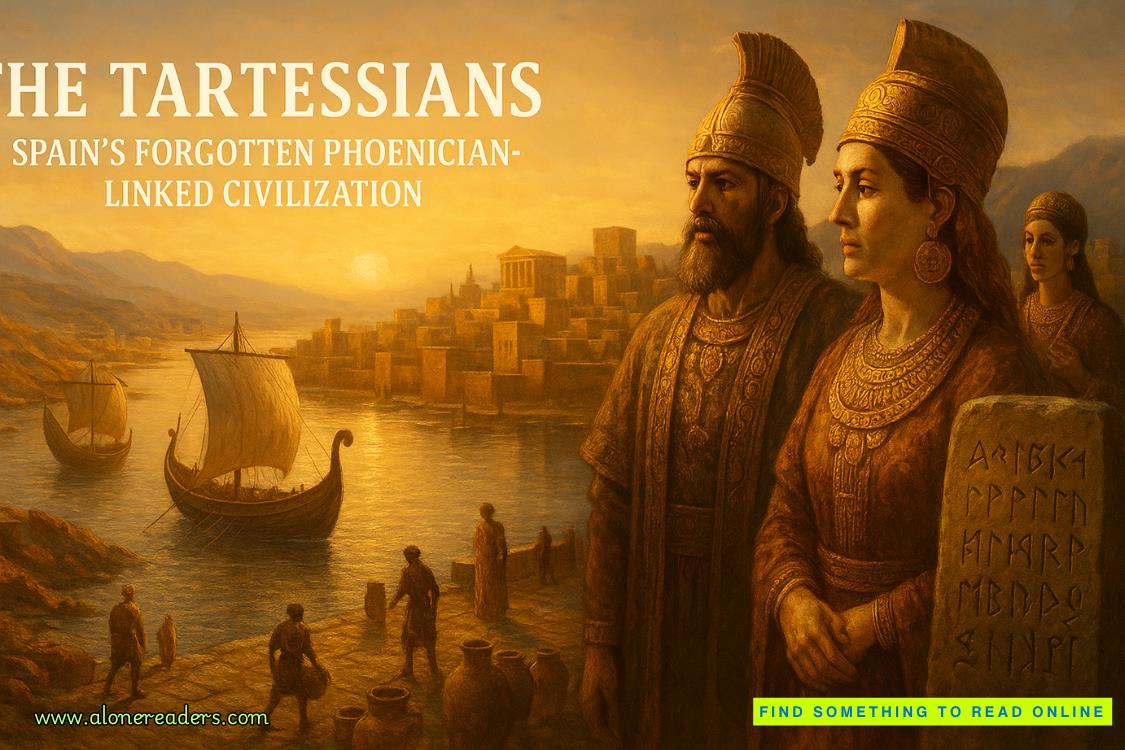
The story of the Tartessians occupies a rare space between archaeology, legend, and lost cultural memory. Emerging in southwestern Iberia during the early first millennium BCE, they represent what many historians consider Spain’s earliest proto-urban civilization, flourishing long before Roman, Carthaginian, or even Iberian tribal dominance reshaped the peninsula. The Tartessians were intimately connected to the Phoenicians, the great maritime traders of the Mediterranean, yet at the same time they cultivated a distinctly local identity—an identity built on mineral wealth, metallurgical innovation, and a cultural sophistication that still defies full explanation. Over the centuries, the memory of Tartessos faded until it became a shadowy, semi-mythical reference in Greek texts. Today, new discoveries are forcing historians to reconsider how advanced this forgotten culture truly was and why its sudden disappearance remains one of the most perplexing enigmas of ancient Europe.
What makes the Tartessians particularly fascinating is that they appear both familiar and utterly unique. Greek historians described Tartessos as a kingdom rich in gold, silver, and tin, ruled by wise monarchs and protected by river-fed harbors that connected Iberia to the larger Mediterranean world. At the same time, archaeological evidence reveals cultural traits that cannot be traced directly to any single influence. Their language remains undeciphered, their religious practices are only partially understood, and their political structure—though referenced by Greek sources as a monarchy—features little direct material evidence confirming how authority was organized. This blend of documented wealth and elusive detail transforms the Tartessians into a civilization that feels close enough to grasp yet always just beyond definitive understanding.
One of the keys to unlocking Tartessian society lies in their relationship with the Phoenicians. When these Levantine mariners began establishing trading outposts along the Iberian coast around the 9th–8th centuries BCE, they encountered a region abundant in precious metals. Southeastern Spain’s mineral belts, particularly in the Sierra Morena and the Guadalquivir basin, were among the richest in the ancient world. The Phoenicians, masters of metallurgy and trade, recognized the potential immediately and forged strong commercial ties with local elites. Through these relationships, the Tartessians gained access not only to external markets but also to advanced technologies and cultural influences. Phoenician artisanship, alphabetic writing, religious symbolism, and luxury goods began appearing in Tartessian contexts, illustrating how deeply connected the two cultures became.
Yet it would be a mistake to see Tartessos merely as a Phoenician satellite. Local craftsmanship, especially in the field of metalworking, displays a distinctive character that scholars now refer to as Tartessian style. Their workshops produced elaborate jewelry, ceremonial weapons, and finely worked bronze and gold objects that combined eastern Mediterranean motifs with uniquely Iberian aesthetics. The famed Tartessian hoards—carefully buried deposits of treasures found in places like El Carambolo—demonstrate not only wealth but a sophisticated sense of artistry and ritual intention. These artifacts suggest an elite class that valued display, ceremony, and symbolic authority. The Tartessians were not passive recipients of foreign influence; they were cultural innovators who blended imported ideas with local traditions to create something entirely original.
Perhaps even more intriguing is the question of the Tartessian language. While inscriptions have survived, they remain only partially deciphered. Linguists debate whether the language is Indo-European, pre-Indo-European, or something altogether distinct. The alphabet used for these inscriptions seems to derive from the Phoenician script but with local adaptations that complicate direct translation. The result is a corpus of textual material tantalizingly close to comprehension yet resistant to full interpretation. If the Tartessian language were ever deciphered, it would likely transform our understanding of the civilization, shedding light on their religious beliefs, myths, administrative systems, and perhaps even the causes of their decline.
Religious life in Tartessos appears to have blended native Iberian spiritual concepts with Phoenician deities and eastern ritual practices. Archaeological finds indicate the presence of shrines and ceremonial spaces dedicated to gods associated with fertility, metallurgy, and maritime travel. Many scholars believe the Tartessians may have worshipped a local earth goddess, whose attributes later merged with Phoenician figures such as Astarte. The discovery of zoomorphic and anthropomorphic figurines suggests a pantheon that was both diverse and deeply symbolic. Evidence of ritually buried artifacts and burned offerings indicates complex ceremonial traditions that paralleled those of other Mediterranean cultures while maintaining a distinctly Iberian character. The fusion of native and foreign religious elements is one of the defining features of Tartessian cultural identity.
Economically, Tartessos thrived on resource extraction and trade. Their control of mineral-rich areas made them indispensable partners for Phoenician merchants, who in turn supplied them with luxury goods, exotic materials, and connections to faraway markets. The Tartessians also engaged in agriculture, animal husbandry, and inland trade networks that extended deep into the Iberian interior. Their settlements, centered around the lower Guadalquivir River, appear to have been strategically located to exploit both river and maritime routes. This ability to bridge inland and coastal economies placed Tartessos at the crossroads of cultural and commercial exchange, making it one of the most prosperous societies in early Iberian history.
The Greek explorer and geographer Herodotus famously described the Tartessians as a powerful and wealthy kingdom ruled by a monarch named Arganthonios, whose reign allegedly lasted for decades, if not a century. While such longevity is likely exaggerated, the account reflects how Greek observers viewed Tartessos: as a stable, prosperous, and diplomatically open society. Arganthonios was said to have provided financial assistance to Greek settlers seeking to escape eastern conflicts, indicating a kingdom both wealthy and politically active. Whether these stories are literal or symbolic, they contribute to an image of a civilization that had achieved notable prominence in the western Mediterranean. Tartessos, in Greek imagination, was a place of abundance and benevolent rule, a characterization that separates it from many other peripheral cultures of the ancient world.
Yet despite its prosperity and fame, Tartessos vanished with startling abruptness around the 5th century BCE. Archaeologists note a near-sudden cessation of elite burials, luxury workshops, and monumental architecture. Trade networks with the Phoenicians waned sharply as Carthage—rising from Phoenician colonies in North Africa—tightened its control over western Mediterranean commerce. As Carthage expanded its influence, Tartessian elites may have lost access to the foreign markets and materials that sustained their prosperity. Some scholars propose that internal political fragmentation or conflict contributed to the collapse. Others suggest that environmental change, such as river silting or climatic shifts, may have disrupted economic lifelines. The exact cause remains uncertain, making the fall of Tartessos one of the greatest archaeological mysteries of ancient Europe.
There is also the intriguing possibility that Tartessos did not disappear at all, but rather transformed into what archaeologists call the Turdetani, an Iberian-speaking group recorded by later Greek and Roman writers. The Turdetani inhabited the same region where Tartessos once flourished and displayed cultural traits suggesting continuity rather than replacement. Their legal codes, agricultural systems, and social organization were described as unusually sophisticated, leading some historians to argue that they were simply the descendants of the Tartessian elite operating within a new geopolitical context shaped by Carthaginian and later Roman pressures. If true, Tartessos may not have vanished but instead survived in a subdued, redefined form, its earlier brilliance dimmed by shifting power dynamics in the Mediterranean.
Modern archaeological discoveries continue to reshape the narrative. Large-scale excavations in the Guadalquivir basin and discoveries such as monumental Tartessian structures near Badajoz suggest a level of urbanization previously underestimated. These findings challenge older assumptions that Tartessos was merely a loose confederation of tribal elites. Instead, emerging evidence points toward a complex society with planned settlements, administrative coordination, and durable architecture. In some sites, archaeologists have uncovered monumental buildings with rich decorative elements, indicating both wealth and political organization.
Even more remarkable are the multi-layered hoards of precious metals, ceramics, carved ivories, and weapons that reflect a society where ritual deposition played a significant role. Whether these hoards were offerings to deities, symbols of elite authority, or protective caches during times of crisis remains a subject of debate. What is clear is that the Tartessians placed immense symbolic value on metal objects, especially gold and silver. Their mastery of metallurgy is one of the most striking aspects of their cultural legacy, influencing Iberian craftsmanship for centuries after their decline.
The Tartessians also played a key role in the emergence of early Iberian writing systems. Their adaptation of the Phoenician alphabet into a local variant marked one of the earliest known writing traditions in Western Europe. Although still undeciphered, these inscriptions demonstrate a level of linguistic and administrative complexity that underscores the civilization’s sophistication. The fact that their script remains only partially understood adds an aura of mystery, making Tartessos not just a forgotten civilization but also a linguistic puzzle waiting to be solved. Unlocking the Tartessian script would be equivalent to discovering a lost chapter of Iberian history, revealing details of governance, religion, trade, and daily life that currently remain shrouded.
Today, interest in Tartessos is booming. Spanish archaeologists, linguists, and historians are reevaluating its place in Mediterranean prehistory, and new technologies—such as remote sensing, geochemical analysis, and paleoenvironmental reconstruction—are providing insights unimaginable a century ago. As each decade passes, the picture grows more complex and compelling. Tartessos emerges not as a minor local culture overshadowed by Phoenician colonization but rather as a civilization that actively participated in shaping the western Mediterranean world. Far from being an obscure footnote, the Tartessians represent one of Europe’s earliest experiments in cross-cultural synthesis, technological innovation, and regional political organization.
The legacy of Tartessos lies not only in its material remains but also in its narrative as a civilization that thrived where continents, cultures, and trade routes converged. It stood at the meeting point of Atlantic and Mediterranean worlds, absorbing influences from both while developing a worldview entirely its own. Its prosperity was built on natural resources, strategic geography, and the ability to negotiate partnerships with powerful trading cultures like the Phoenicians. Yet its disappearance serves as a reminder of how delicate the balance of ancient prosperity could be. Civilizations rise on networks, alliances, and environments that can shift rapidly, and Tartessos is a profound example of how quickly a brilliant society can fade into obscurity.
But perhaps the most enduring aspect of Tartessos is the sense of mystery it continues to evoke. Inscriptions that cannot be read, kings whose stories straddle myth and history, treasures buried with unknown intention, and cities lost beneath river sediments or farmland—these fragments create a civilization defined as much by absence as by presence. Tartessos captivates because it invites questions that remain unanswered, and in doing so, it holds open the possibility that major discoveries still await.
As research advances, the Tartessians are slowly recovering their place as a foundational culture in Iberian antiquity. They were innovators, traders, metallurgists, and cultural mediators who shaped their world and influenced those that came after. Their story enriches the broader narrative of ancient Europe and highlights the profound interconnectedness of early Mediterranean civilizations. To understand Tartessos is to appreciate how cultural exchange, resource wealth, and geopolitical strategy combined to create one of the most intriguing lost civilizations of antiquity, a society whose brilliance once illuminated the Atlantic edge of the known world.
In this rediscovery, the Tartessians are no longer a forgotten people but a revived chapter of human history—one that continues to expand as new evidence emerges. Their civilization stands as a testament to resilience, innovation, and the enduring allure of the ancient world’s unsolved mysteries.



 The Hundred Days Offensive: How the Allies Defeated Germany in World War I
 The Second Battle of the Marne: The Turning Point of World War I in 1918
 The Spring Offensive of 1918: Germany's Final Gamble to Win World War I
 The Treaty of Brest-Litovsk: How Russia Left World War I
 The Russian Revolution and World War I: How War Brought Down the Tsar
 The Zimmermann Telegram Explained: Germany's Secret Offer to Mexico in World War I










