Among the vast timeline of human history, certain civilizations vanish so completely that their memory survives only through shards of pottery, buried dwellings, and enigmatic patterns carved into clay. The Cucuteni-Trypillia civilization is one such astonishing chapter—one that reveals a prehistoric Europe far more advanced, interconnected, and symbolically rich than many imagined. Flourishing between 5500 and 2750 BCE across what is now Romania, Moldova, and Ukraine, this culture built some of the world’s earliest and largest proto-urban settlements, produced pottery of unparalleled beauty, and maintained social systems whose sophistication continues to challenge modern assumptions about Stone Age Europe.
Although largely absent from popular historical narratives, this civilization left behind a legacy so monumental that archaeologists often refer to their settlements as Europe’s first “mega-cities.” Their vast settlements, intricate artistry, ritual practices, and enigmatic collapse paint a picture of a people both deeply connected to their land and extraordinarily innovative. Yet their disappearance remains one of prehistory’s most alluring mysteries, inspiring debates about environmental pressures, social transitions, and even the earliest seeds of organized warfare.
The story of the Cucuteni-Trypillia civilization is, in essence, the story of a society that achieved remarkable complexity long before the famous urban centers of Mesopotamia, Egypt, or the Indus Valley. Its forgotten achievements continue to reshape our understanding of what early European societies were capable of.
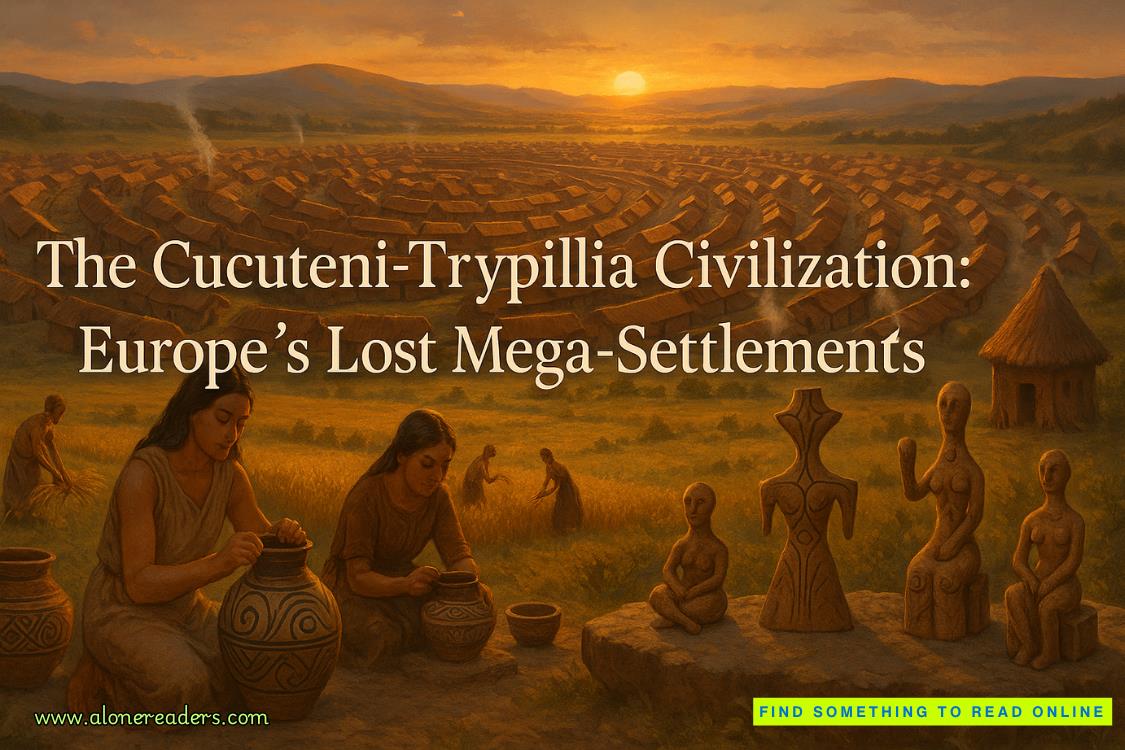
At the heart of this civilization’s uniqueness were its enormous settlements, often designed in concentric rings and containing thousands of structures. Some sites covered up to 300 hectares, making them comparable in scale to early Mesopotamian cities—yet they were constructed more than a millennium earlier. The very scale and planning of these settlements demonstrate a level of social coordination, resource distribution, and community identity that was once thought impossible for Neolithic European societies.
These mega-settlements challenge the notion that prehistoric Europe was dominated solely by scattered tribes or small agricultural villages. Instead, they reveal a region capable of sustaining complex social networks, large-scale food production, and shared cultural practices over vast territories. This complexity is echoed through their meticulously decorated ceramics, symbolic figurines, and a long tradition of ritual burnings that still puzzles researchers today.
One of the most striking aspects of the Cucuteni-Trypillia culture is its unique architectural tradition. Homes were typically built from wood, clay, and straw using wattle-and-daub techniques. But what makes them so remarkable is their layout: dwellings were often arranged in orderly circular formations, with wide streets and designated communal spaces. In the largest settlements, archaeologists have uncovered up to 3,000 houses, suggesting populations that may have reached 15,000 or more. For a society lacking metal tools, animal-powered transport on a large scale, or written language, this achievement is nothing short of extraordinary.
The structure of these settlements hints at an early form of social organization that valued cooperation over hierarchy. There is little evidence of palaces, designated rulers, or authoritative elites—suggesting a culture where collective decision-making may have played a significant role. Many scholars propose that this was a society guided by shared rituals, communal identity, and symbolic traditions rather than rigid political systems.
The symbolism embedded in their material culture further supports this hypothesis. The Cucuteni-Trypillia people produced some of the most intricate pottery in prehistoric Europe, decorated with spirals, complex geometric patterns, and vivid red-black-white color schemes. These patterns were not merely decorative; they likely held deep cosmological or spiritual significance. The spiral motif, for example, is often interpreted as a representation of life cycles, cosmic forces, or the rhythm of nature—recurring themes in early agrarian societies.
Perhaps even more intriguing are their clay figurines, which include stylized female forms, abstract anthropomorphic shapes, and enigmatic “seated goddess” statues that appear repeatedly across their territory. Many scholars believe these figurines played a role in fertility rituals, ancestor worship, or community identity, though their exact meaning remains uncertain. What is clear is that these objects reflect a society deeply connected to symbolic and ritualistic traditions.
Among the most debated practices of this civilization is their custom of purposefully burning their own settlements. Archaeologists have uncovered thick layers of ash and clay fragments at nearly every major site, indicating that houses were intentionally set ablaze after periods of use. Some structures appear to have been burned at temperatures exceeding 1000°C, far higher than accidental fires would produce.
Theories about this practice include:
Regardless of the reason, the act of burning entire settlements speaks to a worldview where destruction and rebirth were tightly interwoven, reflecting a unique cosmology with fire at its center.
The economy of the Cucuteni-Trypillia people was built on agriculture, supplemented by hunting, fishing, and long-distance trade. They cultivated crops such as wheat, barley, and legumes, while also raising cattle, sheep, and goats. But what distinguishes them is the scale of their agricultural output, necessary to support such large populations.
These mega-settlements required significant food storage, distribution, and planning, suggesting that the community maintained sophisticated strategies for managing surplus. Evidence of loom weights and spindle whorls indicates a thriving textile production sector, while mining and obsidian trade suggest networks that connected them with distant regions.
Despite these impressive accomplishments, the Cucuteni-Trypillia culture underwent a mysterious collapse around 2750 BCE. The reasons remain uncertain, but several theories have gained traction:
What is particularly notable is the absence of clear evidence of warfare or violent destruction. Unlike many ancient collapse narratives involving conquest, the Cucuteni-Trypillia decline appears to have been gradual and multifaceted—more a transformation than an annihilation.
Although their civilization disappeared, the influence of the Cucuteni-Trypillia culture did not vanish entirely. Archaeological evidence suggests that their traditions—especially pottery motifs, settlement planning, and symbolic figurines—continued to appear in later European cultures. Their legacy is echoed in the development of Eastern European agrarian societies and possibly in early Indo-European cultural exchanges.
In the modern era, their rediscovery has forced historians to rethink the scope and sophistication of prehistoric Europe. The idea that Europe had dense, organized, symbolically rich proto-cities thousands of years before Rome, Athens, or Mycenae challenges long-held assumptions about the continent’s early cultural development.
What makes the Cucuteni-Trypillia civilization especially compelling today is how deeply human their story is. Their pottery speaks of beauty and creativity. Their settlements speak of cooperation and collective identity. Their ritual practices hint at a worldview where life, death, and renewal were intricately connected. Their collapse serves as a reminder of how environmental pressures, social transitions, and cultural evolution shape civilizations across time.
Yet perhaps the most powerful element of their legacy is their mystery. With no written records and only fragments of their symbolic language preserved in clay, they remain a civilization we understand primarily through material traces—traces that invite curiosity, imagination, and reinterpretation. Every excavation reveals new insights but also new questions, deepening the intrigue surrounding their existence.
The Cucuteni-Trypillia civilization stands as a testament to Europe’s overlooked prehistoric brilliance—a society that built some of the world’s earliest mega-settlements, mastered symbolic expression, and cultivated a complex cultural identity that endured for nearly three millennia. Their story invites us to expand our understanding of human potential, reminding us that advanced social structures and artistic sophistication are not the exclusive heritage of the world’s most famous ancient empires.
In exploring their lost world, we gain not only a deeper appreciation for Europe’s ancient past but also a profound respect for the unseen civilizations that shaped human history long before written memory began. The Cucuteni-Trypillia civilization, once forgotten, now emerges as one of the most remarkable prehistoric societies ever discovered—and its legacy continues to illuminate the mysteries of humanity’s earliest cultural achievements.



 The Hundred Days Offensive: How the Allies Defeated Germany in World War I
 The Second Battle of the Marne: The Turning Point of World War I in 1918
 The Spring Offensive of 1918: Germany's Final Gamble to Win World War I
 The Treaty of Brest-Litovsk: How Russia Left World War I
 The Russian Revolution and World War I: How War Brought Down the Tsar
 The Zimmermann Telegram Explained: Germany's Secret Offer to Mexico in World War I