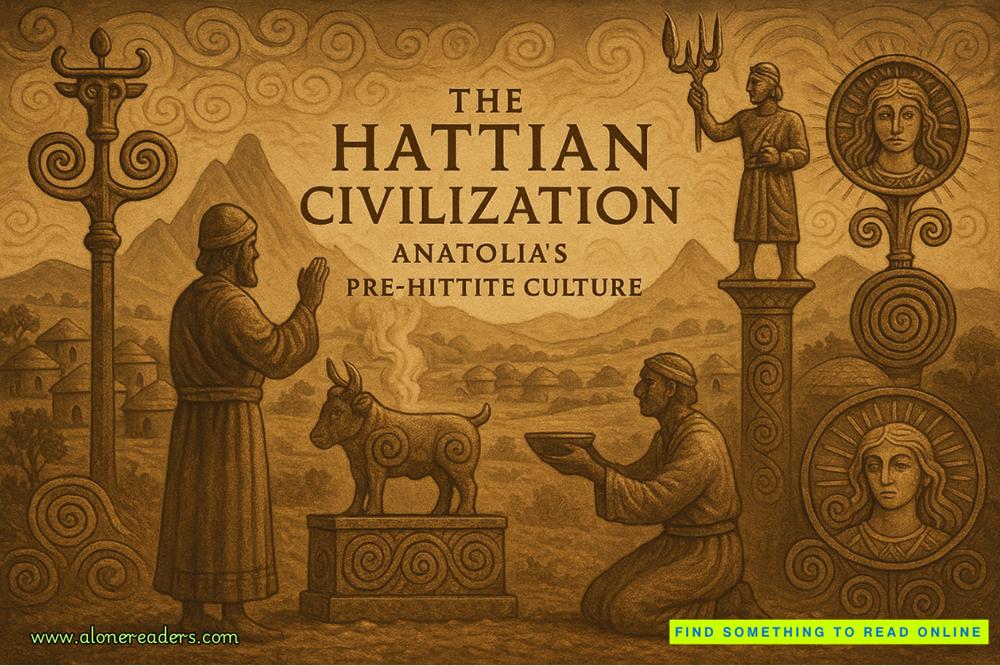
Long before the Hittites became a dominant imperial force in Anatolia, an older layer of culture lay embedded in the landscape—the Hattian civilization, a society whose traditions, language, and sacred worldview predated Indo-European influences and shaped the identity of central Anatolia for millennia. Although much of what we know about the Hattians comes from later Hittite sources, the fragments that survive paint a picture of a sophisticated, deeply symbolic, and spiritually rich culture. Through archaeology, comparative ritual study, and linguistic reconstruction, the Hattians emerge as a people whose legacy subtly but powerfully shaped the foundation of Anatolian history.
One of the most striking aspects of the Hattians is their identity as a non-Indo-European people occupying central Anatolia long before the arrival of the Hittite-speaking groups. Their capital, Hattusa, would much later become the heart of the Hittite Empire, but its earliest layers reveal a cultural system distinct in language, religious iconography, and societal organization. The Hattians were not an empire in the centralized sense; rather, they were a mosaic of city-states linked by shared ritual life, local kingship traditions, and an economy based on agriculture, metallurgy, and trade. Their civilization flourished roughly between the 3rd and early 2nd millennium BCE, representing one of the oldest structured cultures of the Anatolian plateau.
The Hattian language itself is one of the most intriguing remnants of this civilization. It is considered a language isolate, unrelated to the Indo-European Hittite or other known families. Surviving primarily through Hittite transcriptions of older hymns and rituals, Hattian vocabulary reveals a distinctly different sound system and conceptual framework. Words tied to religion, kingship, and natural forces are especially prominent, suggesting that sacred expression was central to Hattian cultural transmission. The persistence of these Hattian hymns within the archives of an Indo-European people indicates an extraordinary degree of cultural prestige. The Hittites did not simply conquer the region—they inherited and preserved the spiritual heritage of the people who lived there before them.
Religious life was at the core of Hattian identity. Their gods were rooted in natural forces, associating mountains, storms, fertility, and celestial bodies with divine personalities. Among these, Taru, the storm god, and Furu, the sun goddess, were among the most revered. Their partnership symbolized balance between the life-giving rains and the eternal cosmic order. Hattian religion emphasized the cyclical relationship between people and nature, viewing rituals as essential acts that ensured harmony in the cosmos. This worldview was deeply embedded within the agricultural seasons, with ceremonies marking planting, harvesting, and the unpredictable forces of the Anatolian climate.
Many of the religious rituals later preserved in Hittite tablets are explicitly noted as Hattian in origin, suggesting that the Hittites adopted not only the ceremonies but also their associated mythologies. The Hattian festivals were complex performances involving hymns, masks, dance, animal symbolism, and offerings designed to appease or invigorate a deity’s power. Priests operated as intermediaries who reenacted mythic events to renew the bond between the divine and human realms. The endurance of these traditions within Hittite imperial culture demonstrates how deeply revered Hattian ceremonies remained for centuries, even after political power shifted.
Another hallmark of the Hattian civilization is its unique artistic and symbolic expression. Archaeological finds from central Anatolia reveal a world filled with iconic metal standards shaped like bulls, stags, and intricate geometric patterns. These objects, often cast in bronze, were likely used in ceremonial processions or attached to cult wagons. Their craftsmanship reflects advanced metallurgical knowledge, with sophisticated casting techniques and symbolic motifs that express a complex spiritual language.
The reverence for bull imagery is especially prominent. The bull symbolized strength, fertility, and divine authority, connecting earthly rulers with celestial powers. This symbolism appears in shrines, ceremonial vessels, and offerings, suggesting that the Hattians viewed the bull as an embodiment of cosmic stability. The use of animal symbolism in Hattian art also illustrates their worldview: animals were not merely creatures; they were carriers of sacred meaning, linking humans with broader cosmic rhythms.
Beyond religious artifacts, excavations across sites such as Hattusa, Alacahöyük, and Horoztepe reveal the presence of elite tombs containing gold, silver, electrum, and intricately crafted ceremonial weapons. These tombs point to stratified leadership structures and the existence of local kings who served as both political and spiritual heads. Their graves were rich with symbolic objects—sun disks, metal figurines, and ornate pins—that conveyed authority and reflected a belief in continuity between earthly leadership and divine favor.
Trade and interaction with neighboring cultures also shaped Hattian society. Central Anatolia was positioned along routes connecting Mesopotamia, the Caucasus, and the Aegean, allowing the Hattians to engage in exchanges involving metals, textiles, and agricultural goods. Evidence of early writing systems, particularly the adoption of Mesopotamian cuneiform through Assyrian merchant colonies, reveals how interconnected the region was. Although the Hattians did not develop their own writing system that survived, their role in facilitating trade contributed to the spread of administrative technologies and cultural exchanges across the Near East.
The political landscape of Hattian Anatolia was structured around autonomous city-states, each governed by its own ruler. These rulers, often referred to in later sources as “kings of Hatti,” presided over rituals, local laws, and military defenses. They were not emperors commanding vast territories, but rather stewards of localized power whose authority was just as spiritual as it was administrative. The decentralized nature of Hattian governance helps explain why their culture endured even after Indo-European groups entered the region. Conquerors could absorb cities one by one, but the cultural system underlying them remained resilient.
As Indo-European Hittite speakers arrived in Anatolia around the early 2nd millennium BCE, the transition from Hattian to Hittite dominance was gradual, involving assimilation rather than annihilation. Many Hattian city-states were absorbed into the expanding Hittite political framework, but their traditions were preserved and integrated rather than erased. The Hittites named their kingdom after “Hatti,” adopted Hattian deities, and carefully preserved Hattian-language rituals in their state archives. This cultural preservation illustrates the deep respect the Hittites had for the civilization that preceded them, recognizing the spiritual and symbolic authority embedded within Hattian traditions.
In fact, some of the most famous Hittite myths—including tales involving the storm god and various agricultural rituals—are believed to be adaptations of older Hattian stories. The blending of these traditions created a hybrid heritage that shaped Hittite royal ideology. The kings of the Hittite Empire performed rituals of clear Hattian origin, using Hattian hymns and ceremonial objects to legitimize their rule. This continuity underscores how the Hattians became the spiritual ancestors of the region’s later imperial identity.
Despite the disappearance of their language and the transformation of their cities under Hittite rule, the Hattians remain a profound cultural force in Anatolian history. Their spiritual worldview, artistic innovations, and early political forms created the foundational cultural layer of central Anatolia. Archaeology continues to uncover artifacts that highlight their creativity, while linguistic studies of preserved ritual texts reveal a people with a deeply poetic and symbolic relationship to the divine.
The Hattian civilization stands as a reminder that history is not shaped only by empires. Sometimes, enduring influence comes from older, quieter cultures whose myths, rituals, and artistic expressions become the foundation for later greatness. In the case of Anatolia, the Hattians were that foundational force. Their civilization may be less widely known than the Hittite Empire that followed, but their cultural DNA permeates the earliest layers of Anatolian identity. Their legacy echoes through ritual texts, sacred iconography, and archaeological treasures that continue to reveal the depth of this ancient society.
Through ongoing research, we are beginning to see the Hattians not as a footnote to Hittite history, but as a vibrant and essential civilization in their own right, whose contributions shaped the spiritual and cultural heart of ancient Anatolia. Their story remains a powerful testament to the civilizations that thrived long before the better-known empires rose—and a reminder of how much human history lies buried beneath the surface, waiting to be rediscovered.



 The Hundred Days Offensive: How the Allies Defeated Germany in World War I
 The Second Battle of the Marne: The Turning Point of World War I in 1918
 The Spring Offensive of 1918: Germany's Final Gamble to Win World War I
 The Treaty of Brest-Litovsk: How Russia Left World War I
 The Russian Revolution and World War I: How War Brought Down the Tsar
 The Zimmermann Telegram Explained: Germany's Secret Offer to Mexico in World War I










