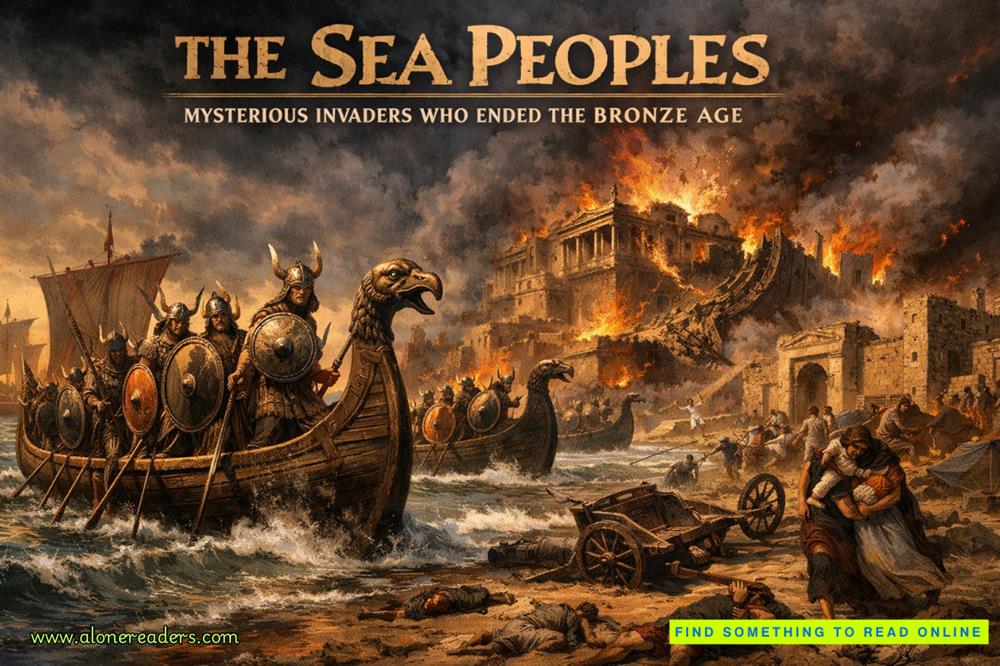
The end of the Bronze Age was not a gentle transition or an orderly decline. It was a violent, chaotic rupture that shattered some of the most sophisticated civilizations the ancient world had ever produced. Palaces burned, cities were abandoned, long-standing trade networks vanished almost overnight, and literacy itself disappeared in several regions for centuries. At the center of this collapse stands one of history’s most enduring enigmas: the Sea Peoples. They were not a single nation, empire, or ethnic group, but a loose constellation of maritime raiders, displaced populations, and warrior bands whose sudden appearance coincided with the destruction of the eastern Mediterranean world around 1200 BCE. Their name, given by later scholars rather than by themselves, masks a far more complex reality—one in which migration, climate stress, economic fragility, and warfare converged into a perfect storm.
For centuries before their arrival, the Bronze Age system had functioned as a tightly interlinked international order. Kingdoms across Anatolia, the Levant, Mesopotamia, and the Aegean relied on long-distance trade for essential resources, especially tin, without which bronze could not be produced. Diplomatic marriages, gift exchanges, and treaties bound royal courts together, while palace economies centralized production and redistribution. This system was highly efficient but also extremely brittle. When disruption came, it did not affect one state at a time—it cascaded across the entire network. The Sea Peoples emerged precisely at this moment of vulnerability, acting less like the sole cause of collapse and more like a catalytic force that pushed already strained societies past the point of recovery.
The earliest detailed descriptions of the Sea Peoples come from Egyptian records, particularly reliefs and inscriptions that depict waves of foreign warriors attacking by both land and sea. These sources list multiple groups with distinct names, clothing styles, and weaponry, suggesting a coalition rather than a unified command. Some wore feathered or horned helmets, others fought with long cut-and-thrust swords that were advanced for their time, and many carried round shields unlike the rectangular shields favored by older Near Eastern armies. The imagery is striking not only for its violence but for its scale. These were not small pirate raids. They were mass movements involving families, wagons, and entire communities, indicating migration as much as invasion.
One of the most unsettling aspects of the Sea Peoples phenomenon is how quickly established powers failed to contain them. Cities that had stood for centuries fell within a generation. Major urban centers were destroyed and never rebuilt on the same scale. Administrative systems collapsed, leaving behind layers of ash, broken tablets, and abandoned workshops. The archaeological record shows abrupt endings: unfinished projects, hoarded valuables left behind, and sudden breaks in artistic traditions. This pattern strongly suggests that societies were overwhelmed rather than gradually declining. The Sea Peoples did not merely exploit weakness; they accelerated systemic breakdown by attacking the nodes—ports, trade hubs, and coastal cities—that held the Bronze Age world together.
Their origins remain one of the most debated topics in ancient history. Linguistic clues, pottery styles, and weapon designs hint at connections to the Aegean world, Anatolia, and even central Mediterranean regions. Rather than pointing to a single homeland, the evidence suggests multiple points of origin. Some groups may have come from Mycenaean Greece or its periphery, displaced by internal conflict or economic collapse. Others may have originated in western Anatolia or the islands of the eastern Mediterranean. What united them was not ethnicity but circumstance. Environmental stress, resource shortages, and political instability appear to have pushed disparate peoples into motion at roughly the same time.
Climate data increasingly supports the idea that prolonged drought played a critical role in triggering these migrations. Reduced agricultural yields would have undermined palace economies dependent on surplus extraction. As food shortages worsened, social unrest likely followed, weakening state authority and making populations more willing—or more desperate—to move. In this context, the Sea Peoples can be understood not simply as aggressors but as symptoms of a wider ecological and economic crisis. Their raids were both acts of survival and engines of destruction, feeding on instability while deepening it.
Militarily, the Sea Peoples represented a significant shift in warfare. Bronze Age armies were traditionally elite, chariot-based forces controlled by centralized states. The Sea Peoples, by contrast, appear to have relied heavily on infantry, close-combat weapons, and naval mobility. This made them adaptable and difficult to counter, especially for states whose military doctrines were optimized for set-piece battles rather than fluid, multi-front assaults. Their use of iron weapons—still rare at the time—may have given them an additional advantage, foreshadowing the technological transition that followed the Bronze Age collapse.
The psychological impact of their attacks should not be underestimated. For societies accustomed to stability and ritualized diplomacy, the sudden appearance of relentless, unfamiliar enemies must have been profoundly destabilizing. Records speak of fear, desperation, and appeals to the gods as defenses failed. Even where invasions were repelled, the cost was immense. Armies were depleted, economies exhausted, and confidence in divine and royal protection shaken. In many regions, this loss of legitimacy proved fatal to existing political structures.
What followed the collapse was not immediate recovery but a long, uneven dark age. Writing systems vanished in some areas, monumental architecture ceased, and populations declined sharply. Trade routes that had connected continents fell silent. Yet from this devastation emerged new social forms. Smaller, more resilient communities replaced palace states. Iron technology spread more widely. Cultural identities shifted, laying the groundwork for the civilizations of the Iron Age. In this sense, the Sea Peoples stand at a historical hinge point—not just as destroyers, but as unwitting midwives to a new world order.
Modern scholarship increasingly views the Sea Peoples through a multifactorial lens. No single explanation—neither invasion, nor climate change, nor economic collapse—fully accounts for the scale of the Bronze Age’s end. Instead, it was the interaction of multiple stresses that proved fatal. The Sea Peoples were both agents and products of this interaction. They exploited weakened states, but they were also driven by forces beyond their control. This dual role is what makes them so compelling and so difficult to define.
Their legacy is paradoxical. They left few written records of their own, yet their impact reshaped history. They destroyed cities, but also broke rigid systems that could no longer adapt. They ended an age defined by bronze, palaces, and kings, and ushered in a harsher but more flexible era of iron, local power, and cultural reinvention. In the silence they left behind—in the burned layers of ancient cities and the gaps in historical memory—we glimpse the profound fragility of complex civilizations.
The mystery of the Sea Peoples endures precisely because it resists simple narratives. They were not merely barbarian hordes descending on a peaceful world, nor were they innocent refugees swept along by circumstance. They were both disruptors and survivors, moving through a collapsing system and, in doing so, bringing it to an end. Their story is a reminder that civilization is not undone by a single blow, but by the convergence of pressures that make such a blow possible. In the ruins of the Bronze Age, the Sea Peoples remain a haunting symbol of how quickly the foundations of even the most advanced societies can give way.



 The Hundred Days Offensive: How the Allies Defeated Germany in World War I
 The Second Battle of the Marne: The Turning Point of World War I in 1918
 The Spring Offensive of 1918: Germany's Final Gamble to Win World War I
 The Treaty of Brest-Litovsk: How Russia Left World War I
 The Russian Revolution and World War I: How War Brought Down the Tsar
 The Zimmermann Telegram Explained: Germany's Secret Offer to Mexico in World War I










