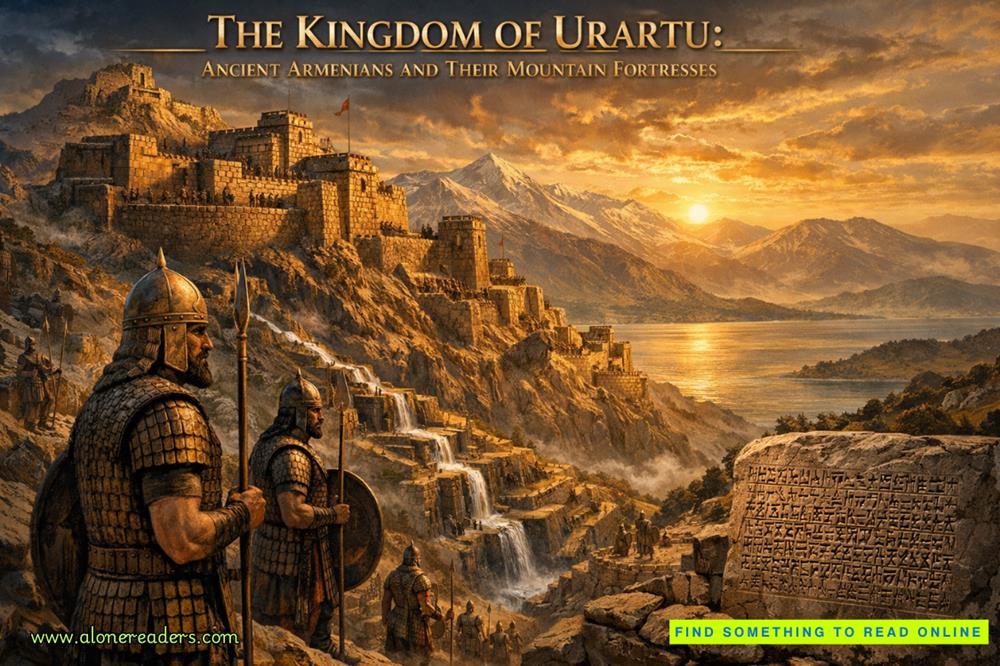
The Kingdom of Urartu emerged in the early Iron Age as one of the most formidable yet frequently overlooked civilizations of the ancient Near East. Flourishing between the ninth and sixth centuries BCE, Urartu was not a marginal tribal society but a centralized, technologically advanced state that controlled the Armenian Highlands and challenged the greatest imperial power of its age. Its rulers constructed vast stone fortresses atop mountains, engineered complex irrigation systems in hostile terrain, and forged a military culture adapted to highland warfare. Though later traditions absorbed Urartu into broader Armenian history, the civilization itself possessed a distinct identity, language, and political vision that shaped the region long after its disappearance.
Urartu developed in a landscape that was both a blessing and a constraint. The Armenian Highlands are defined by rugged mountains, volcanic plateaus, narrow valleys, and severe winters. Rather than being limited by this environment, Urartian rulers transformed it into a strategic asset. Mountain geography became the backbone of Urartian statecraft, shaping everything from military planning to administrative control. The heartland around Lake Van offered defensible terrain, access to freshwater, and routes connecting Anatolia, the Caucasus, and northern Mesopotamia. This positioning allowed Urartu to control trade corridors while remaining difficult to invade.
The political formation of Urartu was a response to external pressure rather than gradual cultural evolution. Prior to unification, the region consisted of loosely organized tribal groups and small polities. The expansion of Mesopotamian empires northward forced these communities to consolidate. Urartu emerged as a defensive empire, structured explicitly to resist domination from the south. Its kings adopted centralized authority, formal bureaucracy, and monumental architecture to project power across a fractured highland landscape.
Urartian kingship was intensely militarized and ritualized. The ruler was both a war leader and a divine agent, acting under the authority of a state god who legitimized conquest and construction. Royal inscriptions emphasize victories, fortress foundations, and canal building, revealing a worldview in which territorial control and divine favor were inseparable. Unlike later Armenian kingdoms, Urartu’s political ideology did not emphasize ethnic unity but rather loyalty to the crown and obedience to state authority.
The most visible legacy of Urartu lies in its fortresses. These were not simple defensive walls but complex military-administrative centers designed to dominate territory and project authority. Built from massive basalt and limestone blocks, Urartian fortresses often crown steep ridges, cliffs, and volcanic outcrops. Their placement was deliberate: visibility over valleys, control of roads, and psychological intimidation of subject populations. The architecture itself communicated permanence and power, even in regions where direct occupation was limited.
Inside these fortresses were granaries, armories, workshops, temples, and royal residences. This reveals that fortresses were not merely military outposts but hubs of governance and logistics. In times of peace, they functioned as administrative centers collecting tribute and managing agricultural output. In times of war, they became fortified supply depots capable of sustaining prolonged resistance. The density of these installations across Urartian territory suggests a highly organized system of regional control rather than sporadic strongholds.
Urartian military strategy relied on mobility, terrain mastery, and fortified depth. Armies were structured to operate in mountainous environments, using narrow passes and elevated positions to offset numerical disadvantages. Defense was layered, with outer forts delaying invaders while central strongholds absorbed pressure. This system proved effective for centuries, frustrating repeated campaigns by southern empires that struggled to adapt to high-altitude warfare.
Beyond warfare, Urartu distinguished itself through extraordinary hydraulic engineering. Agriculture in the highlands was precarious due to uneven rainfall and rocky soils. To address this, Urartian rulers invested heavily in irrigation canals, dams, and reservoirs that redirected mountain water to arable land. Some of these canals stretched tens of kilometers across difficult terrain, maintaining precise gradients to ensure water flow. This was state-sponsored engineering on an imperial scale, not local experimentation.
These irrigation systems transformed marginal landscapes into productive agricultural zones capable of supporting large populations and standing armies. Grain, wine, and livestock production increased dramatically under Urartian control. The state tightly regulated these resources, storing surplus in fortress granaries and redistributing supplies during military campaigns. This economic foundation underpinned Urartu’s ability to sustain prolonged conflict and large construction projects.
Culturally, Urartu blended local traditions with influences from neighboring civilizations while maintaining a distinct identity. The Urartian language, unrelated to Indo-European tongues, was used in royal inscriptions written in adapted cuneiform. Artistic expression favored geometric motifs, animal symbolism, and scenes of royal dominance. Metalwork in bronze and iron reached high levels of sophistication, particularly in weapons, armor, and ceremonial objects. Art functioned as propaganda, reinforcing royal authority and divine sanction.
Religion in Urartu reinforced state ideology. Temples were integrated into fortresses, symbolizing the inseparability of sacred and political power. Ritual offerings, inscriptions, and architectural alignment all emphasized the ruler’s role as intermediary between gods and people. This fusion of religion and governance strengthened loyalty in a culturally diverse empire composed of conquered communities.
Despite its strength, Urartu was not immune to the broader transformations reshaping the ancient Near East. From the late seventh century BCE onward, external pressures intensified. Shifting trade routes, internal revolts, and the rise of new powers destabilized the regional balance. Urartu’s fortress-based system, once an advantage, became a rigidity in an era of rapid political change. Archaeological evidence suggests destruction layers, abandonment of sites, and population displacement rather than a single catastrophic collapse.
Unlike some empires that fell dramatically, Urartu faded unevenly. Certain regions retained Urartian administrative practices and cultural elements long after central authority dissolved. Over time, these traditions merged with emerging Armenian polities, contributing architectural styles, settlement patterns, and concepts of kingship. Urartu did not vanish—it transformed, leaving an imprint embedded within later Armenian civilization.
Modern scholarship increasingly recognizes Urartu as a foundational civilization of the Armenian Highlands rather than a peripheral footnote. Its achievements in engineering, military organization, and state formation rival those of better-known contemporaries. The reason Urartu remained forgotten for so long lies partly in the scarcity of literary sources and the overshadowing presence of southern empires in historical narratives. Archaeology has been crucial in restoring Urartu to its rightful place in ancient history.
The legacy of Urartu challenges simplistic narratives of ancient civilizations as either fleeting or isolated. It demonstrates how a society can adapt to extreme environments, leverage geography strategically, and construct durable political systems without vast lowland resources. Urartu’s mountain fortresses were not symbols of isolation but instruments of connection, binding distant valleys into a coherent imperial structure.
In the broader story of ancient civilizations, Urartu stands as a reminder that power does not always arise from fertile river plains or coastal trade hubs. Sometimes it is forged in stone, elevation, and endurance. The Urartians mastered their mountains, and in doing so, created one of the Iron Age’s most resilient and fascinating states—an empire carved into rock, sustained by water, and remembered through ruins that still dominate the highlands today.



 The Hundred Days Offensive: How the Allies Defeated Germany in World War I
 The Second Battle of the Marne: The Turning Point of World War I in 1918
 The Spring Offensive of 1918: Germany's Final Gamble to Win World War I
 The Treaty of Brest-Litovsk: How Russia Left World War I
 The Russian Revolution and World War I: How War Brought Down the Tsar
 The Zimmermann Telegram Explained: Germany's Secret Offer to Mexico in World War I