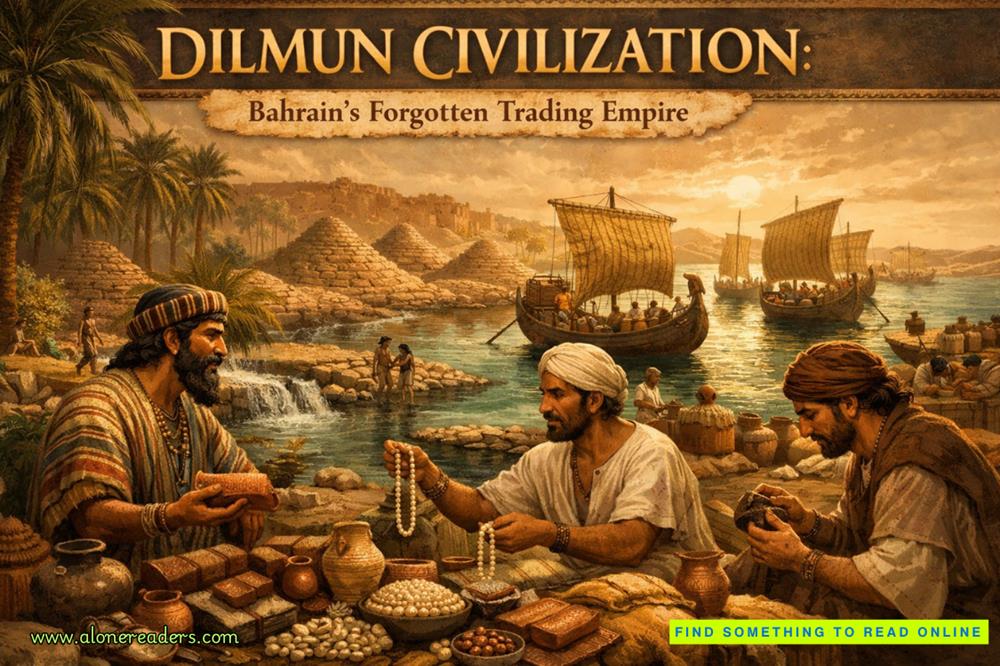
Long before Bahrain became synonymous with oil wealth and modern finance, the islands were the beating heart of one of the ancient world’s most strategically vital trading civilizations. Known to the Sumerians as Dilmun, this Bronze Age society flourished not through conquest or imperial domination, but through its mastery of geography, logistics, and maritime commerce. Dilmun was not merely a trading stop; it was a commercial civilization built around exchange, trust, and connectivity, serving as a crucial intermediary between Mesopotamia, the Indus Valley, and the Arabian hinterlands.
The earliest references to Dilmun appear in Sumerian cuneiform texts dating back to the late fourth millennium BCE. In these records, Dilmun is described as a distant, prosperous land where goods flowed freely and wealth accumulated without warfare. It was portrayed not only as a real economic partner but also as an almost mythic place—a land of purity, abundance, and divine favor. This dual identity, part commercial hub and part sacred geography, would define Dilmun’s role in ancient consciousness for centuries.
Geographically, Dilmun occupied an almost perfect position for long-distance trade. Situated in the central Persian Gulf, the islands of present-day Bahrain controlled maritime routes linking southern Mesopotamia with Oman, the Indus Valley, and eastern Arabia. What made Dilmun uniquely valuable, however, was not just its location, but its abundant freshwater springs, both on land and underwater. In a region dominated by arid coastlines, this natural advantage transformed Dilmun into a vital resupply point for sailors and merchants crossing the Gulf.
By the early third millennium BCE, Dilmun had evolved into a sophisticated entrepôt economy. Goods did not merely pass through its ports; they were stored, taxed, repackaged, and redistributed. Copper from Oman, timber and precious stones from the Indus Valley, textiles and agricultural products from Mesopotamia, and pearls harvested locally all moved through Dilmun’s hands. Its prosperity was built on facilitation rather than production, a model strikingly modern in its logic.
Archaeological evidence from Bahrain reveals a society that invested heavily in infrastructure supporting trade. Warehouses, seals, weights, and standardized measures suggest a regulated commercial system. The presence of Dilmun seals—distinctive circular stamps used to mark goods—indicates administrative oversight and an emphasis on authenticity and trust. These seals appear across Mesopotamian sites, confirming Dilmun’s role as a recognized and reliable trading partner rather than a peripheral supplier.
Perhaps the most visually striking legacy of the Dilmun Civilization is its vast field of burial mounds. Tens of thousands of stone tumuli dot Bahrain’s landscape, forming one of the largest prehistoric cemeteries in the world. These burial mounds were not uniform; their size and complexity varied dramatically, reflecting social stratification. The sheer scale of these cemeteries points to long-term stability, wealth accumulation, and a deeply rooted belief system tied to ancestry and status. Elite tombs, with multiple chambers and elaborate construction, suggest the existence of a powerful mercantile aristocracy rather than warrior kings.
Despite its economic strength, Dilmun never appears to have developed into a militarized empire. There is little evidence of large-scale fortifications or standing armies during its peak. Instead, Dilmun’s power derived from control of trade routes and economic interdependence. Mesopotamian city-states depended on Dilmun for copper and luxury goods, while Dilmun relied on Mesopotamia for agricultural surpluses and manufactured products. This mutual reliance created a balance that favored diplomacy and continuity over conquest.
Religiously and culturally, Dilmun occupied a unique place in Mesopotamian imagination. In Sumerian mythology, Dilmun was described as a sacred land untouched by sickness, aging, or death—a kind of earthly paradise. This symbolic elevation likely stemmed from Dilmun’s real-world association with freshwater abundance and prosperity. In a region where water meant survival, Dilmun’s springs would have appeared miraculous, reinforcing its semi-divine reputation.
Yet Dilmun was not isolated from political realities. Over time, powerful Mesopotamian empires sought to exert control over Gulf trade. Akkadian and later Neo-Sumerian rulers claimed influence over Dilmun, sometimes referring to it as a subordinate or allied territory. These claims, however, seem to have been more about securing trade access than direct governance. Dilmun retained a significant degree of autonomy, continuing to operate as a commercial intermediary even as regional power dynamics shifted.
The decline of the Dilmun Civilization was gradual rather than catastrophic. By the mid-second millennium BCE, changes in trade networks, political upheaval in Mesopotamia, and the rise of competing Gulf centers began to erode Dilmun’s dominance. Environmental factors may also have played a role. The silting of harbors, depletion of freshwater springs, or shifts in sea routes would have undermined the very foundations of Dilmun’s economic model. As trade patterns evolved, Dilmun’s strategic advantage diminished.
Later civilizations, including the Kassites and Neo-Babylonians, continued to reference Dilmun, but increasingly as a peripheral or symbolic land rather than a dominant trading power. By the first millennium BCE, Dilmun had largely faded from political relevance, its legacy absorbed into the broader cultural memory of the region. What remained were the burial mounds, the scattered ruins, and the echoes preserved in ancient texts.
Modern archaeology has gradually reconstructed Dilmun’s story, challenging earlier assumptions that Gulf societies were marginal to ancient history. Dilmun demonstrates that commerce, not conquest, could serve as the foundation of a powerful civilization. Its success depended on trust, regulation, and connectivity—principles that resonate strongly with modern global trade systems.
Today, Bahrain’s identity as a financial and logistical hub mirrors its ancient past in striking ways. Just as Dilmun once linked civilizations through maritime exchange, modern Bahrain positions itself as a connector between regions and markets. This continuity underscores the enduring influence of geography and trade culture across millennia.
The Dilmun Civilization reminds us that history is not shaped solely by empires that marched armies across continents. Some of the most influential societies were those that mastered exchange, facilitated cooperation, and understood the value of being indispensable rather than dominant. Dilmun’s true legacy lies in proving that economic intelligence can rival military power, and that forgotten civilizations often shaped the ancient world far more deeply than their silence suggests.



 The Hundred Days Offensive: How the Allies Defeated Germany in World War I
 The Second Battle of the Marne: The Turning Point of World War I in 1918
 The Spring Offensive of 1918: Germany's Final Gamble to Win World War I
 The Treaty of Brest-Litovsk: How Russia Left World War I
 The Russian Revolution and World War I: How War Brought Down the Tsar
 The Zimmermann Telegram Explained: Germany's Secret Offer to Mexico in World War I