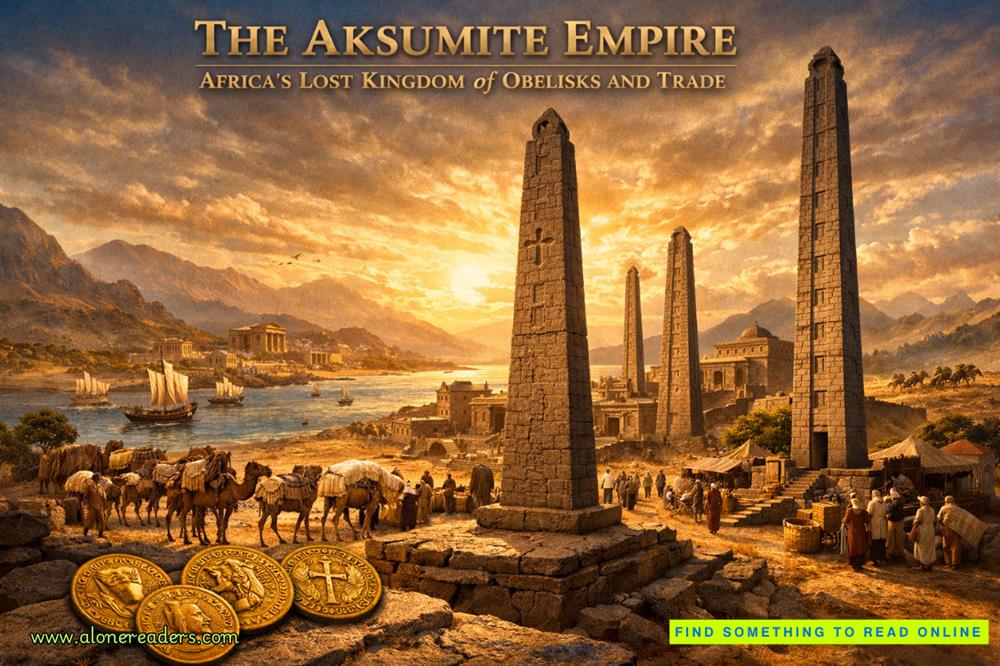
The story of the Aksumite Empire is one of Africa’s most extraordinary yet underestimated chapters, a civilization that once stood shoulder to shoulder with Rome, Persia, and China, yet gradually slipped from global memory. Rising in the highlands of what is now northern Ethiopia and Eritrea, Aksum was not an isolated African kingdom but a sophisticated imperial power embedded in the arteries of ancient global trade. From roughly the first century CE to the seventh, the Aksumite state controlled strategic corridors between the Mediterranean world and the Indian Ocean, transforming geography into wealth, ideology into authority, and stone into timeless monuments.
At the heart of Aksum’s power was its location. The empire occupied a commanding position near the Red Sea, linking the Roman Mediterranean to Arabia, East Africa, and the Indian subcontinent. Long before the rise of medieval Islamic caliphates or European maritime empires, Aksumite merchants facilitated the movement of gold, ivory, frankincense, obsidian, slaves, and exotic animals across continents. Roman coins found in India and Indian pepper discovered in Mediterranean ports both passed, directly or indirectly, through Aksumite hands. This was not peripheral trade; it was central infrastructure in the ancient global economy.
What distinguished Aksum from many contemporary African polities was its early transition from regional exchange to state-regulated international commerce. Aksumite rulers minted their own gold, silver, and bronze coinage, inscribed with royal names and religious symbols. This act alone signaled sovereignty and economic maturity. Coinage allowed standardized taxation, soldier payment, and diplomatic exchange, while also advertising imperial authority beyond borders. Few African states of antiquity achieved this level of monetary sophistication, and even fewer did so at such scale.
The visual symbols of Aksumite power still dominate the landscape today: the monumental granite obelisks, or stelae, some rising over 20 meters high and weighing hundreds of tons. These were not mere decorative monuments. They were architectural statements of kingship, funerary ideology, and engineering mastery. Carved to resemble multi-story buildings with false doors and windows, the stelae represented royal palaces for the dead, bridging earthly authority and the afterlife. Transporting and erecting these monoliths without iron cranes or modern machinery required astonishing logistical planning, labor organization, and mathematical precision.
Unlike the pyramids of Egypt, which often dominate discussions of African monumental architecture, Aksum’s obelisks emphasize vertical elegance and urban symbolism. They stood at the core of a living city, not in isolated necropolises, reinforcing the idea that imperial power was both sacred and civic. Stone, in Aksum, was propaganda.
Aksumite political organization further challenges simplistic views of ancient African governance. The empire was not a loose tribal confederation but a centralized monarchy with administrative hierarchies, regional governors, and diplomatic outreach. Royal inscriptions record military campaigns in Nubia, southern Arabia, and inland African territories, demonstrating both offensive capability and territorial ambition. Aksum’s armies crossed the Red Sea to intervene in Arabian politics, projecting power far beyond the African mainland.
One of the most consequential moments in Aksumite history came in the fourth century CE, when the empire adopted Christianity as a state religion. This decision placed Aksum among the earliest Christian states in the world, alongside Armenia and Rome. Christianity was not merely a spiritual transformation; it was a strategic realignment. By adopting the faith of the Roman world, Aksum integrated itself ideologically into Mediterranean political culture while retaining its African identity.
The fusion of Christianity with indigenous traditions produced a distinctive religious culture. Churches were constructed alongside pre-Christian sacred spaces, royal coins replaced pagan symbols with crosses, and kings presented themselves as divinely sanctioned rulers. This synthesis strengthened internal cohesion and reinforced legitimacy, particularly during periods of external pressure. Religion became a tool of statecraft, not an imported replacement for African belief systems.
Aksum’s prosperity rested on a delicate balance between land and sea. Inland agriculture supported urban populations through terrace farming, irrigation, and cattle husbandry, while coastal ports connected the empire to maritime trade networks. The port of Adulis functioned as a commercial gateway, linking African interiors to Indian Ocean routes. Taxes, customs duties, and royal monopolies transformed commerce into state revenue, funding monumental construction and military expansion.
Yet Aksum was not immune to global shifts. From the sixth century onward, changes in climate, trade routes, and regional power dynamics began to erode its dominance. Soil exhaustion and deforestation likely strained agricultural systems, while political instability in the Mediterranean reduced demand for certain luxury goods. The rise of Islamic polities in Arabia and the Red Sea region altered commercial geography, diverting trade flows away from Aksumite-controlled routes.
Importantly, Aksum did not collapse suddenly. It contracted, adapted, and transformed. Political power shifted inland, monumental construction slowed, and written records became scarcer. The empire’s legacy, however, endured through religious institutions, language, and cultural memory. Ethiopian Christian traditions trace their roots directly to Aksumite foundations, preserving continuity where imperial structures faded.
Modern neglect of Aksum’s significance reveals more about global historical bias than about the empire itself. For centuries, African civilizations were framed as isolated or derivative, despite clear archaeological and textual evidence of innovation and connectivity. Aksum disrupts these narratives. It was African, imperial, literate, Christian, and commercially sophisticated long before European expansion reshaped global trade.
The Aksumite Empire stands as proof that Africa was not merely connected to the ancient world, but instrumental in shaping it. Its obelisks were not relics of a forgotten people; they were declarations of presence in a global system. Its merchants were not intermediaries at the margins; they were architects of exchange. And its rulers were not passive recipients of external influence; they were strategic actors in a competitive international order.
Today, as discussions of globalization often begin in early modern Europe, Aksum reminds us that global history has deeper, broader, and more African roots than commonly acknowledged. The lost kingdom of obelisks and trade was never truly lost. It was overlooked.



 The Hundred Days Offensive: How the Allies Defeated Germany in World War I
 The Second Battle of the Marne: The Turning Point of World War I in 1918
 The Spring Offensive of 1918: Germany's Final Gamble to Win World War I
 The Treaty of Brest-Litovsk: How Russia Left World War I
 The Russian Revolution and World War I: How War Brought Down the Tsar
 The Zimmermann Telegram Explained: Germany's Secret Offer to Mexico in World War I