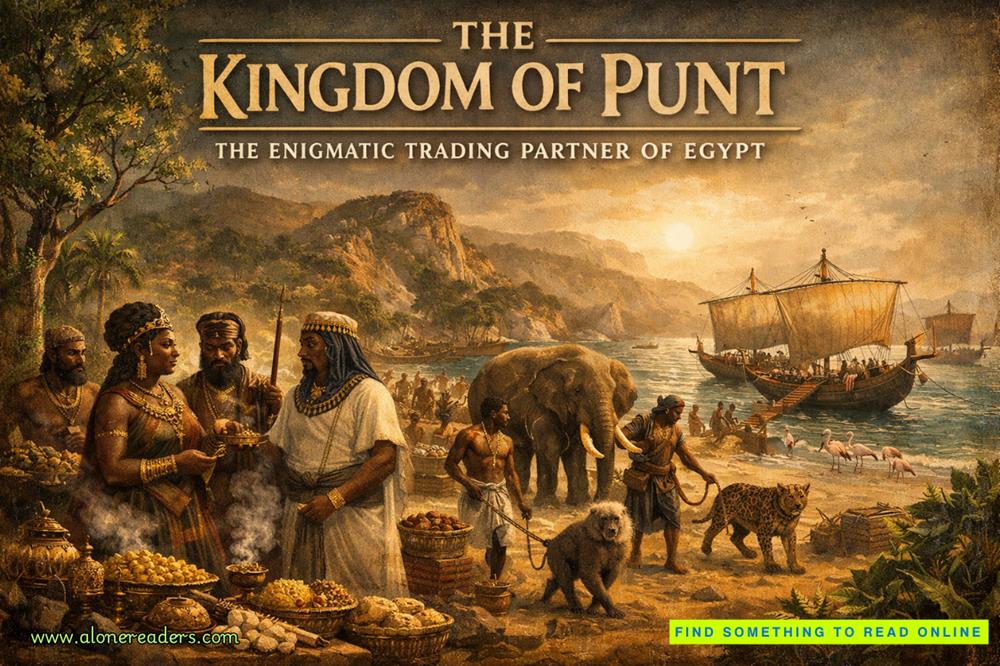
The Kingdom of Punt occupies a singular position in ancient history as one of the most elusive yet economically vital civilizations known to the ancient world. Revered by ancient Egyptians as a land of extraordinary abundance, Punt was not merely a trading partner but a semi-mythical source of divine wealth, exotic materials, and cultural fascination. For over a millennium, Egyptian texts spoke of Punt as a distant, fertile land from which flowed incense, gold, ebony, ivory, and living treasures that could not be found along the Nile. Yet, despite its prominence in royal inscriptions and temple reliefs, Punt itself left behind no clearly identified cities, monuments, or inscriptions of its own, earning its reputation as one of antiquity’s most enduring geographical and historical enigmas.
Egyptian records describe Punt not as a conquered territory but as an independent and respected partner, suggesting a relationship built on diplomacy rather than domination. This distinction is crucial. Unlike Nubia or the Levant, Punt was never annexed, taxed, or militarily subdued. Instead, Egyptian expeditions were organized as elaborate trade missions, sanctioned by the gods and celebrated as achievements of statecraft. This implies that Punt possessed its own political organization, economic leverage, and maritime expertise, making it a civilization capable of negotiating on equal terms with one of the most powerful states of the ancient world.
The earliest references to Punt date back to Egypt’s Old Kingdom, around the Fifth Dynasty, where inscriptions speak of “God’s Land” as a sacred source of incense used in temple rituals. These early mentions already indicate a well-established trade network, implying that Punt’s prosperity predated formal Egyptian contact. By the Middle Kingdom, expeditions to Punt had become more systematic, with ships constructed specifically for long-distance Red Sea voyages. The fact that Egypt invested heavily in naval infrastructure solely to reach Punt underscores the exceptional value of Puntite commodities within Egyptian religious and economic systems.
The most vivid and detailed account of Punt comes from the reign of Queen Hatshepsut during the Eighteenth Dynasty. The reliefs carved into her mortuary temple depict not only the journey itself but the people of Punt, their settlements, flora, fauna, and rulers. These scenes are unparalleled in Egyptian art for their ethnographic precision. Puntite houses are shown raised on stilts, surrounded by palm trees and incense groves, indicating a humid coastal environment rather than an arid desert. The Puntites themselves are portrayed with distinct physical features, hairstyles, and clothing, reinforcing the idea that they were culturally and ethnically distinct from Egyptians.
One of the most striking figures in these reliefs is the Puntite queen, depicted with pronounced physical traits that have sparked centuries of scholarly debate. Far from caricature, her portrayal suggests realism rather than symbolism, indicating that Egyptian artists aimed to document Punt as it truly appeared. This reinforces the notion that Punt was a real, functioning society rather than a mythical abstraction. The depiction of Puntite rulers receiving Egyptian envoys with ceremony and dignity further suggests a structured political hierarchy and a diplomatic culture accustomed to foreign relations.
The commodities obtained from Punt were not luxury curiosities but cornerstones of Egyptian religious life. Frankincense and myrrh, harvested from living incense trees brought back to Egypt, were essential for temple rituals, funerary practices, and royal ceremonies. These substances were believed to carry divine essence, linking Punt directly to Egyptian cosmology. Gold from Punt was prized for its purity, while ebony and ivory fueled elite craftsmanship. Exotic animals such as baboons, often associated with wisdom and the god Thoth, were transported alive to Egypt, highlighting the logistical sophistication of Punt-Egypt trade.
Trade routes to Punt reveal a high level of maritime and geographic knowledge. Egyptian ships likely sailed from ports along the Red Sea coast, navigating open waters rather than hugging shorelines. This required advanced shipbuilding techniques, navigation skills, and seasonal planning based on winds and currents. Such voyages were perilous and expensive, reinforcing the idea that Punt’s resources were worth extraordinary effort. Equally important is the implication that Punt itself possessed harbors, docking facilities, and trade intermediaries capable of receiving and provisioning foreign fleets.
The location of Punt has long been debated, with theories placing it along the southern Red Sea coast, encompassing parts of modern-day Eritrea, eastern Sudan, Ethiopia, and northern Somalia. Botanical evidence from incense trees depicted in Egyptian reliefs aligns closely with species native to the Horn of Africa. Faunal evidence, including baboons and certain bird species, further supports this region. However, the absence of unequivocal archaeological remains makes it difficult to pinpoint Punt precisely, reinforcing its reputation as a civilization known primarily through the eyes of others.
What distinguishes Punt from many other ancient societies is the asymmetry of historical visibility. Egypt documented Punt extensively, yet Punt left no known written record of its own interactions with Egypt. This imbalance has shaped modern understanding, filtering Punt through an Egyptian lens that emphasized wealth, fertility, and divine favor. It is possible that Punt’s own traditions were oral rather than written, or that its records were produced on perishable materials unsuited to long-term preservation in a humid climate. Either way, Punt’s silence amplifies its mystery rather than diminishing its significance.
Economically, Punt appears to have functioned as a hub within a broader Indian Ocean and African trade network. Goods from inland Africa may have been funneled through Puntite ports, making Punt an intermediary rather than a mere producer. This would explain the diversity of materials attributed to Punt and its sustained importance across centuries. Such a role would require political stability, commercial regulation, and alliances with inland communities, suggesting a level of complexity comparable to other ancient trading states.
The decline of Punt is as obscure as its origins. After the New Kingdom, references to Punt become sporadic and eventually disappear from Egyptian records. This does not necessarily indicate collapse. Trade routes may have shifted, political centers may have relocated, or Punt may have fragmented into smaller entities absorbed into emerging regional powers. Climate change, overexploitation of incense trees, or disruptions in maritime trade could all have contributed to its fading from history. What is certain is that Punt did not vanish suddenly but gradually receded from Egypt’s geopolitical horizon.
The legacy of Punt endures not through ruins or inscriptions but through its profound impact on one of history’s greatest civilizations. Punt shaped Egyptian religious practice, influenced royal ideology, and expanded Egypt’s geographic imagination beyond the Nile Valley. It challenged Egypt to engage with the wider world not through conquest but through exchange. In this sense, Punt represents an alternative model of ancient power, one based on resource control, strategic location, and diplomatic engagement rather than territorial expansion.
Ultimately, the Kingdom of Punt stands as a reminder that history is often written by those who trade, travel, and observe rather than those who leave monuments. Punt’s story survives because it mattered deeply to Egypt, not because it sought immortality through stone. Its anonymity is not a weakness but a testament to a civilization confident enough to prosper without proclaiming itself to posterity. In the grand narrative of forgotten ancient civilizations, Punt remains both present and absent, a land vividly described yet perpetually just beyond reach, inviting scholars and readers alike to imagine the world as ancient traders once knew it—vast, interconnected, and full of mysteries still unsolved.



 The Hundred Days Offensive: How the Allies Defeated Germany in World War I
 The Second Battle of the Marne: The Turning Point of World War I in 1918
 The Spring Offensive of 1918: Germany's Final Gamble to Win World War I
 The Treaty of Brest-Litovsk: How Russia Left World War I
 The Russian Revolution and World War I: How War Brought Down the Tsar
 The Zimmermann Telegram Explained: Germany's Secret Offer to Mexico in World War I