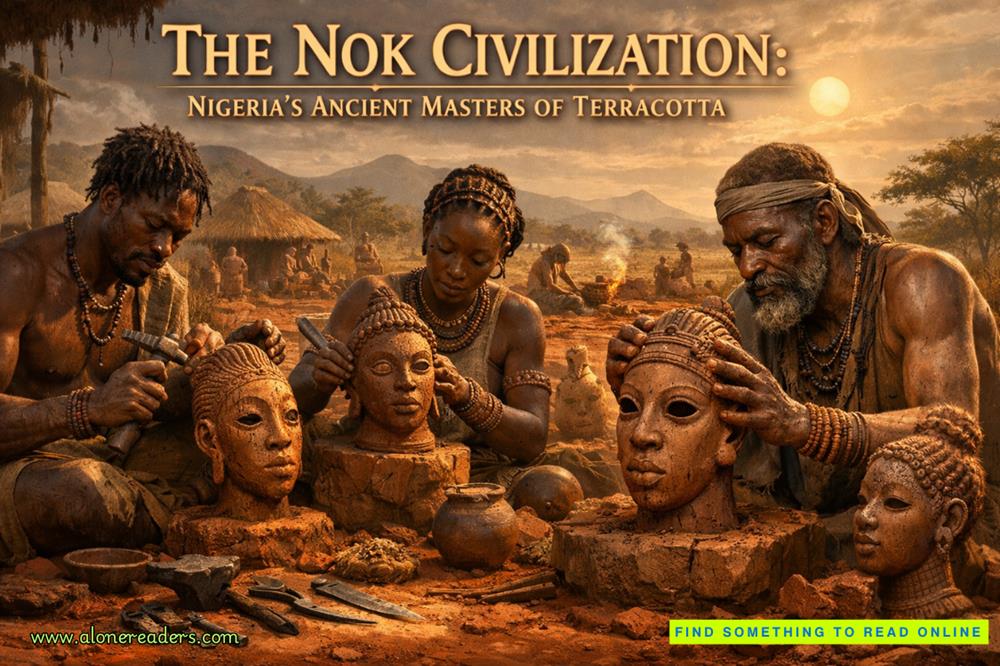
The story of the Nok Civilization stands as one of the most profound yet long-overlooked chapters in African antiquity, revealing a society that mastered complex artistic expression, early metallurgy, and symbolic communication centuries before many comparable developments elsewhere in the world. Flourishing roughly between 1500 BCE and 300 CE in what is now central Nigeria, the Nok people left behind no written records, no monumental stone architecture, and no royal inscriptions. Instead, they spoke across millennia through terracotta sculptures of extraordinary sophistication, artifacts that silently but powerfully challenge outdated assumptions about Africa’s ancient past.
The earliest recognition of Nok culture came not through grand excavations, but by accident. Tin miners in the Jos Plateau region uncovered fragments of terracotta heads buried deep within alluvial soils, their pierced eyes, stylized features, and commanding expressions unlike anything previously attributed to sub-Saharan Africa. At first dismissed or misunderstood, these fragments would later redefine scholarly understanding of early African civilizations. Radiocarbon dating eventually placed them among the oldest large-scale figurative sculptures in the world south of the Sahara, forcing historians to reconsider timelines of artistic and technological development.
What distinguishes Nok terracotta is not merely its age, but its technical mastery and expressive depth. The sculptures depict human figures, animals, and composite beings with elongated heads, carefully incised hairstyles, beards, jewelry, and garments. Eyes are often rendered as triangular or almond-shaped voids, while mouths are parted in what appears to be speech, chant, or ritual breath. These are not crude or experimental works; they demonstrate a mature artistic tradition governed by established conventions and symbolic meaning. Such consistency suggests organized workshops, shared cultural norms, and possibly specialized artisan classes.
The choice of terracotta as a medium was itself significant. Clay was abundant, but transforming it into durable sculpture required controlled firing techniques, precise preparation, and an understanding of material behavior under heat. The Nok achieved this at scale, producing life-sized or near life-sized works that survived burial, erosion, and centuries of neglect. The sculptures’ hollow construction points to deliberate engineering decisions, reducing cracking during firing while allowing larger forms. This reflects a sophisticated knowledge of ceramic technology, not isolated experimentation.
Equally remarkable is the Nok Civilization’s early association with ironworking. Archaeological evidence suggests that Nok communities were among the earliest in sub-Saharan Africa to smelt and use iron. This development reshaped their economic and social structures. Iron tools improved agricultural productivity, enabling population growth and settlement stability. Weapons transformed hunting and defense, while ironworking itself likely carried ritual or symbolic importance, as metallurgy often did in ancient societies. The coexistence of advanced sculpture and early iron technology places the Nok at a pivotal intersection of artistic and industrial evolution.
Despite these achievements, Nok society remains enigmatic. No cities, palaces, or tombs definitively linked to elite rulers have been identified. Instead, evidence points to dispersed settlements, possibly organized around kinship groups or ritual centers rather than centralized states. The terracotta figures may represent ancestors, spiritual intermediaries, community leaders, or mythological beings. Some sculptures depict diseased or deformed individuals, suggesting ritual healing practices or symbolic representations of suffering and transformation. This diversity implies a rich spiritual worldview, one deeply embedded in daily life rather than confined to monumental religion.
Agriculture formed the backbone of Nok subsistence. Archaeobotanical findings indicate the cultivation of pearl millet and other indigenous crops adapted to the savanna environment. Combined with iron tools, this allowed communities to manage land efficiently and sustain long-term habitation. Livestock likely supplemented diets, while hunting remained important. Such economic balance fostered resilience, enabling Nok culture to persist for over a millennium despite climatic fluctuations and environmental pressures.
Trade networks further connected the Nok to broader regional systems. While direct evidence is limited, stylistic similarities and material distributions suggest interaction with neighboring cultures across West Africa. Clay sources, iron ore procurement, and shared artistic motifs imply networks of exchange and communication extending beyond individual communities. Nok terracotta, though primarily local in material, embodies ideas that may have traveled widely, influencing later artistic traditions in the region.
The decline of the Nok Civilization remains one of its greatest mysteries. By around 300 CE, the production of terracotta sculpture ceased, and distinctive Nok material culture faded from the archaeological record. Theories range from environmental degradation and soil exhaustion to social transformation or migration. Climatic shifts may have altered agricultural viability, while population pressures could have forced communities to reorganize or disperse. Rather than sudden collapse, the evidence suggests a gradual transformation, with Nok cultural elements absorbed into successor societies.
What is undeniable is Nok’s enduring legacy. Later West African civilizations, including those renowned for bronze casting and sculptural realism, emerged in regions once influenced by Nok traditions. While direct lines of continuity are debated, the conceptual foundation of figurative art, symbolic representation, and technical confidence in sculpture can be traced back to Nok innovations. In this sense, Nok is not an isolated phenomenon, but a cornerstone of African artistic heritage.
Modern recognition of the Nok Civilization has been hindered by looting, illicit antiquities trade, and insufficient archaeological protection. Many terracotta pieces entered private collections without context, stripping them of crucial information about their original use and meaning. This loss has complicated scholarly interpretation, underscoring the importance of ethical excavation and cultural preservation. Today, Nigerian archaeologists and institutions work to reclaim and study Nok heritage, reframing it within Africa’s own historical narrative rather than as an exotic anomaly.
The global significance of Nok art lies in its power to dismantle outdated hierarchies of civilization. For generations, African history was misrepresented as lacking complexity prior to external contact. Nok terracotta stands as irrefutable evidence of indigenous innovation, long before colonial or trans-Saharan influences. These sculptures testify to intellectual depth, aesthetic vision, and technological skill rooted firmly in African soil.
To engage with the Nok Civilization is to confront a past that is both distant and urgently relevant. It reminds us that human creativity does not follow a single geographic or cultural trajectory. The Nok people shaped their world through art, technology, and belief systems that resonated within their environment and beyond. Their terracotta figures, silent yet expressive, continue to speak of a civilization that mastered form, meaning, and material, leaving an indelible imprint on the story of humanity.




 The Hundred Days Offensive: How the Allies Defeated Germany in World War I
 The Second Battle of the Marne: The Turning Point of World War I in 1918
 The Spring Offensive of 1918: Germany's Final Gamble to Win World War I
 The Treaty of Brest-Litovsk: How Russia Left World War I
 The Russian Revolution and World War I: How War Brought Down the Tsar
 The Zimmermann Telegram Explained: Germany's Secret Offer to Mexico in World War I