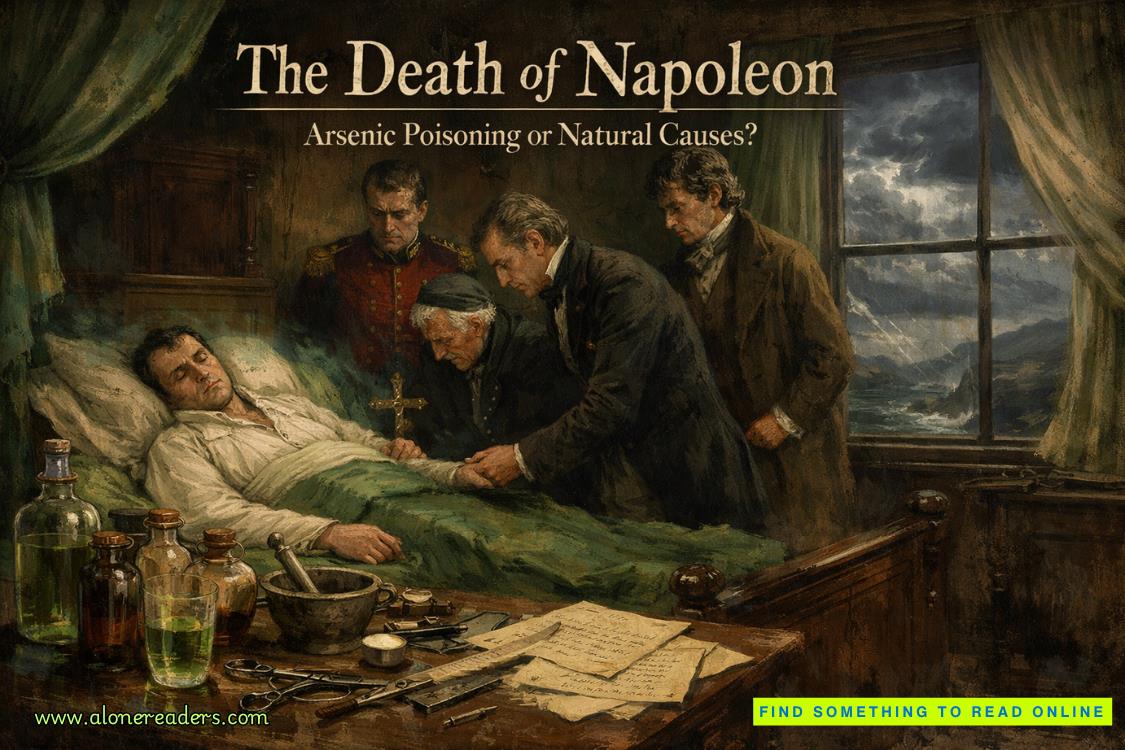
Napoleon Bonaparte, one of history’s most formidable military and political figures, died on 5 May 1821 on the remote island of Saint Helena. His death at the age of fifty-one ended a life that had reshaped Europe and altered the trajectory of global history. Yet, more than two centuries later, the circumstances surrounding his final illness continue to provoke debate. The central question persists with remarkable intensity: did Napoleon die of natural causes, or was he slowly poisoned with arsenic? This controversy has become one of the most enduring topics within historical conspiracy theories, fueled by medical anomalies, political intrigue, and evolving scientific interpretations.
Following his defeat at Waterloo in 1815, Napoleon surrendered to the British and was exiled to Saint Helena, a bleak volcanic island in the South Atlantic chosen precisely for its isolation. Longwood House, his residence, was damp, poorly ventilated, and plagued by mold. Napoleon arrived already weakened by years of relentless campaigning, stress, and prior health issues. From the outset, his captivity was marked by tension with his British handlers, particularly Governor Sir Hudson Lowe. Napoleon viewed his confinement as harsh and humiliating, while British authorities feared escape attempts or political manipulation. This atmosphere of distrust later became fertile ground for suspicions surrounding his death.
During the final years of his life, Napoleon suffered from chronic abdominal pain, nausea, vomiting, loss of appetite, swelling of the legs, and profound weakness. Witnesses noted his progressive emaciation and recurring gastric distress. His symptoms worsened steadily during the months leading up to his death, leaving him bedridden for extended periods. At the time, medical knowledge was limited, and diagnostic tools were rudimentary. Treatments often involved purgatives, enemas, and mercury-based compounds, which may have aggravated his condition rather than alleviating it.
The official autopsy was conducted the day after Napoleon’s death by several physicians, including his personal doctor, Francesco Antommarchi, and British medical officers. The findings described a severely diseased stomach, with what appeared to be a malignant lesion or ulcer near the pylorus. The stomach wall was reportedly thickened and hardened, consistent with advanced gastric cancer. Notably, Napoleon’s father had died of stomach cancer, lending weight to the theory of a hereditary condition. For much of the nineteenth and early twentieth centuries, this explanation was widely accepted as the definitive cause of death.
However, doubts began to surface as historians scrutinized inconsistencies in eyewitness accounts and medical records. The autopsy description was detailed but lacked microscopic confirmation, which was impossible at the time. Moreover, some observers questioned whether Napoleon’s symptoms fully aligned with terminal stomach cancer. His fluctuating condition, periods of apparent recovery, and certain physical signs did not neatly fit the expected progression of the disease, prompting renewed interest in alternative explanations.
The arsenic poisoning theory emerged prominently in the mid-twentieth century, transforming the debate. In the 1960s, researchers analyzing samples of Napoleon’s hair reported elevated levels of arsenic, far exceeding what would normally be expected. Since arsenic was a known poison historically used for discreet assassinations, this discovery electrified both scholars and the public. The idea that Napoleon may have been deliberately poisoned appealed to those who believed his enemies had motive and opportunity, even in exile.
Supporters of the poisoning theory point to several factors. Arsenic poisoning can produce gastrointestinal symptoms similar to those Napoleon experienced, including abdominal pain, vomiting, and weakness. Chronic exposure may also cause hair loss, skin changes, and swelling of extremities, all reportedly observed in Napoleon’s final years. The presence of arsenic in multiple hair samples taken at different times suggested long-term exposure rather than a single lethal dose, reinforcing the notion of slow poisoning.
Speculation quickly turned to potential perpetrators. The British government, wary of Napoleon’s enduring influence, is often implicated in conspiracy narratives. Others suspect individuals within Napoleon’s household, such as servants or companions who may have been bribed or coerced. Even internal rivalries among his loyalists have been suggested. These theories thrive on the idea that Napoleon, though defeated, remained too dangerous to be allowed a natural death.
Yet, the arsenic evidence itself has been vigorously contested. Arsenic was surprisingly common in the nineteenth century. It was present in medicines, cosmetics, pesticides, and even wallpapers. The distinctive green pigment used in wallpaper of the era contained arsenic compounds that could release toxic fumes in damp conditions. Longwood House, with its moisture-laden walls, may have exposed Napoleon to environmental arsenic without any malicious intent. This explanation accounts for chronic exposure while removing the necessity of a calculated assassination plot.
Further complicating the issue, later studies found that arsenic levels in Napoleon’s hair were consistent across samples taken from different stages of his life, including periods long before his exile. This finding undermines the argument that arsenic exposure was unique to Saint Helena or linked specifically to his death. If arsenic was present throughout his life, it becomes less persuasive as the decisive cause of his final illness.
Modern toxicological analysis has also cast doubt on the poisoning theory. The pattern and concentration of arsenic found in Napoleon’s hair do not conclusively match known cases of fatal chronic arsenic poisoning. Moreover, key symptoms such as severe neurological damage or characteristic skin lesions were not consistently documented. While arsenic exposure may have contributed to his overall poor health, many experts argue it was unlikely to be the primary cause of death.
The natural causes theory, particularly stomach cancer, has regained support in recent decades through retrospective medical analysis. Napoleon’s family history, the autopsy findings, and the nature of his symptoms align strongly with advanced gastric carcinoma. His persistent gastric pain, progressive weight loss, and eventual gastrointestinal bleeding are hallmarks of the disease. Additionally, the stress of exile, depression, and inadequate medical treatment would have accelerated his decline.
Another important factor often overlooked is the medical intervention Napoleon received. He was administered calomel, a mercury-based laxative commonly used at the time. Shortly before his death, he was given a large dose that caused severe diarrhea and dehydration. Some historians believe this treatment may have hastened his death, weakening an already frail body. While not malicious, such interventions highlight the dangers of early nineteenth-century medicine.
The debate over Napoleon’s death is as much about historical interpretation as it is about medical evidence. Conspiracy theories often flourish where documentation is incomplete and political motives are plausible. Napoleon’s towering legacy and dramatic downfall make him an ideal subject for suspicion and intrigue. The idea that such a monumental figure could be quietly eliminated adds narrative power, even if the evidence remains inconclusive.
What makes this controversy particularly enduring is the intersection of science and history. Advances in forensic analysis have allowed researchers to revisit centuries-old questions with new tools, yet these tools also introduce new uncertainties. Hair analysis, for example, can reveal exposure but not intent. Medical records provide clues but lack the precision of modern diagnostics. As a result, each new study seems to reopen the case rather than close it.
Public fascination with the mystery also reflects broader cultural themes. Napoleon symbolizes ambition, power, and the fragility of greatness. His lonely death on a distant island stands in stark contrast to his earlier dominance of Europe. Whether he died naturally or was poisoned, the image of a fallen emperor suffering in exile resonates deeply, encouraging reinterpretation and debate.
Among contemporary historians and medical experts, a cautious consensus has emerged. While arsenic exposure was likely part of Napoleon’s environment and may have contributed to his discomfort, the most plausible primary cause of death remains natural illness, most likely stomach cancer compounded by stress and medical mismanagement. This conclusion does not entirely dismiss the poisoning theory but places it within a broader context of nineteenth-century living conditions and medical practices.
Ultimately, the death of Napoleon exemplifies how history resists simple answers. The absence of definitive proof allows competing narratives to coexist, each shaped by the priorities and assumptions of those who tell them. For some, the poisoning theory satisfies a desire for dramatic justice or intrigue. For others, the natural causes explanation underscores the vulnerability of even the most powerful individuals to disease and decline.
More than two hundred years after his death, Napoleon continues to command attention, not only for his achievements but also for the unresolved questions that surround his final days. The debate over arsenic poisoning versus natural causes remains a compelling reminder that history is not merely a record of events, but an ongoing investigation, shaped by evidence, interpretation, and imagination.




 The Hundred Days Offensive: How the Allies Defeated Germany in World War I
 The Second Battle of the Marne: The Turning Point of World War I in 1918
 The Spring Offensive of 1918: Germany's Final Gamble to Win World War I
 The Treaty of Brest-Litovsk: How Russia Left World War I
 The Russian Revolution and World War I: How War Brought Down the Tsar
 The Zimmermann Telegram Explained: Germany's Secret Offer to Mexico in World War I