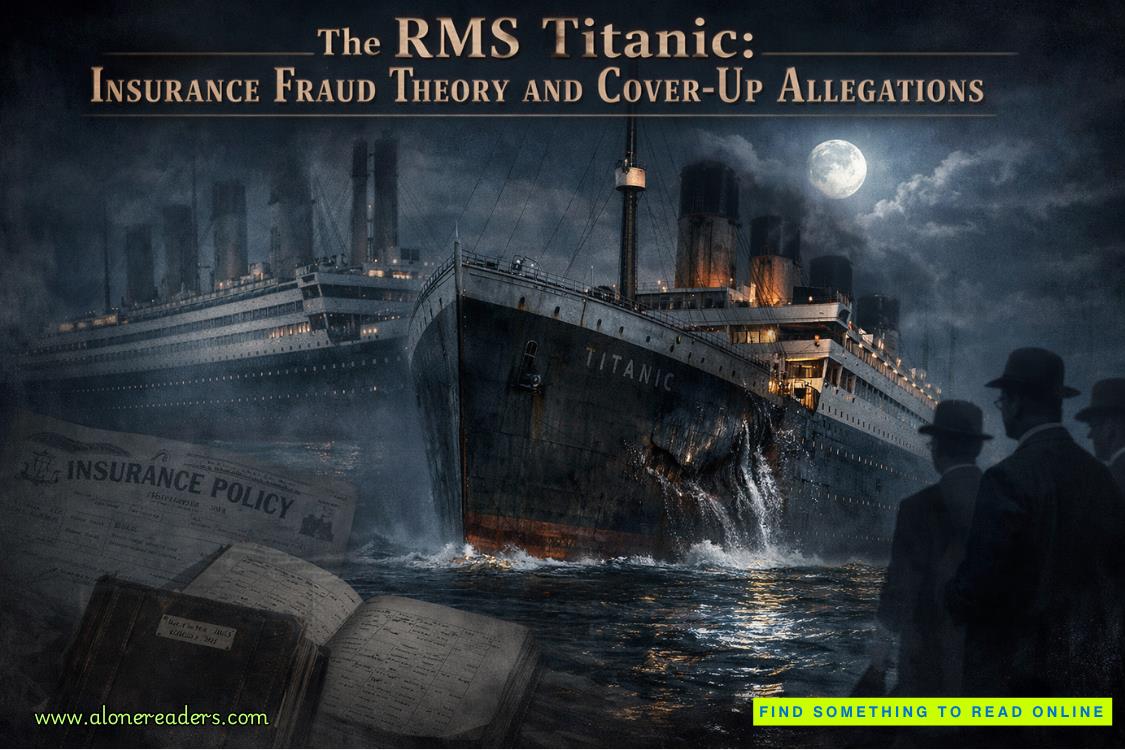
The sinking of the RMS Titanic in April 1912 has long stood as one of the most tragic maritime disasters in human history. Officially described as an unfortunate convergence of human error, natural conditions, and technological overconfidence, the loss of more than 1,500 lives has been etched into collective memory as a solemn lesson of hubris. Yet beneath this widely accepted narrative lies a persistent and controversial alternative interpretation: the insurance fraud theory, which claims that the Titanic disaster was not an accident at all, but the culmination of a calculated deception orchestrated by powerful financial interests.
At the core of this theory is the assertion that the ship that sank was not the RMS Titanic, but her near-identical sister ship, the RMS Olympic. Proponents argue that the Olympic, severely damaged in a collision prior to 1912 and allegedly underinsured, was secretly swapped with the Titanic to allow White Star Line and its financiers to collect a substantial insurance payout. According to this view, the tragedy was either recklessly enabled or deliberately allowed to unfold, with human lives treated as collateral in a scheme to salvage financial losses.
To understand why such a theory persists, one must first examine the financial and corporate environment surrounding the White Star Line in the early twentieth century. The company, owned by American banking magnate J.P. Morgan through his conglomerate International Mercantile Marine, was locked in intense competition with rival shipping lines. Building the Olympic-class liners was an enormous financial gamble. These ships represented not just technological marvels but massive capital investments, stretching budgets and exposing companies to catastrophic risk should anything go wrong.
The RMS Olympic, launched in 1911, quickly became a financial liability. Shortly after entering service, she collided with the British warship HMS Hawke. Though officially repaired, critics of the official account insist the damage was more extensive than publicly acknowledged. The Olympic was allegedly rendered structurally compromised, affecting her long-term safety and commercial viability. Compounding the problem, insurance coverage reportedly fell short of covering a total loss, placing White Star Line in a precarious financial position.
The Titanic, meanwhile, was nearing completion. She was insured for a significantly higher amount, reflecting her status as a brand-new flagship and symbol of modern engineering. The insurance fraud theory posits that at this moment, an opportunity emerged. Since the two ships were nearly identical in appearance, configuration, and internal layout, a covert swap could theoretically be executed by altering nameplates, interior fittings, and documentation. The damaged Olympic could then sail under the name Titanic, be deliberately lost at sea, and generate an insurance payout sufficient to offset corporate losses.
Supporters of the theory often point to photographic anomalies as circumstantial evidence. They argue that certain porthole arrangements visible in pre-sailing photographs do not align with Titanic’s documented design but instead match Olympic’s configuration. Additionally, some interior features photographed aboard the Titanic appear inconsistent with official blueprints. These discrepancies are cited as signs of last-minute alterations meant to disguise one ship as the other.
The behavior of key figures surrounding the voyage is also scrutinized. J.P. Morgan himself famously canceled his planned journey aboard the Titanic at the last moment, despite being an enthusiastic supporter of the ship. Several other wealthy and influential individuals likewise withdrew shortly before departure. To conspiracy theorists, these absences suggest foreknowledge of impending disaster. While benign explanations exist, the clustering of cancellations among elite passengers continues to fuel suspicion.
Further reinforcing the theory is the matter of safety provisions. The Titanic carried lifeboats sufficient for only about half of those onboard, a decision justified at the time by outdated maritime regulations. However, critics argue that if a deliberate loss was anticipated, minimal safety compliance would align with a mindset prioritizing financial recovery over human survival. The fact that Titanic was traveling at high speed through an iceberg-laden region is interpreted as recklessness at best and intentional risk escalation at worst.
The aftermath of the disaster provides additional material for conspiracy claims. Official inquiries in both Britain and the United States concluded that the sinking resulted from an iceberg collision compounded by navigational errors. Yet these investigations were conducted under immense political and public pressure, with reputations, industries, and national pride at stake. Proponents of the fraud theory argue that a full exposure of corporate negligence or deliberate wrongdoing would have been unthinkable, necessitating a carefully managed narrative.
Insurance payouts further complicate the picture. White Star Line received compensation close to the insured value of Titanic, easing the company’s financial burden. Though this alone does not prove fraud, critics contend that the timing and scale of the payout aligned too conveniently with White Star Line’s financial needs. They also note that no criminal proceedings were ever pursued against company executives, despite systemic failures in safety and decision-making.
Skeptics of the insurance fraud theory counter that such a conspiracy would have required the silence and cooperation of hundreds of workers, engineers, officers, and officials. They argue that no credible documentary evidence supports the ship swap claim and that the logistical complexity of such an operation would have made secrecy impossible. From this perspective, the theory relies heavily on selective interpretation of data and post-hoc reasoning.
Yet conspiracy proponents respond that power structures in the early twentieth century were highly centralized, and corporate secrecy was far easier to maintain than in the modern era. Workers were often bound by strict contracts, financial dependence, and limited mobility. Records could be altered, destroyed, or selectively released without digital redundancy. In this environment, they argue, a controlled narrative could be sustained, especially when reinforced by tragedy and public emotion.
Another aspect often cited is the discovery of the wreck itself in 1985. Some theorists claim that structural features observed in the wreckage more closely resemble Olympic than Titanic. Differences in steel plating, window spacing, and internal bulkheads are highlighted as potential identifiers. While mainstream experts attribute these observations to design modifications made during construction, the debate remains unresolved in the minds of conspiracy adherents.
The enduring appeal of the Titanic insurance fraud theory lies not only in the mystery of the ship’s identity but in what it represents symbolically. It reflects deep skepticism toward corporate power, elite privilege, and official narratives. The idea that wealthy industrialists might sacrifice lives for profit resonates strongly in an age shaped by financial scandals and institutional distrust. Titanic, in this interpretation, becomes more than a maritime disaster; it becomes an allegory of unchecked capitalism and moral decay.
Importantly, belief in the theory does not necessarily imply denial of the tragedy’s human cost. Many who explore these allegations do so precisely because they believe the victims deserve truth rather than myth. They argue that romanticized retellings of heroism and fate may obscure systemic failures and ethical breaches that remain relevant today.
Whether the insurance fraud theory is ultimately true or false, its persistence highlights gaps between official history and public trust. The Titanic story continues to evolve not because new icebergs are discovered, but because each generation re-examines power, accountability, and the price of progress. As long as unanswered questions remain and institutions resist transparency, alternative interpretations will continue to surface.
In the final analysis, the RMS Titanic insurance fraud theory occupies a space between speculation and skepticism, fueled by circumstantial evidence, historical ambiguity, and cultural unease. It challenges readers to question not only what happened on a cold April night in 1912, but how narratives are constructed, preserved, and defended. The true legacy of the Titanic may not lie solely at the bottom of the Atlantic, but in the ongoing struggle to discern truth in the shadow of authority, wealth, and silence.



 The Hundred Days Offensive: How the Allies Defeated Germany in World War I
 The Second Battle of the Marne: The Turning Point of World War I in 1918
 The Spring Offensive of 1918: Germany's Final Gamble to Win World War I
 The Treaty of Brest-Litovsk: How Russia Left World War I
 The Russian Revolution and World War I: How War Brought Down the Tsar
 The Zimmermann Telegram Explained: Germany's Secret Offer to Mexico in World War I










