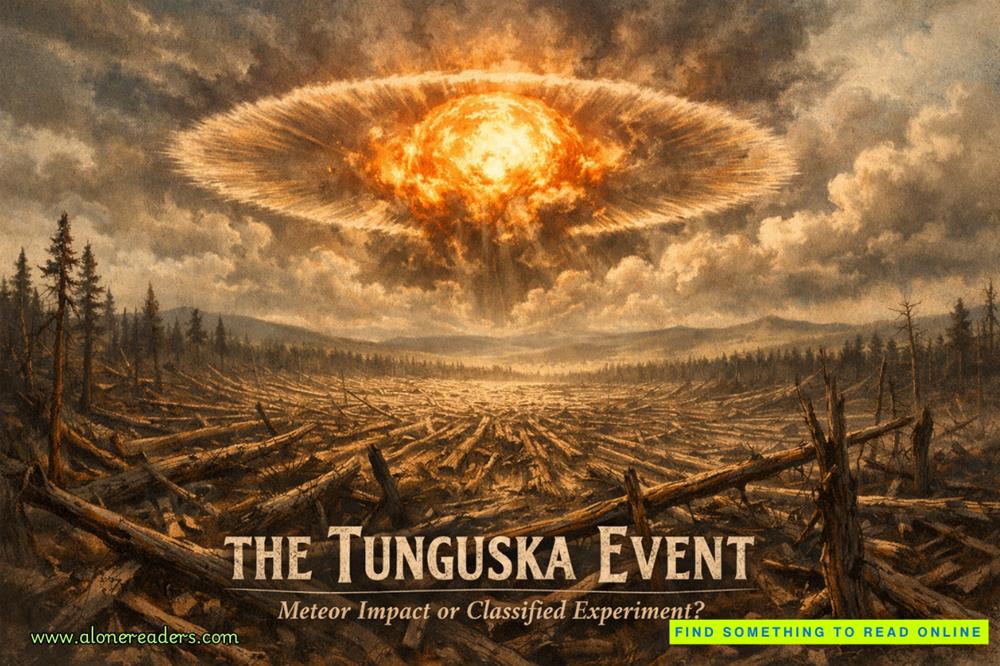
In the early morning hours of June 30, 1908, an immense explosion tore through the remote taiga of central Siberia, near the Podkamennaya Tunguska River. The blast was so powerful that it flattened an estimated eighty million trees across an area of more than two thousand square kilometers, an expanse larger than many modern cities. Witnesses reported a blinding flash, intense heat, and a deafening roar that echoed hundreds of kilometers away. Shockwaves shattered windows in distant towns, knocked people off their feet, and were detected by seismic instruments across Eurasia. Even today, more than a century later, the Tunguska Event remains one of the most enigmatic natural disasters in recorded history, straddling the boundary between established science and persistent speculation.
What makes Tunguska uniquely compelling is not only the sheer scale of destruction but also what investigators did not find. There was no visible impact crater, no large fragments of rock or metal, and no clear physical remnant that could be easily cataloged. This absence immediately set Tunguska apart from other known meteor impacts and opened the door to alternative interpretations. For decades, scientists struggled to explain how such devastation could occur without leaving behind the unmistakable geological scars associated with an asteroid collision. This uncertainty transformed Tunguska into fertile ground for historical conspiracy theories, classified experiment hypotheses, and more exotic explanations involving advanced technology or unknown forms of energy.
Eyewitness accounts collected years later paint a vivid and unsettling picture. Indigenous Evenki people described the sky splitting in two, followed by fire raining down from above. Some claimed they felt intense heat that burned their skin even at great distances. A farmer hundreds of kilometers away recalled being thrown from his porch by the shockwave, while another witness likened the sound to repeated cannon fire. These testimonies, though fragmented and sometimes contradictory, consistently emphasize the extraordinary violence and suddenness of the event. Importantly, many accounts suggest the explosion occurred in the air, not on the ground, a detail that would later prove central to scientific interpretations.
For nearly two decades after 1908, the Tunguska region remained largely unexplored by scientists. Political instability, the vast remoteness of Siberia, and the logistical challenges of travel delayed formal investigation. It was not until the late 1920s that Soviet researcher Leonid Kulik led the first major expeditions into the affected area. What Kulik discovered only deepened the mystery. Trees were found lying flattened in a distinctive radial pattern, all pointing away from a central epicenter, yet standing at the center were charred, branchless trunks still rooted upright, as if scorched by an immense burst of heat from above. This peculiar arrangement strongly suggested an airburst rather than a ground impact.
The prevailing scientific explanation that emerged over time is that Tunguska was caused by a large meteoroid or comet fragment exploding in the atmosphere, releasing energy equivalent to ten to fifteen megatons of TNT. This would make it comparable to a high-yield nuclear weapon, detonated naturally decades before the atomic age. According to this model, the object entered Earth’s atmosphere at high speed, heated rapidly due to air compression, and disintegrated violently several kilometers above the ground. The resulting shockwave flattened forests and generated intense thermal radiation, but the object itself was largely vaporized, leaving no crater.
While this explanation is widely accepted today, it is not without unresolved questions. The exact composition of the object remains uncertain. Some researchers favor a stony asteroid, while others argue for a comet composed primarily of ice and dust, which would better explain the lack of solid debris. Traces of microscopic particles rich in nickel and other extraterrestrial elements have been found in the soil and tree resin, lending support to an косmic origin. Yet the ambiguity of the physical evidence has ensured that doubt never fully disappeared, especially outside strictly scientific circles.
Into this uncertainty stepped a range of alternative theories, many of which fall under the umbrella of historical conspiracy theories. One of the most persistent ideas is that Tunguska was the result of a classified human experiment, possibly involving early energy weapons or prototype technologies. Proponents of this view often point to the timing of the event, occurring during an era of rapid scientific experimentation and secretive military research. They speculate that an experimental device, perhaps involving electrical or electromagnetic energy, malfunctioned catastrophically over Siberia, a region chosen precisely because of its isolation.
Some versions of this theory connect Tunguska to the work of Nikola Tesla, the brilliant and controversial inventor known for his experiments with wireless energy transmission. According to this narrative, Tesla may have tested a powerful energy beam intended to demonstrate long-distance power delivery, inadvertently causing the Siberian explosion. Supporters highlight Tesla’s documented claims of transmitting enormous amounts of energy through the atmosphere and his interest in global-scale experiments. However, no credible historical evidence directly links Tesla to Tunguska, and most historians regard this theory as speculative at best.
Another line of conspiracy thinking proposes that Tunguska was caused by a natural but unknown terrestrial phenomenon, such as a massive release of methane gas from beneath the Earth’s crust or an unusual geophysical explosion. Siberia is rich in natural gas reserves, and methane is highly explosive under the right conditions. In this scenario, a sudden ignition of atmospheric methane could have produced a powerful blast without leaving a crater. While intriguing, this idea struggles to explain the observed airburst characteristics and the downward-directed shockwave implied by the tree patterns.
More exotic theories venture even further from mainstream science, suggesting that Tunguska was the result of extraterrestrial technology, such as a spacecraft explosion or a deliberate intervention to prevent an asteroid from striking Earth. Advocates of this view argue that the object may have altered course or detonated intentionally, accounting for the lack of impact debris. These claims often draw on Cold War-era secrecy and later fascination with unidentified flying objects. However, they rely heavily on conjecture and reinterpretations of eyewitness testimony rather than verifiable evidence.
What sustains these theories is not merely a fascination with the unusual, but a deeper cultural pattern. The Tunguska Event occurred at a time when scientific understanding of cosmic impacts was limited, and it predated the nuclear age, making its energy scale difficult for early observers to comprehend. As a result, explanations involving hidden forces or secret technologies felt plausible to many. Even today, the idea that such a massive explosion could occur without a clear cause challenges intuitive expectations, leaving psychological space for alternative narratives to flourish.
Modern scientific analysis has continued to refine the meteor airburst model. Computer simulations demonstrate that an object tens of meters in diameter, traveling at cosmic velocities, could indeed produce the observed damage if it disintegrated in the atmosphere. Comparisons are often drawn to the 2013 Chelyabinsk meteor, which exploded over Russia with far less energy but still injured over a thousand people due to shattered glass. Chelyabinsk provided direct contemporary confirmation that airbursts are real, powerful, and potentially devastating, lending strong support to the Tunguska explanation as a natural cosmic event.
Yet Tunguska remains unique in its scale and circumstances. The remoteness of the location meant there were no photographs, no immediate measurements, and no rapid scientific response. This gap between event and investigation allowed myths to take root and persist. In the absence of definitive artifacts, each new generation has reinterpreted Tunguska through the lens of its own fears and fascinations, whether they be secret weapons, lost technologies, or visitors from beyond Earth.
From a historical perspective, the Tunguska Event occupies a liminal space between natural disaster and cultural myth. It serves as a reminder of Earth’s vulnerability to cosmic forces, long before modern planetary defense initiatives existed. At the same time, it illustrates how human societies respond to unexplained phenomena, often filling gaps in knowledge with narratives that reflect broader anxieties about power, secrecy, and control. In this sense, Tunguska is as much a psychological and cultural event as it is a physical one.
When evaluated critically, the classified experiment theories lack substantiated evidence and rely heavily on coincidence and speculation. No historical documents, credible witnesses, or technological records support the existence of a human-made device capable of producing such an explosion in 1908. By contrast, the meteor airburst hypothesis aligns with known physics, geological findings, and comparative modern events. Scientific uncertainty does not equate to equal plausibility among all explanations, a distinction often blurred in conspiracy discourse.
Nevertheless, dismissing the conspiracies entirely would miss an important point. They reveal how extraordinary events challenge established frameworks and invite imaginative reinterpretation. The endurance of these theories speaks to a broader human tendency to seek intentional causes behind catastrophic occurrences, especially when randomness feels unsatisfying or frightening. Tunguska’s mystery endures not because science has failed, but because the event itself sits at the outer edge of everyday experience.
More than a century later, the Siberian forest has largely recovered. Trees once flattened have regrown, and the scars of destruction are visible mainly in subtle ecological patterns and satellite imagery. Yet the intellectual and cultural impact of Tunguska has not faded. It continues to inspire research, debate, fiction, and speculation, bridging the worlds of astrophysics and historical conspiracy theory.
Ultimately, the question posed by the Tunguska Event—meteor impact or classified experiment—reflects a deeper inquiry into how we interpret the unknown. While the weight of evidence strongly favors a natural cosmic origin, the absence of absolute proof ensures that alternative ideas will persist. Tunguska remains a powerful symbol of uncertainty, a moment when the sky itself seemed to turn hostile, and humanity was reminded that not all threats come with warning or explanation.





 The Hundred Days Offensive: How the Allies Defeated Germany in World War I
 The Second Battle of the Marne: The Turning Point of World War I in 1918
 The Spring Offensive of 1918: Germany's Final Gamble to Win World War I
 The Treaty of Brest-Litovsk: How Russia Left World War I
 The Russian Revolution and World War I: How War Brought Down the Tsar
 The Zimmermann Telegram Explained: Germany's Secret Offer to Mexico in World War I










