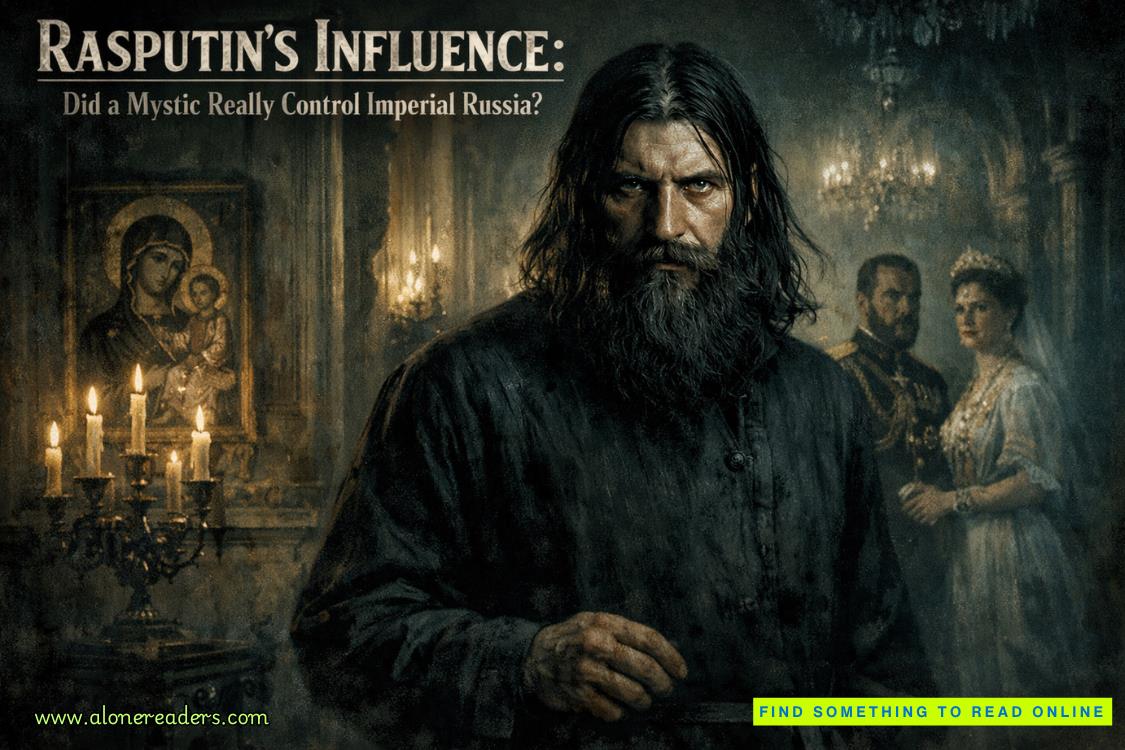
Few figures in modern history provoke as much fascination, controversy, and outright disbelief as Grigori Yefimovich Rasputin, the Siberian peasant mystic who rose from obscurity to the very heart of the Russian imperial court. His name has become synonymous with dark influence, political manipulation, and supernatural power, often portrayed as a sinister puppet master who controlled the fate of Imperial Russia through occult means and psychological domination. The enduring question remains: did Rasputin truly control Imperial Russia, or is his reputation a product of fear, rumor, and historical exaggeration?
Born in 1869 in a remote Siberian village, Rasputin’s early life was marked by poverty, illiteracy, and religious wandering. He was not formally trained as a monk, nor was he ordained by the Russian Orthodox Church, yet he cultivated an image of a holy man endowed with divine insight. In a deeply religious society gripped by social unrest, spiritual anxiety, and political uncertainty, Rasputin’s brand of mysticism found fertile ground. His rise coincided with the waning years of the Romanov dynasty, a period when the Russian monarchy was increasingly isolated from its people and desperate for hope.
The turning point in Rasputin’s life came when he was introduced to the imperial family, particularly Empress Alexandra Feodorovna, who was emotionally fragile, intensely religious, and tormented by the illness of her only son and heir, Tsarevich Alexei. Alexei suffered from hemophilia, a condition poorly understood at the time and often fatal. Every minor injury could result in uncontrollable bleeding, plunging the imperial family into cycles of fear and despair. Traditional medicine failed repeatedly, and the doctors could offer little reassurance. Into this void stepped Rasputin, whose prayers and presence appeared to coincide with periods of improvement in the boy’s condition.
Whether through psychological calming, the cessation of harmful medical treatments, or sheer coincidence, Rasputin gained a reputation within the palace as a miracle healer. For Empress Alexandra, this was no mere coincidence but evidence of divine intervention. She became convinced that Rasputin was chosen by God to protect her son and, by extension, the Russian monarchy. This belief forged an unbreakable bond between the empress and the mystic, granting Rasputin unprecedented access to the royal household.
From this point onward, rumors began to swirl. Whispers spread through aristocratic salons and military circles that Rasputin wielded extraordinary influence over imperial decisions. His unrefined manners, scandalous behavior, and rumored sexual exploits clashed violently with the rigid decorum of the Russian court. To many nobles, he embodied everything that was wrong with the monarchy: incompetence, moral decay, and dangerous detachment from reality. Yet despite repeated warnings, Tsar Nicholas II and Empress Alexandra refused to dismiss him.
The perception of Rasputin as a political manipulator intensified during World War I, when Tsar Nicholas II took personal command of the Russian army and left the capital in the hands of Alexandra. During this period, Rasputin’s proximity to the empress placed him at the center of state affairs. He offered advice on ministerial appointments, government policies, and even military strategy. While there is no evidence that he held formal power, his recommendations were often followed, leading many contemporaries to believe that Russia was effectively being governed by a mystic.
It is crucial, however, to separate actual influence from perceived omnipotence. Rasputin did not draft laws, command troops, or control the bureaucracy. His influence operated through personal trust rather than institutional authority. The empress valued his opinions because she believed he spoke with divine guidance. In a system already weakened by autocracy and isolation, even informal influence could have dramatic consequences. When ministers were dismissed or appointed following Rasputin’s advice, the public interpreted these actions as proof of his control.
Public resentment toward Rasputin reached unprecedented levels. Newspapers, political cartoons, and underground pamphlets portrayed him as a corrupt demon manipulating the throne. Some accused him of being a German spy, exploiting wartime paranoia and anti-German sentiment toward Empress Alexandra, who was born a German princess. These allegations were never substantiated, yet they further eroded public confidence in the monarchy and amplified the image of Rasputin as a national threat.
The Russian Orthodox Church itself was divided. While some clergy viewed Rasputin as a devout spiritual seeker, others condemned him as a heretic and moral degenerate. Reports of drunkenness, womanizing, and blasphemous teachings circulated widely. Whether exaggerated or accurate, these stories reinforced the belief that the imperial family had fallen under the spell of a dangerous charlatan. In reality, Rasputin embodied a contradiction: a man capable of genuine spiritual comfort and profound moral hypocrisy.
The conspiracy theories surrounding Rasputin intensified after his assassination in December 1916. A group of aristocrats, convinced that killing Rasputin would save Russia, lured him into a plot that quickly became legendary. Accounts of his death describe poisoning, shooting, beating, and drowning, often embellished to suggest he possessed supernatural resilience. These dramatic narratives cemented his mythic status and obscured the mundane political motivations behind the murder.
Rasputin’s death did not save the monarchy. Within months, the Russian Revolution swept away the Romanov dynasty entirely. In hindsight, this has fueled speculation that Rasputin was not the cause of Russia’s collapse but a symptom of a deeply broken system. The monarchy’s reliance on a mystic reflected its desperation, isolation, and inability to engage with the realities of modern governance.
Historians increasingly argue that Rasputin’s influence has been overstated. He did not single-handedly doom Imperial Russia, nor did he possess mystical control over its leaders. However, the belief in his power had real consequences. Perception became reality in a society already on the brink of upheaval. The monarchy’s refusal to distance itself from Rasputin symbolized its detachment from public opinion and accelerated its loss of legitimacy.
At the same time, it would be a mistake to dismiss Rasputin as merely a misunderstood healer or harmless eccentric. His presence at court exacerbated existing tensions, undermined trust in leadership, and provided revolutionary movements with powerful propaganda. He became a living embodiment of imperial decay, a figure onto whom all anxieties, frustrations, and fears could be projected.
The enduring fascination with Rasputin lies not only in his life but in what he represents. He occupies a space between history and myth, where documented events blur into legend. His story raises uncomfortable questions about the nature of power, the role of belief in political decision-making, and the vulnerability of institutions when leaders become isolated from reality. In that sense, Rasputin’s influence was less about control and more about exposure. He exposed the fragility of a regime that mistook faith for governance and loyalty for competence.
In evaluating whether Rasputin truly controlled Imperial Russia, the answer lies in nuance. He was neither a sorcerer pulling invisible strings nor an innocent victim of aristocratic paranoia. He was a deeply flawed individual who gained influence through personal trust in a moment of national crisis. His power was real but limited, amplified by fear, rumor, and the symbolic weight of a collapsing empire.
Ultimately, Rasputin did not destroy Imperial Russia, but he stood at the crossroads of its downfall. His rise and fall illuminate how conspiracy theories are born, how charisma can distort judgment, and how societies in crisis seek supernatural explanations for human failures. The myth of Rasputin endures because it offers a compelling narrative of mystery and manipulation, yet the reality is far more unsettling: the fate of Imperial Russia was decided not by a mystic, but by systemic decay, war, and the tragic miscalculations of those in power.
In that light, Rasputin’s true legacy is not one of domination, but of warning. He serves as a historical reminder that when leadership abandons reason for belief, and governance yields to desperation, even the most powerful empires can fall under the shadow of their own illusions.





 The Hundred Days Offensive: How the Allies Defeated Germany in World War I
 The Second Battle of the Marne: The Turning Point of World War I in 1918
 The Spring Offensive of 1918: Germany's Final Gamble to Win World War I
 The Treaty of Brest-Litovsk: How Russia Left World War I
 The Russian Revolution and World War I: How War Brought Down the Tsar
 The Zimmermann Telegram Explained: Germany's Secret Offer to Mexico in World War I