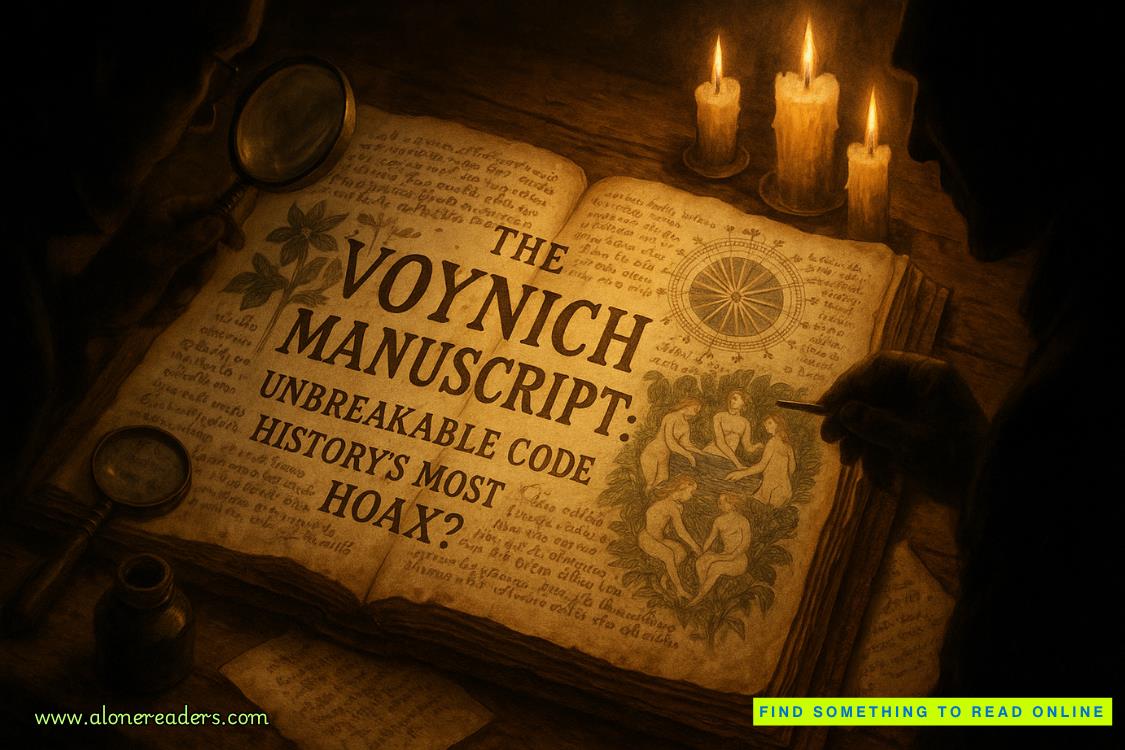
From the moment the Voynich Manuscript reappeared in the early twentieth century, it has stood as one of history’s most perplexing enigmas. Filled with unknown symbols, impossible botanical drawings, cosmic diagrams, and bathing women suspended in strange green liquids, this manuscript has resisted every attempt at translation or scientific decoding. For over a century, cryptographers, medievalists, linguists, mathematicians, intelligence agencies, and even artificial intelligence systems have scrutinized the document, only to arrive at the same conclusion: no one knows what it means. This enduring confusion has fueled two dominant possibilities—either it contains a genuine unbroken code or it is the most successful academic hoax ever produced. The manuscript sits at the strange intersection of philology, cryptography, art history, and conspiracy theory, making it a perfect candidate for historical fascination.
The manuscript, named after rare-book dealer Wilfrid Voynich, who acquired it in 1912, consists of over two hundred vellum pages written in a script unlike any alphabet known to human history. The writing flows naturally, seemingly following linguistic rules, yet it corresponds to no recorded language. The pages are accompanied by illustrations that appear scientific but ultimately defy classification. Strange plants made of mismatched roots and leaves, circular astronomical diagrams filled with zodiac signs that do not match known medieval traditions, and unsettling images of women immersed in tubular, organic structures have long suggested that the manuscript is either a deeply encoded scientific document or a masterpiece of intentional nonsense. It is this contradiction—highly organized yet wholly incomprehensible—that continues to captivate the world.
What makes the Voynich Manuscript uniquely confounding is the apparent consistency of its language. Linguists have noted that certain patterns in the script resemble those found in natural languages, such as repeated prefixes, suffixes, and structural rules that mimic grammar. Yet the absence of identifiable vocabulary raises a troubling question: how can a text behave like a real language without corresponding to any known linguistic family? To some researchers, this suggests the manuscript might encode a natural language through a cipher so sophisticated that it remains unbroken even in the age of computers. To others, the manuscript’s statistical consistency is precisely what makes it suspicious—a skilled forger may mimic the structure of language without conveying any actual meaning, simply by reproducing natural linguistic rhythms.
The illustrations deepen the mystery. The botanical section presents more than a hundred plants, none of which exist in nature. While some claim to see partial similarities to Mediterranean flora, most scholars agree that the composite nature of the drawings—roots that belong to one species and leaves that belong to another—indicates invention rather than documentation. If the book is genuine, this suggests a herbalist exploring unknown or extinct species, or perhaps coding real plants through symbolic combinations. If it is a hoax, these plants represent an imaginative designer who understood that the illusion of scientific legitimacy required visual complexity, even if accuracy was unnecessary.
The so-called astronomical and cosmological diagrams provide another layer of uncertainty. Spirals, wheels, concentric circles, and strange star maps imply celestial study or esoteric mysticism. Some pages contain zodiac symbols but arranged in unfamiliar sequences, possibly hinting at a lost cosmological tradition. Yet the diagrams lack mathematical annotations or recognizable astronomical theories, making them difficult to interpret as true scientific charts. The ambiguity leaves space for countless interpretations, from alchemical cosmology to extraterrestrial observation, depending on how far one is willing to stretch historical assumptions.
Perhaps the most controversial section of the Voynich Manuscript is the so-called “balneological” or bathing section. Dozens of naked women immerse themselves in green, flowing pools connected by organic pipes and biological channels. Some appear pregnant. Others hold tubes that merge with star-like structures above. The imagery is strange—too detailed to be random but too illogical to represent any known medieval medical practice. Those who argue for authenticity claim the images may depict ancient gynecological treatments, fertility rituals, or symbolic representations of bodily humors. Those who argue for fraud see the section as intentional absurdity—an elaborate fantasy meant to distract the viewer from the possibility that the text itself says nothing at all.
Despite the manuscript’s bizarre nature, the possibility of it being an encoded scientific treatise cannot be dismissed entirely. Medieval Europe had a long tradition of cryptic alchemical manuscripts, many of which employed symbolic art and coded language to conceal exclusive knowledge. Secret medical knowledge, particularly relating to women’s health, was also sometimes disguised due to cultural taboos. If the Voynich Manuscript truly encodes such information, the complexity of its script suggests that it was intended only for a initiated readership. In that case, the illustrations may act as mnemonic devices, symbolic metaphors, or visual keys for decoding the text.
Yet this argument faces an immediate challenge: why would a medieval scholar invent an entirely new language rather than encrypt an existing one? Most known historical ciphers—from ancient Rome to the Renaissance—modify existing alphabets. The Voynich script has more than twenty unique characters that do not map cleanly onto any known writing system. If it is a cipher, it is one without historical precedent, implying either genius or folly. This raises another possibility: that the manuscript does not encode a real language but a form of constructed language, similar to modern invented languages like Esperanto or Klingon. If so, the manuscript could be the earliest known example of linguistic invention for artistic or philosophical purposes, centuries before such ideas became fashionable.
The hoax theory introduces a different interpretation—one grounded in psychology, economics, and historical context rather than cryptography. According to this view, the Voynich Manuscript may have been created to deceive wealthy collectors, scholars, or even rulers seeking rare knowledge. In the late medieval and Renaissance periods, alchemical fraud was common. Elaborate manuscripts promising secret formulas, magical knowledge, or lost scientific wisdom were often fabricated to extract money from noble patrons. If the Voynich Manuscript is such a creation, it is a remarkably well-executed example. The vellum dates to the early fifteenth century, but this only proves the age of the material, not the age of the writing. A clever forger could have obtained blank vellum pages and filled them with meaningless, yet convincing, content.
Supporters of the hoax theory point to the manuscript’s lack of corrections—hundreds of pages without visible errors, revisions, or scraped parchment. In real medieval manuscripts, scribes regularly corrected mistakes. The Voynich’s pristine consistency may imply that the script has no semantic content, making errors irrelevant. A forger copying random characters could work quickly and smoothly, while a real author encoding meaningful information would naturally make more mistakes. This absence of editing raises suspicion that the manuscript’s creator may have been more concerned with visual impression than communicative accuracy.
Another argument for deception lies in the manuscript’s extraordinary ambiguity. A true scientific or medical text would follow recognizable patterns in structure and categorization. The Voynich Manuscript lacks such clarity. Sections appear grouped by theme—plants, stars, women—but without consistent ordering or explanatory progression. This disorganization could reflect incomplete work, or it could be intentional misdirection, forcing readers into endless speculation. A manuscript designed to appear meaningful while avoiding clear interpretation would look exactly like the Voynich.
Yet the idea of a medieval hoax on this scale also raises questions. Who would have been capable of producing such a sophisticated forgery? The consistent script, imaginative illustrations, and coherent style demonstrate significant artistic skill. Creating over two hundred pages of invented text with no repetition errors would require immense patience and planning. What motive could justify such effort? If the goal was financial gain, why does no historical record document such a transaction? The manuscript’s earliest known reference dates to the seventeenth century, implying it may have circulated privately long before its rediscovery. A hoax usually leaves traces—complaints, accusations, financial records—but the Voynich Manuscript leaves none.
One of the most intriguing aspects of the mystery is how modern cryptographers, including experts who broke wartime codes, have failed to decipher the text. If it is a real cipher, it is unlike any known historical encryption system. If it is fabricated, it still manages to mimic the statistical patterns of real language—something extremely difficult to achieve intentionally. Artificial intelligence has identified patterns but cannot connect them to meaning. The manuscript resists both human and machine interpretation, a rare phenomenon in textual analysis. This resistance lends the manuscript an almost supernatural aura, as if it were a deliberate challenge designed to outlast generations of scholars.
Some alternative theories extend far beyond academic boundaries. These include suggestions that the manuscript represents the surviving knowledge of a lost civilization, that it encodes secret astronomical knowledge from ancient cultures, or even that it reflects communication from non-human intelligence. While such theories lack evidence, the complete absence of explanation encourages speculation. In a world where most historical mysteries eventually find resolution, the Voynich Manuscript stands nearly alone—a text that has preserved its secrecy across centuries of investigation.
The manuscript’s continuing allure lies not simply in its undeciphered script but in what it symbolizes: the limits of human understanding. Modern science prides itself on solving mysteries, yet here is a document that refuses to yield its secrets despite the combined efforts of linguists, historians, mathematicians, chemists, cryptanalysts, and AI. This stubborn opacity forces scholars to confront an uncomfortable possibility—some knowledge may remain forever inaccessible. Whether because its meaning has been genuinely lost to time, or because it never contained meaning in the first place, the Voynich Manuscript stands as a monument to ambiguity.
The debate between genuine code and elaborate hoax will likely persist until a definitive breakthrough emerges—if one is even possible. If the text encodes a lost language or an unrecognized cipher, its decoding could reshape our understanding of medieval science, medicine, or philosophy. If it is a constructed language, it represents an extraordinary work of linguistic creativity. If it is a fraud, it stands as a testament to human ingenuity in deception. In every scenario, the manuscript remains a masterpiece—either of communication or of illusion.
What makes the Voynich Manuscript particularly powerful as a cultural artifact is how it engages the imagination. Readers project their own expectations, fears, hopes, and theories onto its pages. A scientist sees encrypted knowledge. A historian sees forgotten traditions. A skeptic sees deception. A dreamer sees magic. The manuscript becomes a mirror reflecting the psychology of those who study it. This ability to provoke interpretation without providing answers is perhaps why the manuscript endures as one of the world’s most compelling mysteries.
In the end, the question of whether the Voynich Manuscript is an unbreakable code or an elaborate hoax may be less important than what the mystery itself represents. It symbolizes the tantalizing possibility that history still holds secrets powerful enough to defy the modern age. It demonstrates that human curiosity persists even when confronted with the unknown. And it challenges us to consider that meaning may exist even when it cannot be proven. Whether the manuscript contains genuine knowledge or is simply a brilliant illusion, its greatest power lies in its ability to inspire wonder.
Until the day someone cracks the code—or proves once and for all that no code exists—the Voynich Manuscript will remain suspended in uncertainty, residing in that rare space where scholarship meets imagination, where logic meets myth, and where the boundaries of understanding dissolve into pure enigma. That enigma is precisely why the world continues to ask the same question: Is this the world’s most unbreakable cipher, or the greatest intellectual hoax ever devised? And as long as that question remains unanswered, the Voynich Manuscript will continue to stand as history’s most enduring riddle.



 The Hundred Days Offensive: How the Allies Defeated Germany in World War I
 The Second Battle of the Marne: The Turning Point of World War I in 1918
 The Spring Offensive of 1918: Germany's Final Gamble to Win World War I
 The Treaty of Brest-Litovsk: How Russia Left World War I
 The Russian Revolution and World War I: How War Brought Down the Tsar
 The Zimmermann Telegram Explained: Germany's Secret Offer to Mexico in World War I