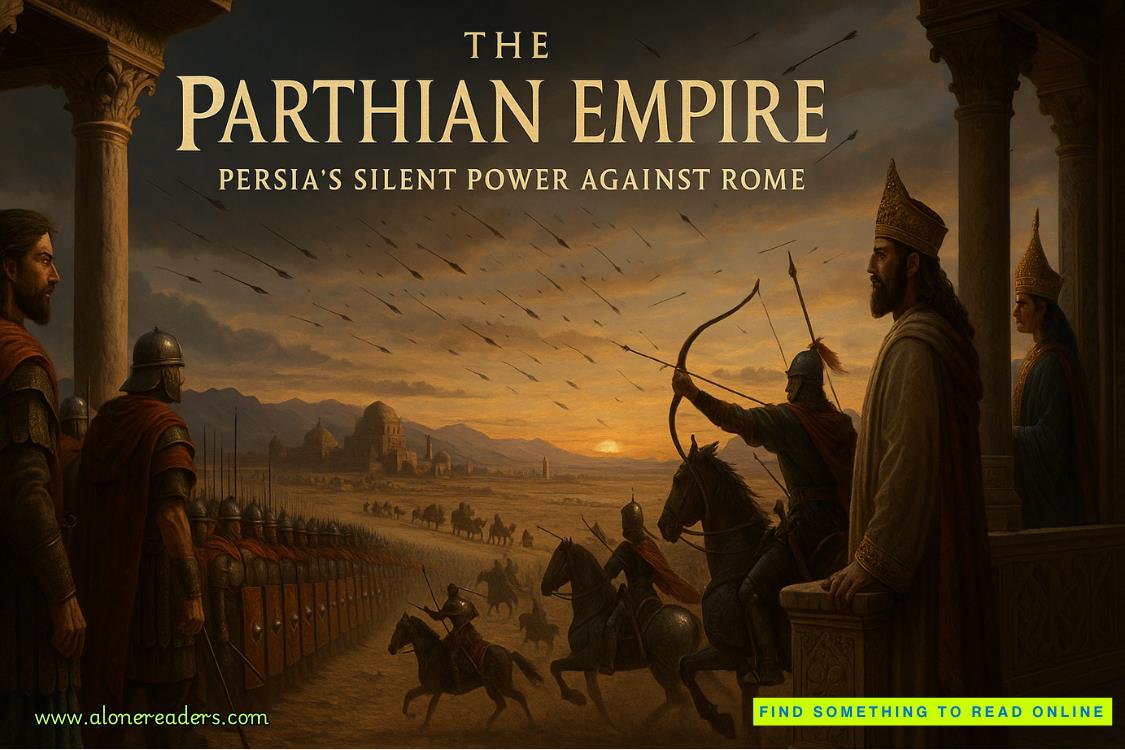
The Parthian Empire is one of those silent powers in history that shaped the fate of Eurasia without ever dominating the popular imagination the way Rome did. For over four centuries, Parthia checked Roman expansion, redirected the flow of global trade, and preserved an independent Persian imperium between the Mediterranean and Central Asia. Far from being a mere footnote between the Achaemenids and the Sasanians, Parthia was the essential bridge empire that ensured Persia remained a sovereign, sophisticated counterweight to Roman ambitions.
Emerging in the mid‑3rd century BCE from the steppe‑Iranian people of Parni, the Arsacid dynasty first seized the province of Parthava from the weakening Seleucid kings and then expanded rapidly into Media and Mesopotamia. At its height, the Parthian realm stretched from central Anatolia and the upper Euphrates across Iran to the frontiers of India and Central Asia, commanding the land arteries of the early Silk Roads. This position was not an accident of geography; it was the strategic foundation of Parthia’s power, giving its kings leverage over both Rome in the west and the Han emperors in the east.
Parthia’s political structure looked very different from the bureaucratic centralization of Rome or Han China. Instead of a tightly controlled provincial system, the Arsacids ruled a federated kingdom of powerful noble houses and semi‑autonomous vassal kings, especially in regions like Armenia, Elymais, and Characene. This aristocratic, almost confederate model made Parthia appear “loose” and chaotic to Roman observers, yet it gave the empire resilience: local elites defended their own interests while still rallying under the Arsacid “King of Kings” when the imperial frontier or royal prestige were threatened. The cost was frequent internal rivalries and civil wars, but the benefit was that no single military disaster or provincial revolt was usually fatal to the empire as a whole.
Culturally, the Parthians saw themselves as heirs to earlier Iranian empires, especially the Achaemenids, even as they adopted and adapted Hellenistic forms. Greek remained an administrative and diplomatic language for centuries, and coins featured Hellenistic artistic conventions alongside Iranian royal imagery. In their cities, one could see a fusion of Greek theaters and colonnades with Iranian fire‑temple traditions and local cults, a Perso‑Hellenistic blend that mirrored Parthia’s geopolitical role as a mediator between the Mediterranean and the Iranian plateau. This hybrid civilization underpinned a distinctive identity that was neither simply “Greek” nor “Eastern” but confidently Iranian with cosmopolitan influences.
The first contact between Parthia and Rome took place not on a battlefield, but at a diplomatic table. Around the late 2nd and early 1st centuries BCE, Mithridates II negotiated with Roman commanders such as Sulla and later Pompey, seeking to define spheres of influence in Anatolia, Syria, and Armenia. Crucially, the Euphrates River became the practical boundary line between the two empires, a fluid but symbolically loaded frontier that would be fought over for centuries as each side tested how far it could probe without provoking full‑scale disaster. From the beginning, relations were a mix of cautious diplomacy, mutual suspicion, and opportunistic intervention in each other’s client kingdoms.
The Roman–Parthian rivalry truly ignited when Roman leaders stopped seeing Parthia as a distant power and started treating it as a target for personal glory. Marcus Licinius Crassus, eager to match the military reputations of Pompey and Julius Caesar, launched an invasion of Parthian Mesopotamia in 53 BCE. His destruction at the Battle of Carrhae became legendary: a wealthy Roman triumvir led a massive legionary army deep into unfamiliar terrain, only to see it methodically annihilated by an enemy who refused to fight on Roman terms. The defeat shattered the myth of Roman invincibility and demonstrated that the Parthians were not a peripheral nuisance, but a strategic peer with its own way of war.
Parthian military power rested less on siege engines and infantry walls and more on mobility, missile fire, and elite heavy cavalry. The core of this system was the combination of light horse archers and heavily armored cataphracts, deployed together in carefully coordinated maneuvers. Parthian horse archers, wielding powerful composite bows from fast, maneuverable horses, could hit from beyond legionary javelin range, feign retreats, and then whirl around to deliver the famous “Parthian shot”—shooting accurately backward at pursuers while galloping away. Meanwhile, cataphracts—knights encased with their horses in lamellar or scale armor—waited to exploit the gaps and panic created by relentless arrow storms.
This style of warfare clashed directly with the Roman way of battle. Roman legions excelled in close‑quarters, disciplined combat on relatively stable fronts, where heavy infantry could grind down opponents. Against the Parthians, Roman soldiers found themselves lured into open plains with little cover, battered by continuous volleys, starving for water and supplies, and punished whenever they tried to break formation to chase elusive horse archers. When Roman ranks compressed to shield themselves from arrows, Parthian cataphracts launched hammer‑blow charges, their long lances and sheer momentum capable of breaking even experienced cohorts. What looked like “cowardly” avoiding of set‑piece battle to some Roman writers was in fact a rational system perfected for the steppe‑desert environment.
At Carrhae, the Parthian commander Surena employed this doctrine with devastating precision. He used a mix of feigned retreat, encirclement, and supply denial, constantly rotating fresh horse archers supported by a long train of camels carrying extra arrows. Crassus’ army, immobile and exposed, was slowly dissolved under arrow fire, its attempts at negotiation ending in humiliation and the capture of legionary standards that would become prized trophies of Arsacid prestige. For decades afterward, those lost eagles symbolized Rome’s failure to impose its will on Parthia, until Augustus negotiated their return as part of a diplomatic settlement that Rome celebrated almost as if it were a battlefield victory.
Despite that early triumph, the Parthians did not systematically drive west into the Roman heartland. Their goals were more limited: to protect Mesopotamia and Iran, maintain influence in Armenia and Syria, and preserve their role as a central node of East–West commerce. When Parthian armies did advance into Roman territory—such as during the turbulent aftermath of Caesar’s assassination, when a Parthian‑backed force temporarily entered Syria and even parts of Anatolia—their campaigns tended to be opportunistic thrusts rather than sustained conquest. The relative weakness of Parthian siege operations and the complexities of ruling non‑Iranian, Hellenized provincial populations limited the attractiveness of deep western expansion.
Conversely, Roman emperors returned repeatedly to the eastern frontier in search of glory, loot, and a decisive settlement that never quite materialized. Mark Antony’s failed invasion, later Julio‑Claudian scheming over Armenia, and especially the bold but costly campaigns of Trajan and Lucius Verus all followed a similar pattern: initial advances and temporary occupation, followed by overstretch and withdrawal. Even when Rome managed to sack the great city of Ctesiphon on the Tigris, it consistently failed to transform such victories into lasting control of the Parthian heartlands, demonstrating that strategic offense was far harder than tactical success. The Euphrates, and at times Armenia, remained a contested but enduring buffer zone rather than a permanent Roman frontier.
If warfare with Rome showcased Parthia’s military ingenuity, the Silk Road trade network displayed its economic and diplomatic sophistication. Sitting between the Mediterranean and China, Parthia acted as a gatekeeper for caravans moving silk, spices, precious stones, metals, glassware, and exotic animals across Eurasia. By limiting direct contact between Roman and Han traders, Parthian authorities and associated merchant communities could buy Chinese silk cheaply in the east and sell it at enormous markups in Roman Syria, turning distance and information gaps into profit. This middleman position enriched Parthian elites through customs duties, tolls, and controlled trading cities, while also making their empire an indispensable partner—and obstacle—for both of the great bookend empires of the ancient world.
Parthia’s commercial diplomacy extended beyond simple profit‑seeking. Embassies and gift exchanges with the Han court attest to an awareness of the symbolic value of long‑distance ties. Lions, gazelles, and other exotic animals appear in Chinese records as gifts from Parthian kings, projecting an image of wealth and control over distant lands. At the same time, Parthian ports and caravan hubs helped integrate Indian Ocean maritime routes with overland corridors, ensuring that goods from India and the Persian Gulf could flow into the same arteries that carried silk and jade from the Far East. This economic web underwrote Parthia’s ability to finance armies, manage aristocratic loyalties, and withstand the fiscal pressures of intermittent war with Rome.
Internally, however, the very aristocratic framework that gave Parthia flexibility also seeded chronic instability. Rival noble houses, regional kings, and ambitious princes frequently contested the Arsacid throne, leading to periods where multiple claimants ruled in different regions. These dynastic struggles sometimes invited Roman interference, as emperors backed one pretender or another in the hope of installing a friendly client on the Parthian throne, turning internal politics into another front of the Roman–Parthian rivalry. Over time, repeated civil conflicts eroded royal authority, strained the treasury, and made it harder for the central government to coordinate large‑scale responses to external threats.
By the early 3rd century CE, a new Persian force emerged from the province of Persis in southwestern Iran, led by Ardashir, founder of what would become the Sasanian Empire. Exploiting widespread dissatisfaction with Arsacid rule and capitalizing on the prestige of a more explicit Achaemenid revival ideology, Ardashir defeated the last Parthian king, Artabanus IV, around 224 CE. Parthia’s fall did not mark the end of Persian power, but rather its transformation: the decentralized aristocratic federation yielded to a more centralized, ideologically assertive Sasanian state that would continue, and even intensify, the long contest with Rome and later Byzantium. In that sense, the Parthians served as the bridge that preserved Iranian sovereignty long enough for a new imperial model to take shape.
The legacy of the Parthian Empire lies not in spectacular monuments or universally known texts, but in the structural realities it imposed on its neighbors. Rome never conquered the Iranian plateau; instead, it had to learn the limits of its military system and the necessity of negotiated frontiers in the East. Parthia’s cavalry‑centered warfare reshaped Roman military planning, forcing adaptations in tactics, equipment, and command that echoed into late antiquity, while its control of trade corridors anchored Persia’s role as a pivotal Eurasian crossroads. Even after the Arsacids fell, their combination of Iranian kingship, aristocratic networks, and steppe‑influenced military traditions endured in Sasanian institutions and later Iranian polities.
Today, the Parthian Empire remains relatively obscure outside specialist circles, overshadowed by both the imperial drama of Rome and the more centralized brilliance of the Achaemenids and Sasanians. Yet Parthia was the indispensable “silent power” that ensured Rome never became a universal empire, that kept Persian sovereignty alive between two great dynasties, and that turned the lands of Iran and Mesopotamia into the beating commercial heart of the ancient Silk Roads. To understand how ancient Eurasia balanced its superpowers, one must look not only at Rome and Han China, but also at the Parthian kings who ruled the middle, commanding cavalry, caravans, and a quiet but enduring kind of power.



 The Hundred Days Offensive: How the Allies Defeated Germany in World War I
 The Second Battle of the Marne: The Turning Point of World War I in 1918
 The Spring Offensive of 1918: Germany's Final Gamble to Win World War I
 The Treaty of Brest-Litovsk: How Russia Left World War I
 The Russian Revolution and World War I: How War Brought Down the Tsar
 The Zimmermann Telegram Explained: Germany's Secret Offer to Mexico in World War I










