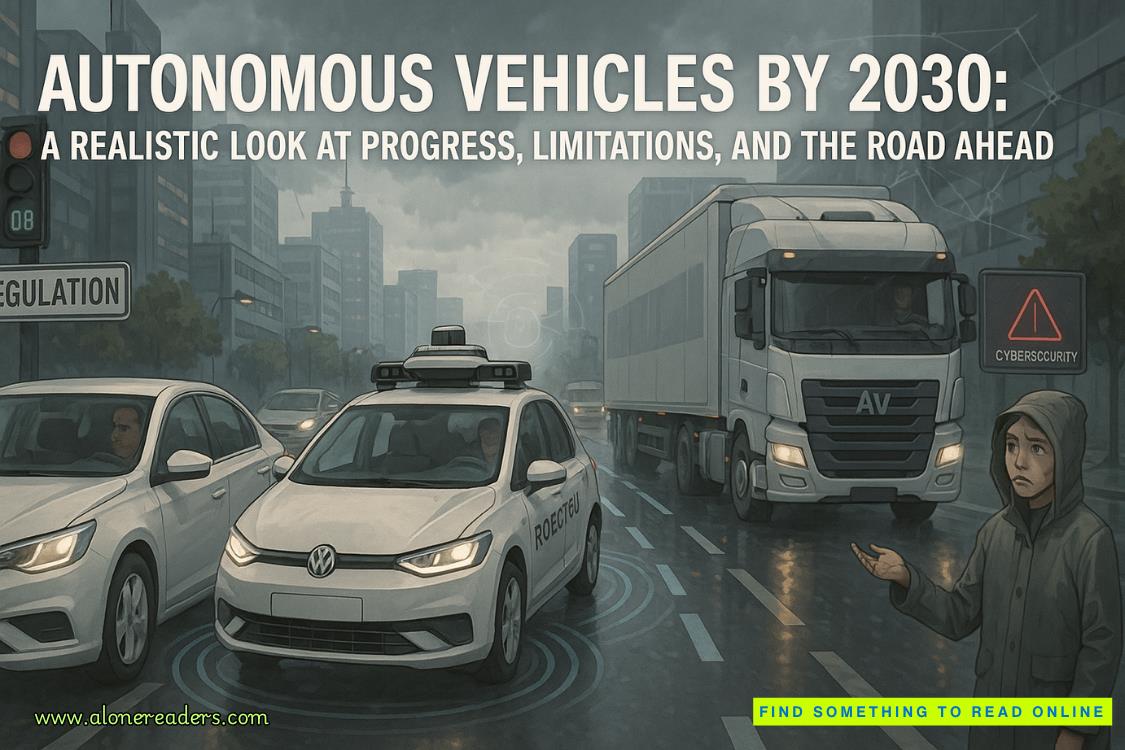
By 2030, the global landscape of autonomous vehicles will be a blend of remarkable progress and sobering reality—a decade that delivers more maturity than magic, more controlled deployment than the sweeping transportation revolution once promised. Instead of highways dominated by driverless machines, the world will see an uneven adoption curve, with Level 2 autonomy saturating consumer markets, limited Level 3 vehicles appearing cautiously, and Level 4 robotaxis thriving only in select urban zones. The fully autonomous Level 5 dream will remain distant, pushed beyond the 2040s.
This middle-ground reality will define the 2030 era: meaningful technological advancements constrained by regulatory hesitation, infrastructure gaps, and unresolved public skepticism. The story of autonomous vehicles in 2030 is not about failure or victory—it is about the complexity of integrating groundbreaking technology into real-world environments shaped by human behavior, policy, economics, and safety expectations.
The following analysis presents a deep, specialist-level look at what 2030 will truly look like in the world of self-driving vehicles.
By 2030, approximately 60% of all new vehicles sold globally will feature Level 2 or Level 2+ autonomy. These systems—hands-off in certain conditions but always eyes-on—will be the industry’s most successful commercial product because they fit seamlessly into the current ecosystem of liability, regulation, and consumer behavior.
Manufacturers will heavily prioritize enhancements to Level 2 rather than making aggressive leaps toward higher autonomy. This will include:
• Highly refined lane-keeping systems
• Adaptive cruise control integrated with predictive AI
• Reliable automated parking and low-speed self-maneuvering
• Advanced collision-avoidance with improved object detection
These features will feel increasingly natural to consumers, subtly shifting driving responsibilities without demanding regulatory overhaul or changing human driving norms.
More importantly, Level 2 systems will serve as the data engines of the future, generating billions of miles of logged real-world driving behavior. Automakers will rely on this data to train future neural network models and to gradually enhance the capabilities of higher-level systems.
The dominance of Level 2 will represent a pragmatic shift within the auto industry: accepting that incremental autonomy is not a compromise but a sustainable pathway toward long-term automation.
Level 3 autonomy will exist in 2030, but it will remain a niche segment—representing only 5–10% of new vehicle sales.
Its biggest obstacle will not be sensors or software, but human behavior. Level 3 requires the driver to be disengaged most of the time yet ready to take over within seconds during system alerts. This state—known as the out-of-the-loop problem—creates a structural safety paradox:
The better the car drives on its own, the worse humans become at taking control when needed.
Even with advancements in driver-monitoring systems, improved alert protocols, and more sophisticated cockpit design, manufacturers will struggle to solve the split-second challenge of sudden manual takeover during edge cases.
Level 3 will find adoption primarily in:
• Luxury brands in Europe and Japan
• Highway-specific contexts with controlled conditions
• Limited pilot programs in jurisdictions that approve conditional automation
Its path forward will remain uncertain, not only because of safety dynamics but also because insurers, regulators, and consumers will continue to question responsibility and trustworthiness.
Level 4 will be the brightest achievement of 2030—but also one of the most misunderstood. Robotaxis will operate successfully and profitably in several major cities, yet their scale will be far smaller than early predictions.
The global market will likely operate 30,000–100,000 Level 4 robotaxis by 2030, dominated by several key players.
Waymo: The Undisputed Leader
By 2030, Waymo will solidify itself as the global pioneer in autonomous ride-hailing.
• Fleet expansion from 2,500 vehicles in 2025 to between 20,000 and 100,000 units by 2030
• Operations in 8–15 major U.S. cities
• Select international deployments in Europe and Asia
• Over 50 million driverless miles logged by 2024, continuing to grow exponentially
• More than 5 million paid robotaxi rides already completed before 2025
Waymo’s competitive advantage will come from both technological mastery and unrivaled datasets—an asset no emerging competitor can match.
Cruise, Zoox, and Motional
Other U.S. services will grow, but more slowly:
• Cruise will return from its 2024 setback, but at a controlled pace
• Zoox will run custom-built robotaxis in 3–5 dense urban areas
• Motional will expand partnerships in Las Vegas and Los Angeles
China’s Explosive Expansion
China will surpass the United States by 2030 in robotaxi volume due to faster regulatory approval and large-scale pilot zones. Companies like Apollo Go, Pony.ai, and others will operate in dozens of cities, helping China reach more operational miles than any other region.
Despite this progress, Level 4 operations will still remain restricted to:
• Favorable weather environments
• High-precision mapped areas
• Cities with advanced infrastructure
• Limited geographic boundaries
Robotaxis will be real—but not yet universal.
By 2030, autonomous trucking will emerge as the most economically transformative application of self-driving technology.
Companies such as Aurora Driver, Tesla Semi, TuSimple, and Chinese manufacturers will operate autonomous trucks on fixed highway corridors. The appeal is clear: predictable environments, huge labor cost savings, and consistent operational patterns.
However, urban last-mile autonomous delivery will remain limited due to complex interactions with pedestrians and infrastructure gaps.
Trucking will prove that autonomy thrives where environments are structured, predictable, and economically incentivized.
The 2030 autonomous systems will be vastly more capable than those of the late 2020s.
Key achievements will include:
• High reliability in dense urban scenarios
• Significantly improved edge-case handling
• 5G-enabled vehicle-to-everything (V2X) communication across 80% of fleets
• Billions of simulation miles strengthening AI decision-making
• Custom AV chips enabling faster processing in real time
Yet fundamental limitations will persist:
• Poor performance in heavy rain, snow, and fog
• Difficulty handling novel, never-seen-before scenarios
• Thermal constraints from onboard compute hardware
• Limitations in perception under occlusion and glare
Autonomous vehicles by 2030 will be highly advanced—but still unable to replace human perception across all environmental conditions.
The world in 2030 will still lack a unified regulatory framework for autonomous vehicles.
• The U.S. will remain a patchwork of permissive and restrictive states
• The EU will take a cautious, harmonized approach focusing on liability
• China will expand rapidly under government-backed pilot zones
• Asia will diverge, with some countries accelerating adoption and others slowing it
A troubling pattern will continue: regulators approve operations first and intervene only after incidents. This reactive approach will slow adoption and reinforce public skepticism.
Despite technical progress, public trust will not keep pace.
Between 2021 and 2024, U.S. distrust in autonomous vehicles grew from 55% to 68%. By 2030, distrust will remain one of the primary barriers to widespread deployment.
High-profile incidents involving robotaxis, along with real concerns about job loss, safety, data privacy, and cyberattacks, will keep public opinion divided. Cities that welcome autonomous vehicles will see them flourish; cities opposed will simply block or restrict them, creating uneven adoption across regions.
The industry will grow to $7 billion in annual global revenue by 2030, driven by:
• Level 2+ vehicle premiums
• Robotaxi operations
• Commercial trucking
• Subscription-based autonomous features
China’s autonomous vehicle sector alone may surpass $600 billion, signaling the scale of its domestic demand and state support.
However, robotaxi profitability will remain uncertain due to:
• High insurance costs
• Expensive vehicles
• Maintenance of sensors and compute systems
• Costly mapping and operational infrastructure
Robotaxis will be viable in dense urban cores but not widely profitable in suburbs or mid-size cities.
The data collected by 2030 will make it clear that:
Level 5 autonomy—true autonomy in all conditions—will not arrive before the 2040s or later.
Unsolved challenges such as ethical frameworks, cybersecurity threats, extreme weather handling, and universal safety validation will continue to push timelines further.
The world of autonomous vehicles in 2030 will be one of mature but incomplete progress. Level 2 autonomy will dominate consumer markets, Level 3 will exist but remain constrained, and Level 4 robotaxis will operate impressively yet within tight geographic boundaries. Trucking will lead commercial autonomy, regulators will lag behind technological reality, and public skepticism will remain one of the largest obstacles.
Autonomous vehicles in 2030 will not represent the sweeping transformation once envisioned—but neither will they be a disappointment. Instead, they will symbolize the true nature of technological revolution: slower, more complex, and more intertwined with human systems than early futurists imagined.



 Top 10 Affordable Electric Cars for 2026: Best Budget EVs Worldwide
 Tesla Model S Review: Speed, Range, and Features in 2026
 Honda Accord vs Toyota Camry: Which Mid-Size Sedan Is Better?
 Chevrolet Silverado vs GMC Sierra: Which Truck Wins?
 2026 Jeep Wrangler Review: Off-Road Capabilities Tested in Extreme Terrain
 2026 Nissan Altima Review: Tech, Comfort, and Safety – In-Depth Expert Analysis