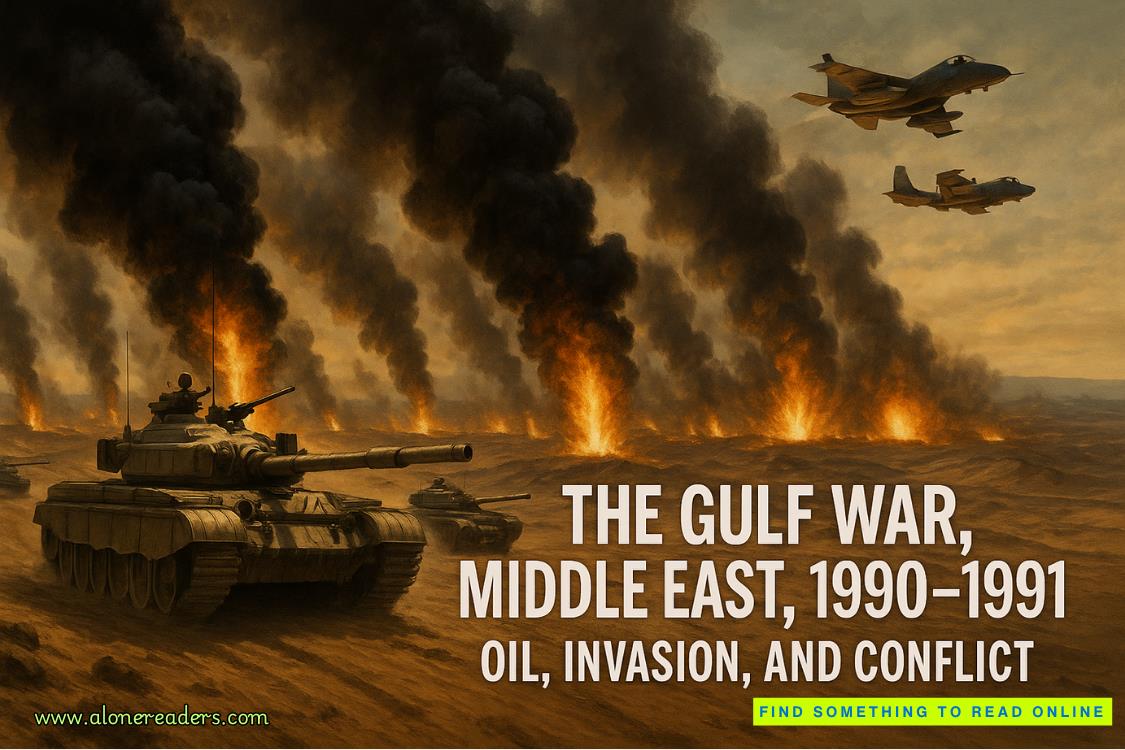
The Gulf War of 1990–1991 stands as one of the most consequential conflicts of the late twentieth century, reshaping global politics, redefining Middle Eastern military dynamics, and reinforcing the centrality of oil in international decision-making. While often reduced to the images of burning oil fields and precision-guided bombings broadcast on live television, the conflict was rooted in deeper regional tensions—economic pressures, territorial disputes, the legacy of colonial borders, and the aspirations of a regime determined to reassert its power. The war was not simply about Iraq invading Kuwait; it was a struggle layered with economic desperation, geopolitical maneuvering, military miscalculations, and an unprecedented international coalition response that permanently reshaped regional alignments.
The invasion of Kuwait on 2 August 1990 did not emerge from a vacuum. Iraq, under Saddam Hussein, had just emerged from the devastating eight-year war with Iran, a conflict that cost hundreds of thousands of lives and drained the Iraqi economy. The country was drowning in debt—much of it owed to Kuwait and Saudi Arabia, the very states Iraq considered its fellow Arab allies. Saddam believed that Iraq had acted as the “shield of the Arab world” against revolutionary Iran, and therefore expected financial forgiveness or at least substantial relief. Instead, Kuwait and the Gulf states pressed Iraq for repayment and maintained oil production levels that kept global prices low.
From Saddam’s perspective, Kuwait’s oil production policies amounted to economic warfare. He repeatedly accused Kuwait of exceeding OPEC quotas, artificially lowering prices, and engaging in slant drilling into the Rumaila oil field along the Iraq-Kuwait border. While the truth of the drilling claims remains debated, Saddam used them to justify his rising hostility. Moreover, Iraq’s historical claim that Kuwait was originally part of its territory gained renewed political value as economic pressures intensified. Combined, these factors produced a combustible mix of grievance, ambition, and desperation that paved the way for military action.
When Iraqi forces crossed the Kuwaiti border, Saddam assumed that the international community would respond with condemnation but not with overwhelming military force. His expectation was shaped by several miscalculations. First, he believed the United States would remain neutral, particularly after ambiguous diplomatic signals during a meeting with U.S. Ambassador April Glaspie, which Saddam interpreted as tacit permission. Second, he underestimated the importance of Kuwait to the global oil economy, assuming major powers would avoid a conflict that could threaten energy stability. Most critically, Saddam overestimated the will of Arab nations to stand united against Western intervention, assuming the Arab world would pressure Kuwait into concessions rather than support a military coalition.
However, these assumptions quickly collapsed. The invasion shocked the Arab world, with Saudi Arabia fearing it could be the next target. The United States, concerned about global oil supplies and the threat to its regional allies, mobilized rapidly. Within weeks, the largest multinational military coalition since World War II began forming under U.S. leadership.
The immediate response to Iraq’s invasion was the deployment of coalition forces to Saudi Arabia to prevent further Iraqi advance. Operation Desert Shield began in August 1990 and marked a monumental shift in Middle Eastern military dynamics. The presence of U.S. forces on Saudi soil—previously unimaginable—became a geopolitical necessity. The coalition ultimately included more than thirty nations, integrating Western powers, Arab states, and regional military forces.
The buildup was not merely military; it was equally diplomatic and economic. United Nations sanctions were imposed, aiming to strangle Iraq’s economy and force withdrawal. Meanwhile, coalition planners prepared for a massive military response if diplomacy failed. For nearly six months, the world watched a slow-motion march toward inevitable conflict, as Iraqi forces entrenched themselves in Kuwait and constructed elaborate defensive lines along the border.
On 17 January 1991, Operation Desert Storm—one of the most intense and technologically advanced air campaigns in history—began. The skies over Iraq and Kuwait erupted with coalition aircraft carrying out precision attacks on command centers, communication networks, airfields, weapon storage facilities, and infrastructure. The intent was clear: paralyze Iraq’s military capability before any ground assault.
Satellite-guided bombs, stealth aircraft such as the F-117, and real-time news coverage brought the conflict into homes around the world. The effectiveness of the air campaign shocked the Iraqi leadership. Within days, Iraq’s air force sought refuge by fleeing to Iran, and its anti-aircraft defenses were largely neutralized. The months-long preparation by coalition forces meant that the ground war would only begin once Iraq’s military capacity had been dramatically degraded.
On 24 February 1991, the coalition launched its ground offensive, executing a rapid and coordinated strategy designed to outflank Iraqi defenses. Instead of pushing directly into Kuwait—where Iraqi troops were dug in—the coalition performed the famous “left hook” maneuver into the western desert, encircling Iraqi forces and cutting off supply lines.
The Iraqi army, exhausted from sanctions, demoralized by the air assault, and poorly equipped compared to coalition forces, collapsed in days. Kuwait City was liberated, and Iraqi troops retreated—many in disarray—along the now-infamous “Highway of Death,” where coalition forces destroyed retreating military vehicles. While images of the destruction sparked ethical debates, coalition commanders defended the action as necessary to prevent a potential counterattack.
Within 100 hours of the ground offensive’s start, the war effectively ended. On 28 February 1991, a ceasefire was declared, marking one of the shortest and most one-sided ground campaigns in modern military history.
Oil was not merely a background factor in the Gulf War—it was central to every strategic calculation. Kuwait’s vast reserves, Iraq’s economic dependence on oil revenue, and the global reliance on Middle Eastern energy made the conflict economically explosive. The fear of Saddam controlling nearly 20 percent of global oil reserves was a primary motivator behind international intervention.
The war highlighted how oil is not just a commodity but a geopolitical instrument. Control over oil fields equated to control over global economic stability. This is why coalition forces prioritized securing Saudi oil infrastructure and why Iraq’s strategy included launching Scud missiles at Israel, hoping to fracture the coalition by provoking retaliation.
But the most memorable symbol of the war’s connection to oil was Iraq’s deliberate ignition of Kuwaiti oil wells during its retreat. Thousands of towering flames, producing massive clouds of black smoke, turned the sky dark for months, creating one of the worst environmental disasters in history. These fires were not just acts of destruction—they were acts of economic and psychological warfare aimed at crippling Kuwait’s future.
The end of the Gulf War did not bring peace to Iraq or to the broader region. Instead, it ushered in a decade of severe sanctions, weapons inspections, and internal uprisings. The Iraqi regime faced internal rebellions from Kurds in the north and Shi’a in the south, both encouraged—then diplomatically abandoned—by the coalition. Saddam crushed these uprisings brutally, creating humanitarian disasters that led to the establishment of no-fly zones enforced by Western aircraft.
UN weapons inspections aimed to dismantle Iraq’s chemical, biological, and nuclear programs. While largely successful, they became a source of ongoing tension, shaping the narrative that eventually led to the 2003 Iraq War.
Regionally, the Gulf War permanently increased U.S. military presence in the Middle East, particularly in Saudi Arabia, which later became a focal point of extremist anger and recruitment. The balance of military power in the region shifted decisively, and the war’s legacy continued to influence global geopolitics for decades.
The Gulf War was far more than a brief military conflict—it was a turning point in modern geopolitical history. It exposed the fragility of borders drawn without regard to regional history, highlighted the economic and political power of oil, and demonstrated the overwhelming technological superiority of Western militaries at the time. It also set in motion long-term consequences that reshaped the Middle East and influenced global politics well into the twenty-first century.
The war remains a complex tapestry of strategic miscalculations, economic desperation, military dominance, and international cooperation. Its lessons continue to echo: alliances matter, economic pressures can ignite wars, and the struggle for resources—especially oil—remains deeply entangled with global conflict.



 Top 10 Highest-Paid Professions in the United States (2025): Salaries, Roles, and Career Paths
 Top 10 Largest U.S. Companies by Revenue in 2025 (Fortune 500 Analysis)
 Top 10 Highest-Earning Global Tech Companies in 2025: Revenue, Strategy, and Market Power
 Top 10 Highest-Earning Mobile Apps in 2025: Revenue, Monetization, and Market Dominance
 ZombieAgent: Inside the Zero-Click AI Attack That Turns ChatGPT Agents into Persistent Data-Leaking Zombies
 China’s Urban Air Is a Hidden Plastic Reservoir: Inside the Microplastic Clouds Over Megacities