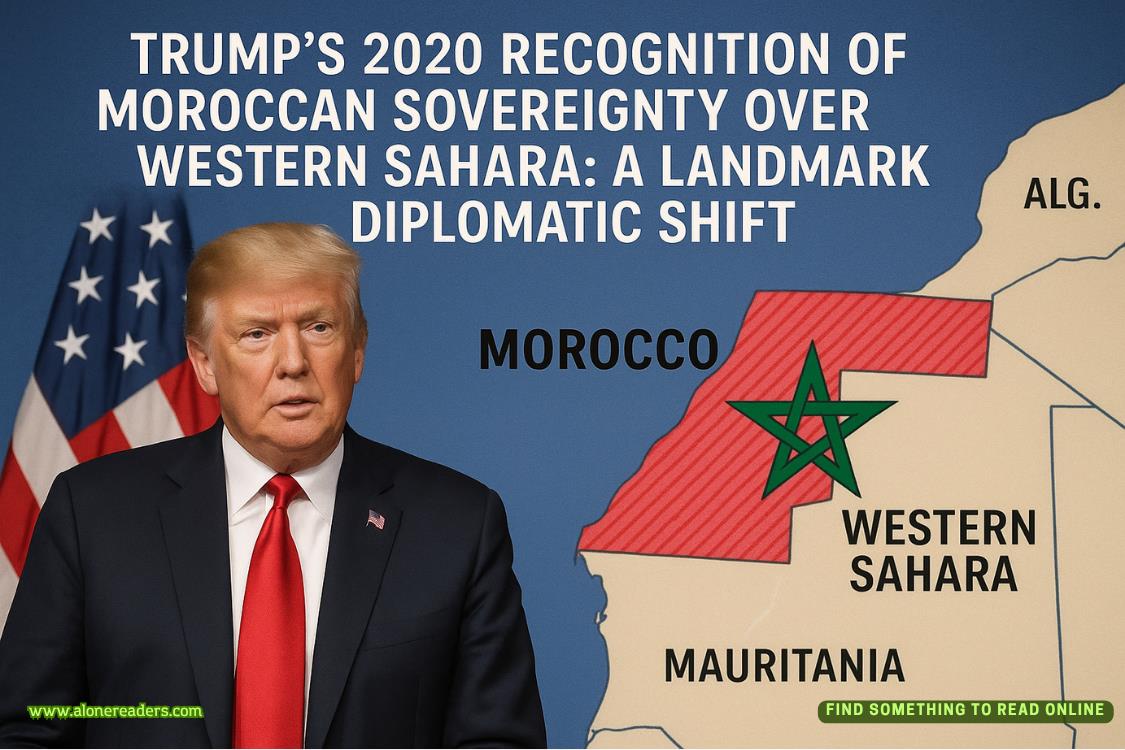
In December 2020, the administration of U.S. President Donald Trump made one of its most consequential foreign policy decisions: recognizing Moroccan sovereignty over Western Sahara. The move, announced as part of a broader diplomatic arrangement that saw Morocco normalize relations with Israel, marked a fundamental shift in the United States’ long-standing position of neutrality on the territorial dispute. Western Sahara, a sparsely populated region along Africa’s northwest coast, had been at the center of a protracted conflict between Morocco and the Sahrawi independence movement, the Polisario Front. Trump’s recognition upended decades of careful diplomatic balance maintained by successive U.S. administrations and carried profound geopolitical implications for North Africa and beyond.
The Western Sahara dispute traces its origins to the decolonization of Africa. After Spain withdrew from the territory in 1975, Morocco asserted sovereignty, claiming historical ties to the region. However, the Polisario Front, backed by Algeria, declared the Sahrawi Arab Democratic Republic (SADR) and sought full independence. The ensuing conflict led to years of warfare and a fragile ceasefire brokered in 1991 by the United Nations, which envisioned a referendum on self-determination that has never materialized. For decades, the U.S. position had been to support U.N. efforts without taking sides on the question of sovereignty. Washington viewed the issue as a matter for negotiation rather than recognition. Trump’s move, therefore, represented a sharp break from the established framework of international diplomacy.
The decision was not made in isolation. It was part of a series of normalization agreements between Israel and several Arab nations — collectively branded as the Abraham Accords. Morocco’s inclusion in these accords came with a clear quid pro quo: in exchange for normalizing ties with Israel, the United States would recognize Morocco’s claims over Western Sahara. This exchange reflected Trump’s transactional approach to diplomacy, where symbolic recognition was leveraged to secure broader geopolitical gains. For Morocco, U.S. recognition was a long-sought diplomatic victory that validated decades of effort to legitimize its sovereignty over the territory. For Israel, it opened new avenues of cooperation with a strategically located Arab state in North Africa.
The recognition carried immediate geopolitical reverberations. In North Africa, it was seen as a challenge to Algeria, which has long supported the Polisario Front both militarily and politically. Algeria’s rivalry with Morocco deepened, and regional tensions intensified. The Polisario Front, feeling abandoned by Washington, announced a resumption of hostilities in November 2020 after years of ceasefire, claiming that Morocco had violated the truce. Trump’s announcement only reinforced the perception that diplomatic channels were collapsing, pushing the conflict toward renewed confrontation.
Internationally, the decision drew criticism from multiple quarters. The United Nations reaffirmed that the status of Western Sahara should be determined through negotiations and that no unilateral recognition could alter its legal status. The European Union, too, declined to follow Washington’s lead, maintaining its support for a U.N.-led solution. Human rights organizations condemned the move as prioritizing geopolitical convenience over the Sahrawi people’s right to self-determination. Even within the United States, several foreign policy analysts and lawmakers expressed concern that the recognition could undermine U.S. credibility on issues of international law and self-determination elsewhere.
From Morocco’s perspective, the U.S. decision represented the culmination of decades of strategic patience and diplomatic lobbying. Rabat had consistently argued that its control over Western Sahara was integral to its national unity and territorial integrity. By securing Washington’s endorsement, Morocco gained leverage to attract foreign investment in the region and to frame the autonomy plan it proposed in 2007 as the only realistic solution. The Moroccan government swiftly capitalized on the recognition, issuing stamps, maps, and official documents reflecting the “Moroccan Sahara.” Domestically, the announcement was met with widespread celebration, seen as a validation of Morocco’s diplomatic and historical claims.
Yet, the recognition did not erase the complex realities on the ground. Western Sahara remains divided by a heavily mined sand berm, with Moroccan forces controlling roughly 80 percent of the territory and the Polisario governing the remainder from refugee camps in Algeria. The Sahrawi population continues to face economic hardship and limited access to political participation. The Trump administration’s move offered no clear mechanism for addressing these human rights concerns, and critics argued that it entrenched Moroccan control without offering meaningful concessions to the Sahrawi people.
For Trump’s foreign policy legacy, the move was emblematic of his administration’s broader philosophy: pragmatic deals that prioritized immediate strategic wins over traditional diplomacy. Recognizing Moroccan sovereignty helped consolidate Arab-Israeli normalization, reinforcing Trump’s portrayal of himself as a peacemaker in the Middle East. It also bolstered U.S. alliances in North Africa, where Morocco has been a key counterterrorism partner and a bridge between Africa and Europe. However, this transactional diplomacy came at the cost of alienating other regional actors, especially Algeria, and complicating future mediation efforts by the United States.
When President Joe Biden took office in January 2021, many expected his administration to reverse or at least reconsider the recognition. However, the Biden administration chose not to revoke the decision, signaling a cautious acceptance of the new reality. U.S. officials continued to support U.N. efforts toward a political solution and encouraged the appointment of a new envoy for Western Sahara. Nonetheless, the Biden administration refrained from publicly emphasizing the recognition, perhaps to avoid further inflaming tensions with Algeria and to maintain flexibility in diplomatic engagement. This careful balancing act highlighted the enduring sensitivity of the issue and the limits of unilateral recognition in resolving long-standing territorial disputes.
Trump’s recognition also reshaped Morocco’s international posture. Rabat leveraged the diplomatic momentum to deepen its economic and security cooperation with both the United States and Israel. Joint military exercises, technology transfers, and investment projects followed. Morocco became a key participant in U.S.-backed regional initiatives aimed at countering extremism and strengthening African connectivity. The normalization with Israel also opened new sectors of collaboration, including agriculture, energy, and tourism. For Morocco, the Western Sahara recognition was not just a symbolic victory but a catalyst for broader international partnerships.
However, the decision also entrenched polarization in North Africa. Algeria, perceiving the move as an affront to its regional standing, intensified support for the Polisario Front and recalled its ambassador from Washington. The Maghreb region, already fragmented by political differences, became further divided. Efforts to promote regional integration through the Arab Maghreb Union stagnated. The Western Sahara dispute thus continued to serve as a geopolitical fault line, shaping alliances and rivalries across the region.
In retrospect, Trump’s recognition of Moroccan sovereignty over Western Sahara stands as a defining diplomatic act of his presidency. It demonstrated how the pursuit of short-term geopolitical gains — in this case, advancing the Abraham Accords — can upend decades of delicate diplomacy. The move brought tangible benefits for Morocco and Israel, yet it left the core issue of Sahrawi self-determination unresolved. The recognition effectively sidelined the United Nations’ central role, weakening the international consensus that had sustained fragile peace for decades.
Today, nearly five years later, the ramifications of that 2020 decision continue to unfold. While Morocco has solidified its control over Western Sahara and strengthened its alliances, the Polisario Front remains entrenched in its demands for independence. The U.S. recognition, though symbolically powerful, did not end the dispute — it merely recalibrated it within a new diplomatic framework. Whether this shift leads to long-term stability or further entrenchment of division remains to be seen. What is clear, however, is that Trump’s recognition irrevocably altered the trajectory of one of Africa’s longest-running territorial conflicts, embedding it within the broader dynamics of Middle Eastern normalization and global power politics.
In essence, the 2020 U.S. recognition of Moroccan sovereignty over Western Sahara was both a diplomatic gamble and a geopolitical milestone. It reinforced Morocco’s regional ascendancy, rewarded participation in the Abraham Accords, and demonstrated Trump’s willingness to wield recognition as a strategic tool. But it also underscored the limits of transactional diplomacy in resolving complex historical disputes. For the people of Western Sahara, the promise of self-determination remains as elusive as ever — caught between international power plays and the shifting sands of realpolitik.



 Top 10 Highest-Paid Professions in the United States (2025): Salaries, Roles, and Career Paths
 Top 10 Largest U.S. Companies by Revenue in 2025 (Fortune 500 Analysis)
 Top 10 Highest-Earning Global Tech Companies in 2025: Revenue, Strategy, and Market Power
 Top 10 Highest-Earning Mobile Apps in 2025: Revenue, Monetization, and Market Dominance
 ZombieAgent: Inside the Zero-Click AI Attack That Turns ChatGPT Agents into Persistent Data-Leaking Zombies
 China’s Urban Air Is a Hidden Plastic Reservoir: Inside the Microplastic Clouds Over Megacities