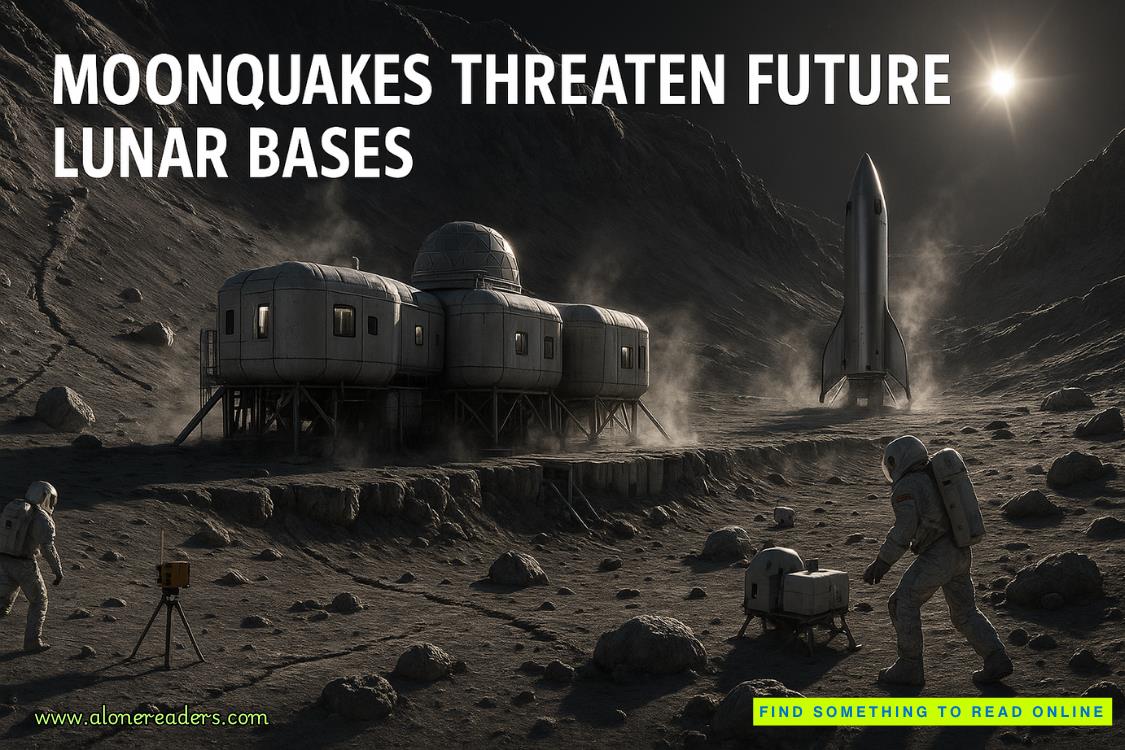
The dream of establishing long-term human settlements on the Moon has always evoked images of sleek habitats, advanced mining operations, and astronauts working against a backdrop of endless grey plains. Yet a subtle and often overlooked threat is reshaping how engineers and scientists envision the next era of lunar exploration: moonquakes—small in magnitude by Earth standards, but potentially devastating when they strike near active faults. New findings based on Apollo-era data and modern modeling now warn that these quakes could trigger landslides, destabilize foundations, and compromise critical infrastructure for NASA’s Artemis missions, especially in areas rich in geological activity.
While the Moon lacks the tectonic dynamism of Earth—no drifting plates, no global seismic networks—it is far from seismically dormant. The lunar crust is continuously contracting as the Moon cools, generating thrust faults that can slip without warning. These faults have been photographed, mapped, and in many locations monitored indirectly through boulder tracks and displaced regolith. For decades, the Apollo seismometers recorded tremors, but only recently have researchers connected these data to specific fault lines, enabling an assessment of long-term hazard. What emerges is a clear message: future lunar bases cannot afford to ignore moonquake risk.
One of the strongest pieces of evidence comes from the Apollo 17 landing site in Taurus–Littrow valley. There, astronauts observed curious geological patterns: trails carved by rolling boulders, landslide debris, and slopes that appeared disturbingly fresh for a world thought to be tectonically quiet. Only in the last few years have researchers been able to model these features with high-resolution terrain data, concluding that they align not with meteor impacts—as earlier theories suggested—but with repeated seismic shaking over the past 90 million years. These modest quakes, reaching magnitudes near 3.0, would barely cause a tremor in an Earth city. On the Moon, however—where gravitational acceleration is only one-sixth of Earth’s and soil is loosely packed—they are powerful enough to dislodge multi-ton rocks and send them sliding downhill.
The culprit behind this activity is the Lee–Lincoln thrust fault, a local—but active—feature that has slipped multiple times over millions of years, shaking the terrain each time. Modeling studies now confirm that ground acceleration from these moonquakes would have been sufficient to trigger the boulder movements documented by the Apollo crew. The significance is startling: if such quakes occurred in the past, they can happen again, especially since analysis shows that many lunar thrust faults are still active due to continued planetary contraction.
The risk itself is statistical but meaningful for long-term habitation. The probability of a damaging moonquake affecting a base built directly adjacent to an active fault is relatively low—about a 1 in 20 million chance on any given day. For short missions like the Apollo landings, such risk was considered negligible. But Artemis aims for something radically different: persistent human presence, potentially involving stays of months or even years, with long-term outposts supporting scientific operations, mining activities, and nuclear power systems. Over a decade-long occupation, the cumulative probability of a damaging quake rises to 1 in 5,500—still small, but no longer dismissible.
More concerning is how modern lunar hardware may respond differently than Apollo equipment. Landers planned for Artemis missions, including Starship variants, are significantly taller and heavier. Their high center of gravity makes them more susceptible to tipping forces generated by lunar seismic waves. Unlike the Apollo Lunar Module, engineered for extremely short occupancy and designed with wide landing pads and low mass, today’s structures must withstand not only quakes but also long-term structural fatigue caused by repeated shaking.
Moreover, thrust faults like Lee–Lincoln are not isolated oddities. They appear worldwide on the lunar surface—visible as bright scarps, ridges, and abrupt slope breaks captured by orbiters. Many of them are geologically young, and some cut across crater rims, suggesting recent motion. This is particularly relevant for Artemis III and subsequent missions, which target the Moon’s south pole. This region holds immense scientific and resource interest due to possible water ice deposits, but it is also marked by numerous faults produced by ongoing lunar contraction. Selecting landing and construction sites without accounting for these structures would introduce unnecessary risk.
The most immediate hazard from moonquakes is localized ground shaking, which can:
Because lunar regolith is dry, fine, and mechanically fragile, even moderate acceleration can propagate efficiently, amplifying seismic motion more than expected. This becomes especially dangerous near slopes or fault-adjacent scarps, where shaking-induced landslides could sweep across outposts or bury equipment.
Mitigation strategies are already being built into planning for Artemis. The most significant protective measure is site selection. Shaking intensity from thrust faults decreases sharply with distance, meaning even a few kilometers of separation between a base and a fault scarp can dramatically reduce risk. Geological mapping using the Lunar Reconnaissance Orbiter and high-precision topographic surveys enable such assessments, but much more refined data is needed before large, permanent facilities can be safely installed.
To fill these gaps, future Artemis missions plan to deploy next-generation seismometers, far more sensitive than Apollo’s instruments and capable of building a detailed seismic profile of the south pole. These sensors will help determine which faults are currently active, how frequently they slip, and how far seismic waves travel. With a network of instruments, engineers will be able to construct risk maps, allowing mission planners to choose stable ground for habitats, launch pads, mining operations, and nuclear energy modules.
Beyond site selection, structural engineering will play a central role. Lunar bases will need:
Designing for earthquakes on Earth is routine, but designing for moonquakes is new territory. Engineers must contend with unpredictable soil mechanical properties, lower gravity, and the absence of atmosphere—all of which change how structures behave under lateral loads.
Nuclear power systems, expected to form the backbone of long-term lunar operations, require special consideration. These facilities must be placed far from faults, built on stable, compacted ground, and shielded from potential debris slides. Unlike solar arrays, which can be repositioned, a reactor built in the wrong location would be nearly impossible to relocate.
Perhaps the most compelling warning from the latest research is that seismic reshaping of the lunar surface has been ongoing for tens of millions of years—and there is no reason to believe it will stop in the next hundred. If the Moon continues cooling and contracting, its faults will continue to slip, sending tremors across the landscape. To build safely, Artemis missions must accept that the Moon is not a static, silent world, but a geologically restless one.
In the end, moonquakes do not pose an existential threat to lunar colonization, but they represent a critical engineering challenge. With proper planning, seismic monitoring, and intelligent base placement, outposts can be built to withstand the Moon’s subtle but persistent shaking. The danger lies not in the quakes themselves, but in ignoring what decades of evidence—and now advanced modeling—are clearly showing.
As NASA prepares to return humans to the lunar surface for the first time in over fifty years, understanding these risks is more relevant than ever. The future of lunar exploration will be shaped not just by rockets and habitats, but by geology—by the faults beneath our feet on a world that still trembles.



 Château de Vincennes: France’s Forgotten Royal Fortress and Medieval Stronghold
 Château de Carcassonne: Europe’s Greatest Medieval Citadel and Fortress
 Château de Chenonceau: The Castle Built by Remarkable Women
 Château de Chambord: France’s Magnificent Renaissance Castle and Architectural Wonder
 Tehri Dam: India's Tallest Dam and the Debate Behind It
 Bhakra Nangal Dam: India's Temple of Modern Development