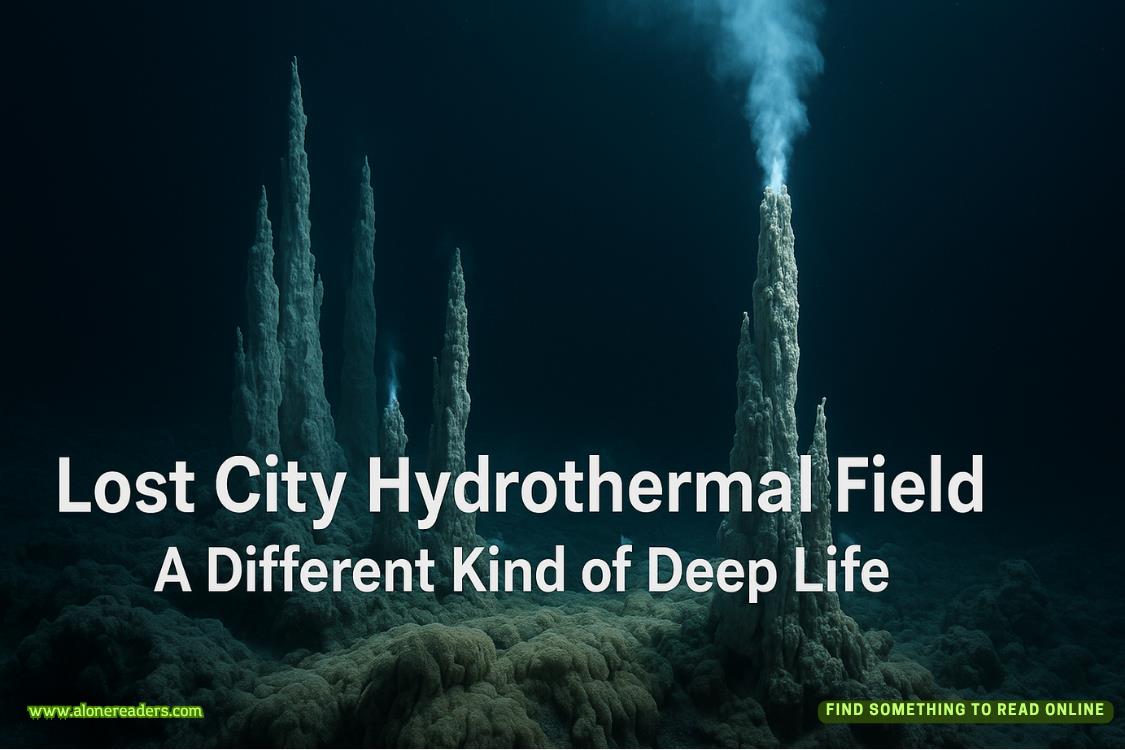
The Lost City Hydrothermal Field is one of the most extraordinary places on Earth—an environment so chemically unusual, so biologically rich, and so geologically ancient that many scientists consider it one of the best analogs for how life may have first emerged on our planet. Located on the uplifted flank of the Atlantis Massif in the mid-Atlantic Ocean, this field is unlike any black smoker vent system ever discovered. Instead of the dark, acidic, metal-rich chimneys typically associated with hydrothermal activity, Lost City produces towering white carbonate structures that rise up to 60 meters, formed through processes that operate at a completely different chemical rhythm than the rest of the deep ocean. The ecosystem that thrives around these structures depends not on sunlight, sulfur oxidation, or typical geothermal chemistry, but on reactions driven by the alteration of Earth’s mantle itself, creating a world of alkaline fluids, hydrogen-rich plumes, and microbial life that pushes the definition of what a habitable environment might be.
The uniqueness of Lost City begins with the fact that it is powered not by volcanic heat, but by serpentinization—a geological process in which mantle rocks rich in olivine react with seawater. This reaction generates heat, produces hydrogen gas, and releases alkaline fluids with a pH that can exceed 11. These fluids then mix with the cold seawater of the deep ocean, precipitating calcium carbonate that slowly builds the massive chimneys and spires rising from the seafloor. This process is extremely long-lived compared to volcanic venting; while black smokers typically last for years or decades, Lost City has likely been active for hundreds of thousands of years, providing a stable chemical environment for microbial communities that may resemble early life on ancient Earth.
What makes the biology of Lost City so remarkable is its reliance on hydrocarbons that form abiotically, meaning they arise from chemical reactions rather than biological activity. During serpentinization, hydrogen gas reacts with carbon dioxide and other carbon compounds to produce methane and more complex hydrocarbons—a process that mirrors some of the primitive chemistry hypothesized for early protocells. These hydrocarbons become the foundational energy sources for microbial life in Lost City, where organisms thrive in conditions that would be hostile to most known forms of life. Temperatures within the chimneys range from 40°C to 90°C, and the alkaline, hydrogen-rich fluids create niches for microbes that specialize in methane production, hydrogen oxidation, and other metabolic pathways rarely seen in modern ecosystems.
The towering chimneys themselves are ecosystems layered with complexity. Inside their porous walls flow warm, alkaline fluids where methanogenic archaea dominate, converting hydrogen and carbon dioxide into methane. These archaea form dense biofilms that cling to the mineral surfaces, thriving in an environment nearly devoid of oxygen. On the outer surfaces of the chimneys, where the alkaline fluids meet the oxygenated seawater, entirely different microbial communities take shape. Here, aerobic bacteria oxidize methane, hydrogen, and formate, tapping into the chemical gradients created by the mixing of fluids. This stratification of life—from oxygen-poor interior to oxygen-rich exterior—creates an ecosystem functioning entirely through chemical energy exchange, without any reliance on photosynthesis.
One of the most intriguing aspects of the Lost City microbes is their resilience and unconventional metabolic machinery. Many of the microorganisms discovered there possess genes that differ significantly from known relatives, adapted for survival under extreme pH, minimal nutrients, and fluctuating thermal conditions. The presence of archaea that can metabolize methane and hydrogen with remarkable efficiency suggests evolutionary pathways that may have been present during Earth’s earliest eons. Some researchers argue that environments like Lost City could have been the cradle of life itself, where naturally formed pores within chimney structures may have served as primitive compartments for chemical reactions eventually leading to biological complexity. The microstructures of these carbonate chimneys, with their thin mineral walls and interlinked chambers, resemble laboratory models of the early conditions necessary for proto-metabolic processes.
Unlike black smoker ecosystems, which depend on mineral-rich, sulfur-heavy vent fluids and typically support lush fields of tube worms, mussels, and extremophile crustaceans, Lost City supports a subtler, more microbial form of life. The absence of volcanic metals and the presence of gentle, warm alkaline fluids mean that large animals are rare or absent. Instead, the field hosts sponges, small crustaceans, and a variety of microorganisms weaving a biochemical tapestry largely hidden from the naked eye. The lack of abundant megafauna does not make the ecosystem less vibrant; rather, it highlights a world dominated by microbial innovation and chemical interaction—one that operates on principles fundamentally different from most other known ecosystems.
Geologically, the Lost City chimneys are works of natural architecture, rising from the seafloor in shapes that resemble cathedrals, spires, and twisted organic sculptures. The tallest of these structures, nicknamed Poseidon, reaches approximately 60 meters, making it one of the largest vent structures ever discovered. The chimneys emit shimmering plumes of hydrothermal fluids laced with hydrogen and methane, creating visual distortions in the water column that appear like underwater mirages. The surfaces of the chimneys are often coated with white carbonate, giving them a ghostly, otherworldly appearance that contrasts sharply with the dark volcanic surroundings of typical deep-sea vents.
The chemical outflows from Lost City also influence the surrounding ocean environment. As hydrogen-rich fluids diffuse outward, they create gradients that shape microbial populations even far from the chimneys themselves. The high pH and chemical composition of the fluids can affect local seawater chemistry, potentially impacting carbon cycling in the deep ocean. Scientists studying Lost City seek to understand how much methane produced within the system escapes to the environment, how microbial communities regulate chemical fluxes, and how this ecosystem contributes to broader planetary processes.
Beyond its scientific importance, the Lost City Hydrothermal Field is an emblem of what remains undiscovered in the world’s oceans. It was only found in 2000, and since then has continued to challenge existing models of deep-sea ecosystems, early Earth chemistry, and the conditions necessary for life. Its unique characteristics make it a prime target for astrobiology research. Planets and moons such as Europa and Enceladus, where water interacts with rocky interiors under extreme pressure, may host environments similar to Lost City. If serpentinization-driven vents can support life on Earth without sunlight, volcanic heat, or abundant organic materials, then similar ecosystems beyond our planet become more plausible.
The mystery and scientific value of Lost City are matched by a growing awareness of its vulnerability. Deep-sea mining interests have increasingly targeted areas near the Mid-Atlantic Ridge, raising concerns about disturbance to ecosystems that took thousands of years to form. Because Lost City is not driven by volcanic activity, its structures grow slowly and could be irreversibly damaged by mechanical disruption or sediment plumes. Protecting this site is essential not only for preserving its biological and geological significance, but also for safeguarding a natural laboratory that may hold answers to fundamental questions about life’s origins.
In many ways, the Lost City Hydrothermal Field invites us to reconsider what we think we know about life on Earth. Its alkaline vents demonstrate that biology can flourish in environments without sunlight, without typical nutrient cycles, and without the chemical frameworks that dominate surface ecosystems. The microbes of Lost City thrive on chemical reactions driven by rocks interacting with water—a reminder that life’s foundation may lie not in surface complexity, but in simple, persistent chemical gradients. The chimneys stand as monuments to geological processes that predate humanity by millions of years, their towering forms quietly supporting ecosystems shaped by time, chemistry, and the slow alteration of the Earth’s mantle.
As exploration technologies advance and our understanding deepens, Lost City will continue to reveal new insights into ancient biochemistry, deep-sea geology, and the universal potential for life in extreme environments. It is a place where science, curiosity, and mystery converge—a deep-ocean cathedral built not by hands, but by the patient forces of water, rock, and time. In this silent world of alkaline plumes and hydrogen-fed microbes, one can glimpse not only the diversity of life, but its resilience, its adaptability, and its profound connection to the planet’s most fundamental processes.



 Château de Vincennes: France’s Forgotten Royal Fortress and Medieval Stronghold
 Château de Carcassonne: Europe’s Greatest Medieval Citadel and Fortress
 Château de Chenonceau: The Castle Built by Remarkable Women
 Château de Chambord: France’s Magnificent Renaissance Castle and Architectural Wonder
 Tehri Dam: India's Tallest Dam and the Debate Behind It
 Bhakra Nangal Dam: India's Temple of Modern Development










