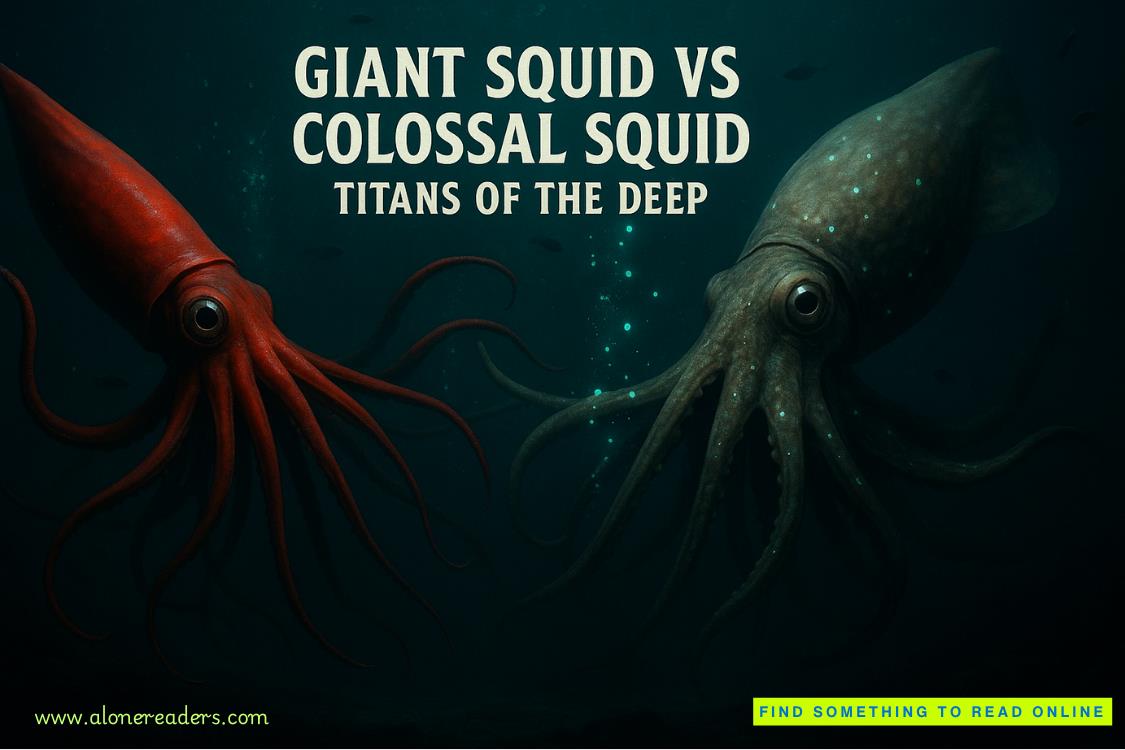
The ocean’s deepest realms hide battles that human eyes have rarely witnessed, but scientists know one thing with certainty — when the giant squid and colossal squid roam the abyss, only the strongest survives. These two mysterious cephalopods have become legendary ocean titans, inspiring myths, scientific debates, and countless unanswered questions. Although they share a similar predatory lifestyle, their anatomy, behavior, and hunting strategies differ significantly. Understanding how these two marine giants compare offers a unique insight into evolution in one of the harshest environments on Earth — the deep sea.
The giant squid (Architeuthis dux) has long, slender tentacles and a streamlined body that allows it to reach impressive lengths. Some individuals are estimated to exceed 40–45 feet, making them among the longest invertebrates ever discovered. In contrast, the colossal squid (Mesonychoteuthis hamiltoni), while shorter in length, is much heavier and more powerful, with recorded weights exceeding 500 kilograms, or even possibly more. Its body is wider with thicker arms, giving it a powerful build suited for ambush attacks rather than long-distance chases. These differences reflect two distinct evolutionary strategies — one built for speed and reach, the other for brute strength and raw power.
Giant squids are believed to prefer slightly shallower abyssal zones, although still incredibly deep by human standards — commonly around 300–1000 meters below the surface. Their long tentacles feature sucker rings with sharp tooth-like structures used to latch onto prey such as fish and other cephalopods. Their bodies are built for rapid movement and sudden strikes, possibly making them more active hunters. The colossal squid, however, is found mostly in the Southern Ocean, primarily in Antarctic waters. It tends to reside even deeper, often beyond 2000 meters, where temperatures are near freezing and sunlight never penetrates. Here, it uses its immense strength and possibly ambush tactics, conserving energy in an environment where food sources are limited and survival is expensive.
One of the most striking anatomical differences lies in their beaks. Both possess powerful beaks, but the colossal squid’s beak is comparatively larger and more robust, capable of tearing through even thick-skinned prey. That alone suggests a more physically destructive hunting style. Moreover, colossal squids are known to have rotating hooks on their arms, a feature unique among squids that likely provides additional gripping power during combat. The giant squid, while still dangerous, relies more on suction and wrapping techniques rather than brute force. Both species possess large eyes — among the largest in the animal kingdom — reaching up to the size of a volleyball, designed to detect faint movements in the dark waters of the abyss.
Their diets offer further insight into their strategies for survival. The giant squid likely hunts smaller fish, deep-sea sharks, and cephalopods using swift ambushes. It may be more opportunistic, striking and releasing muscles rapidly to tire prey before delivering a final attack. The colossal squid appears to deliberately target larger prey, possibly including toothfish, slow-moving deep-sea creatures, and even scavenging from carcasses that sink into the depths. Its bulky build suggests a predator that relies on overwhelming physical power, making every bite count in a world with limited food resources.
The debate over which species is stronger remains active among scientists. Physically, the colossal squid’s massive body, hooks, and heavier musculature make it a powerful force, possibly capable of overpowering many competitors. However, the giant squid’s longer tentacles and agile form give it a wider striking range and better maneuverability. If the two were to engage in a direct confrontation, the outcome would depend largely on the depth, temperature, energy reserves, and whether it was a chase or an ambush encounter. There is no recorded instance of these two species fighting, yet marine biologists believe their territories may overlap at certain depths, suggesting potential encounters in the dark.
Defense mechanisms for both squids are essential, considering their most feared predator — the sperm whale. Scars found on whale skin and remains of squids in their stomachs reveal that these battles are monumental. Both giant and colossal squids use jet propulsion to escape, expelling water through a siphon to generate sudden bursts of speed. Their bodies contain ammonia-rich tissues, less palatable to predators and helpful in maintaining neutral buoyancy. They also possess ink sacs, though the usefulness of ink in deep, pitch-black environments is debatable. Some theories suggest that at shallower depths, the ink might still serve to confuse predators during desperate chases.
Reproduction for these squids remains mysterious due to the challenges of observing them in natural environments. Females are believed to produce extremely large quantities of tiny eggs, releasing them into the water where they drift freely. The young hatch at much smaller sizes, undergoing an enormous growth transformation. This might explain their scarcity — both organisms must survive immense pressure, extreme cold, low oxygen, and constant predation from the moment they enter the ocean. Their rarity in observation suggests that life expectancy might depend heavily on energy efficiency, avoiding conflict whenever possible, and maximizing feeding opportunities during short windows of availability.
The giant squid tends to follow a more active predatory lifestyle, making it a faster hunter but more energetically demanding. The colossal squid, on the other hand, seems built for energy conservation and brute force, a survival strategy fit for the cold, deep Antarctic waters. Their evolutionary paths reveal two oceanic philosophies — one thrives on flexibility and agility, the other on strength and endurance. Both have survived for millions of years, indicating that multiple strategies can be successful when shaped by isolation, pressure, and darkness.
Despite scientific research, much about these animals remains unknown. Physical specimens are scarce, and live footage is extremely rare. Each encounter is an invaluable opportunity to learn more about their physiology and behavior. Still, both squids stand as symbols of the mystery and complexity of the deep sea — a realm where light fades, life adapts in extraordinary ways, and survival is written in silence. The giant squid represents reach, speed, and adaptability, while the colossal squid embodies strength, resilience, and formidable power. They are reminders of how much of our planet remains unexplored and how life can thrive in the most inhospitable corners of Earth.
The question of superiority between the giant and colossal squid may never be conclusively answered, but that is part of their allure. They are oceanic enigmas, towering figures cloaked in darkness, shaped by time and nature to become masters of the abyss. As technology progresses and exploration deepens, humanity may one day witness their true behaviors — perhaps even their encounters. Until then, they remain legends of the deep, titans that rule below the last traces of sunlight, waiting silently in the black waters where few dare to explore.



 Château de Vincennes: France’s Forgotten Royal Fortress and Medieval Stronghold
 Château de Carcassonne: Europe’s Greatest Medieval Citadel and Fortress
 Château de Chenonceau: The Castle Built by Remarkable Women
 Château de Chambord: France’s Magnificent Renaissance Castle and Architectural Wonder
 Tehri Dam: India's Tallest Dam and the Debate Behind It
 Bhakra Nangal Dam: India's Temple of Modern Development