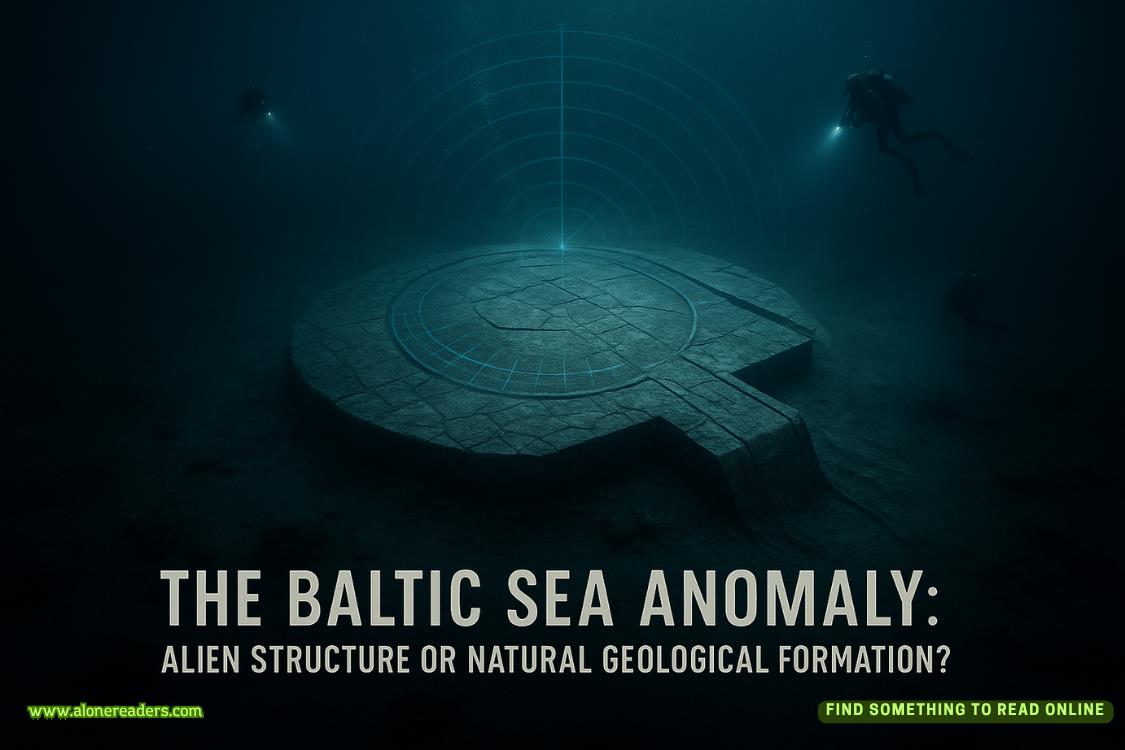
The Baltic Sea Anomaly stands as one of the most intriguing marine discoveries of the 21st century, capturing the imagination of researchers, skeptics, and mystery-seekers alike. Discovered in June 2011 by the Swedish Ocean X diving team, the anomaly lies approximately 90 meters beneath the surface of the northern Baltic Sea. What immediately drew global attention was its striking circular shape, its apparent geometric features, and the possibility that it might represent something far beyond ordinary geology. Over the years, the anomaly has fueled debates ranging from rational geological explanations to bold claims of extraterrestrial origins, making it a modern mystery suspended between science and speculation.
The object itself is roughly 60 meters in diameter and rests atop what appears to be a short “pillar” protruding from the seabed. In sonar images, the formation looks uncannily like a disc or dome, with a top section that appears unnaturally smooth for an underwater rock face. Many viewers noticed what looks like a set of ninety-degree angles, steps, ridges, and even what resembles a staircase leading to a flat platform. Surrounding the formation are long, darkened trails that some have interpreted as “skid marks,” as though the object slid across the seabed before coming to rest. These characteristics were more than enough to ignite public fascination, pushing the anomaly into global headlines and prompting questions about whether it could be an ancient structure, a crashed spacecraft, or even the remnants of a lost civilization.
The Baltic Sea itself adds another layer of intrigue. Known for low salinity, cold temperatures, and relatively slow geological degradation processes, it is a region where shipwrecks and ancient artifacts remain remarkably well-preserved. This environmental context allowed more imaginative interpretations to flourish. If an ancient technological object or advanced structure were to remain intact for millennia, the Baltic would theoretically be one of the places where it could survive. These factors gave oxygen to theories suggesting that the anomaly may not be a simple geological formation, but potentially something created intentionally or something that arrived through unknown means.
When Ocean X first released sonar scans of the anomaly, the public response varied dramatically. Some observers noted a resemblance to popular depictions of extraterrestrial craft, especially the domed and circular shape that echoes classic “UFO” imagery. The smooth upper surface, combined with sharp edges observed in sonar readings, heightened this perception. Others pointed out similarities to ancient megalithic structures, implying a possible link to prehistoric cultures that may have built large stone formations that are now submerged. A few fringe theorists even speculated that the anomaly could be a remnant of a lost civilization, perhaps even predating known human settlements around the Baltic Sea.
The diving team reported unusual technical disturbances when approaching the site, including disrupted satellite phones and malfunctioning equipment. They also claimed that samples from the formation showed burnt or melted characteristics, as if exposed to intense heat in the past. These details, while disputed by some scientists, added to the mystery and gave the anomaly an aura of something beyond normal geology. Even the claim that a diver experienced heightened radiation exposure near the object circulated widely in popular media, though it was never independently confirmed.
From a scientific perspective, geologists and marine researchers provided more grounded explanations. The Baltic Sea floor contains numerous glacial deposits and rock formations shaped during the last Ice Age. As glaciers moved across the region, they carved and deposited stones, boulders, and sediments in patterns that sometimes resemble unnatural shapes. Some experts suggested that the anomaly could be a glacial erratic, a large chunk of rock carried and deposited by ice sheets thousands of years ago. Others proposed that it might be a remnant of basalt or sandstone fractured into geometric forms due to natural processes. The straight lines and angles visible in sonar images could be the result of low-resolution scans or natural fracturing patterns misinterpreted as artificial.
Despite these explanations, parts of the anomaly remain puzzling. The presence of what appears to be a symmetrical circular shape is highly unusual for glacial formations, which are typically irregular. The “stairs” or tiered levels that divers observed are also difficult to attribute solely to natural erosion. Some geologists suggested that these features might result from a combination of sediment layering and ancient volcanic activity, although volcanic rock is not commonly found in the Baltic Sea. The smooth “runway-like” track extending from the object raised further questions, as natural formations typically do not leave such long, linear depressions unless shaped by strong currents or glacial displacement—neither of which perfectly matches the environmental conditions of the anomaly’s resting place.
The debate intensified when laboratory analyses of samples taken from the anomaly suggested materials that included minerals not commonly found in the region. Some reports indicated traces of limonite and goethite, minerals that can form in the presence of hydrothermal activity. Critics argued that these materials are not unusual and could easily exist in glacial deposits, while supporters of the “artificial structure” theory claimed they may hint at engineered or processed materials. The lack of consensus only added fuel to the debate.
The role of sonar imagery in shaping public perception cannot be understated. Sonar scans, especially low-resolution ones, can distort shapes, blur edges, and create visual illusions that appear artificial. Several experts argued that the initial sonar pictures, which went viral online, were likely distorted due to the scanning angle, sediment interference, and equipment limitations. However, even with improved scans, the anomaly retained its circular form, continuing to defy easy explanation.
Ocean X, the team that discovered the anomaly, maintained that the structure appears artificial and called for more extensive research funding to conduct deeper analysis. Their observations included details such as right-angle formations, smooth stone-like surfaces, and what seemed like a round opening or “hole.” They also cited the lack of biological growth on some parts of the structure, which could suggest it was not a typical rock formation. However, skeptics countered that certain types of stones in low-salinity environments can exhibit reduced biological activity, making this point inconclusive.
One of the reasons the Baltic Sea Anomaly remains such a persistent mystery is that no comprehensive, peer-reviewed scientific study has been conducted that definitively resolves its origin. Funding limitations, harsh diving conditions, and the remote location have prevented large-scale analysis. As a result, the scientific community lacks the kind of robust, high-resolution data that would settle the matter. This vacuum of authoritative information leaves space for speculation, interpretation, and imagination.
In many ways, the Baltic Sea Anomaly occupies the same space in public consciousness as other famous unexplained phenomena—objects that hover at the boundary between fact and speculation, inviting interpretation through the lens of one’s personal beliefs about ancient history, extraterrestrial life, or natural processes. The anomaly’s appeal lies not only in its shape and structure but in the possibility that it represents something hidden beneath the waves, something that challenges our understanding of Earth’s past or the universe’s possibilities.
The most balanced understanding of the Baltic Sea Anomaly recognizes it as a geological mystery that has yet to be fully explained. While there is no confirmed evidence that it is a crashed alien craft or an ancient artificial structure, its features are certainly unusual enough to merit further investigation. The combination of geometric patterns, strange sediment trails, and material samples that resist easy categorization makes it a genuinely compelling subject for scientific inquiry. Whether it ultimately proves to be a product of unusual natural geological processes or something entirely unexpected, the anomaly reminds us of how much remains undiscovered on our own planet.
In the end, the fascination surrounding the Baltic Sea Anomaly endures because it lies at the intersection of science and wonder. It embodies the human desire to explore, to question, and to imagine possibilities beyond the ordinary. Until more extensive research is conducted, the anomaly will remain a symbol of the mysteries that rest beneath the oceans—silent, ancient, and waiting for discovery.



 Château de Vincennes: France’s Forgotten Royal Fortress and Medieval Stronghold
 Château de Carcassonne: Europe’s Greatest Medieval Citadel and Fortress
 Château de Chenonceau: The Castle Built by Remarkable Women
 Château de Chambord: France’s Magnificent Renaissance Castle and Architectural Wonder
 Tehri Dam: India's Tallest Dam and the Debate Behind It
 Bhakra Nangal Dam: India's Temple of Modern Development










