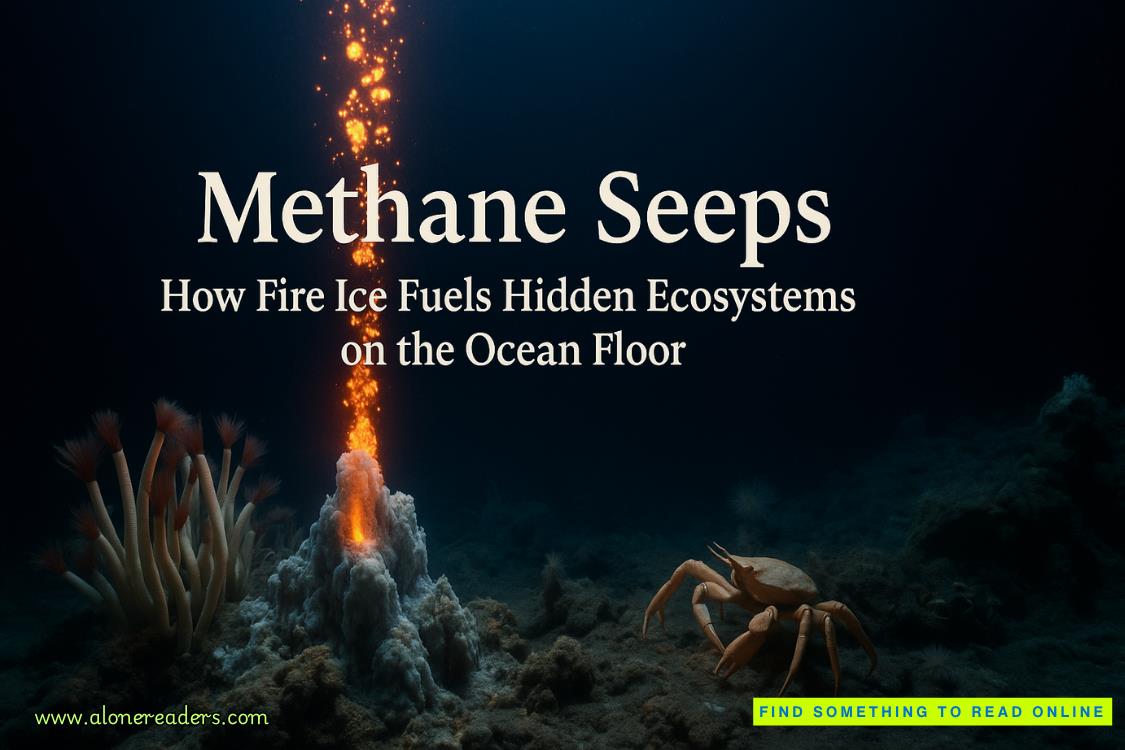
Methane seeps are among the most mysterious and scientifically valuable environments on Earth—hidden worlds where fire seems to emerge from ice and energy bubbles up from beneath the seafloor to fuel thriving networks of life. These locations are not volcanic, nor are they powered by sunlight. Instead, they rely on methane hydrates—a strange material often described as fire ice, because it burns when ignited but remains solid under pressure and low temperature. Deep beneath the ocean, these hydrates trap enormous amounts of methane gas, and when released through fissures or cracks in the seabed, they create methane seeps—dynamic biological hubs that defy conventional rules of marine survival.
What makes methane seeps particularly extraordinary is that they host ecosystems independent of sunlight. Most life on Earth ultimately traces back to photosynthesis, but methane seeps prove that life can thrive in complete darkness, powered instead by chemical transformations. Organisms here rely on chemosynthesis, a process where bacteria convert methane into usable energy, providing the foundation for an entire food chain. From these microorganisms emerge tube worms, crabs, mussels and even specialized fish adapted to extreme environments. This alternative biological strategy reveals not only the resilience of life but also how Earth may have supported life in its earliest stages—and how other planets might support life today.
Methane hydrates themselves are scientifically valuable because they blur the line between liquid, solid and gas. Under normal atmospheric conditions, methane is a light gas, but under seafloor pressure it combines with water molecules to form crystalline solids—like frozen lattices that can trap up to 164 volumes of methane per unit of hydrate. These hydrates could potentially serve as a massive future energy resource, but they are also a climate risk, because sudden releases of methane could accelerate global warming. This dual nature—promising energy source yet potential environmental hazard—makes methane seeps a focal point of global research.
The discovery of such ecosystems began with deep-sea expeditions using remotely operated vehicles and submersibles. Researchers first noticed shimmering plumes rising from cracks in the seabed, initially suspecting volcanic activity. Instead, they found methane bubbles steadily rising from below, sometimes forming shimmering ice-like coatings around the seeps. These were methane hydrates and within them lived entire communities of animals intimately connected to this chemical energy source. Some of the most iconic inhabitants include:
These organisms not only survive—but engineer their environment, forming reefs, mats, and structures that solidify the seafloor and alter local chemistry. They create biological hotspots in otherwise barren oceanic deserts. It is astonishing that material once considered an inert geological curiosity actually sustains complex, energy-efficient, self-organizing ecosystems.
Scientists classify methane seeps into several types depending on geological conditions. Some are associated with continental margins where organic sediments decompose and release methane under pressure. Others exist along tectonic faults or subduction zones, where geological compression forces methane upward. In Arctic regions, methane hydrates lie just beneath shallow sediments, making them sensitive to rising temperatures. These variations determine both the stability of hydrates and the rates of methane release, which impacts local ecology and possibly even climate cycles over geological time.
The stability of methane hydrates is fragile. If ocean temperatures rise or pressures change, hydrates can rapidly destabilize, releasing large quantities of methane gas into the water column and sometimes into the atmosphere. Methane is a highly potent greenhouse gas, more than 25 times stronger than carbon dioxide over a 100-year period. Some scientists believe that past climate shifts may have been triggered by rapid methane releases, possibly contributing to mass extinction events. This makes methane seeps important not only for biological research but also for understanding climate history and future risks.
There is also growing interest in methane hydrates as a potential alternative energy source. They contain more stored energy than all known reserves of coal, oil and natural gas combined. Countries like Japan, India and the United States have initiated exploratory drilling projects to determine whether hydrates could be extracted safely. However, the stability of hydrate layers is delicate; extraction could trigger seafloor collapse, tsunamis or uncontrolled methane leakage. The ocean floor may hold enormous energy—but it is guarded by geological uncertainty. The key challenge is determining whether a controlled extraction method can be developed that protects ecosystems while preventing destabilization.
Beyond Earth, methane seeps spark profound questions about life elsewhere in the universe. If chemosynthetic ecosystems can thrive without sunlight on our own planet, similar environments may exist on Europa, Enceladus or even Mars, where subsurface oceans and chemical reactions could provide energy sources. Studying fire ice ecosystems is not just an oceanic pursuit—it is an astrobiological doorway, helping us rethink the fundamental requirements for life.
Despite the absence of sunlight, visual beauty exists at seep sites. Microbial mats create textured carpets of white, yellow and orange across the seafloor. Tube worms extend in clusters like forests of red-tipped pillars. The water often appears hazy from methane releases, and occasional hydrate ice formations glimmer with frost-like coatings. These places offer a breathtaking natural artistry, sculpted not by light, but by chemistry and pressure. They remind us that the deep sea remains one of Earth’s least-explored frontiers, filled with life forms and processes that could reshape our understanding of biology.
Another fascinating phenomenon occurs when methane seeps generate carbonate rock structures, formed by microbial activity that alters local pH levels and mineral balances. Over time, these become methane-derived authigenic carbonates, serving as fossil records of ancient seep activity. Studying them helps scientists trace the history of methane release throughout geological time, providing clues to past climate transitions and evolutionary patterns. Thus, methane seeps are not just active environments—they are also archives of ancient ocean chemistry.
It is remarkable to think that ice-like crystals containing flammable gas could be the foundation of life for so many marine organisms. Yet methane seeps are proof that life adapts to whatever energy sources are available. They challenge our assumptions about where life can exist and what conditions it needs to flourish. They reveal an interconnected system of geology, chemistry and biology, functioning far below the reach of sunlight. And they present a scientific paradox: fire and ice, danger and life, energy and risk—all intertwined under the seafloor.
Methane seeps are more than scientific curiosities—they are windows into alternative ecosystems, laboratories for climate research, models for future energy extraction and inspiration for interplanetary exploration. As technology advances and deep-sea expeditions become more sophisticated, we may uncover even richer networks of life built on methane. Beneath the crushing pressure of the ocean, life builds its own rules, its own architectures and its own resilience. Where light fails—chemistry rises. The silent rise of methane bubbles from beneath the Earth may tell a greater story about the adaptability of life and the hidden forces that power our planet’s deepest habitats.
These mysterious zones beneath the ocean offer a crucial lesson: not all life is built on sunlight—and perhaps, neither was the first life on Earth. In this unseen world, methane seeps are the life-giving embers, and fire ice is the ignition source. They are nature’s proof that energy can emerge from darkness and that entire ecosystems can thrive in places once believed to be lifeless. Understanding them is more than an academic pursuit—it is a journey into the most fundamental questions of life’s origins, survival and future.



 Château de Vincennes: France’s Forgotten Royal Fortress and Medieval Stronghold
 Château de Carcassonne: Europe’s Greatest Medieval Citadel and Fortress
 Château de Chenonceau: The Castle Built by Remarkable Women
 Château de Chambord: France’s Magnificent Renaissance Castle and Architectural Wonder
 Tehri Dam: India's Tallest Dam and the Debate Behind It
 Bhakra Nangal Dam: India's Temple of Modern Development










