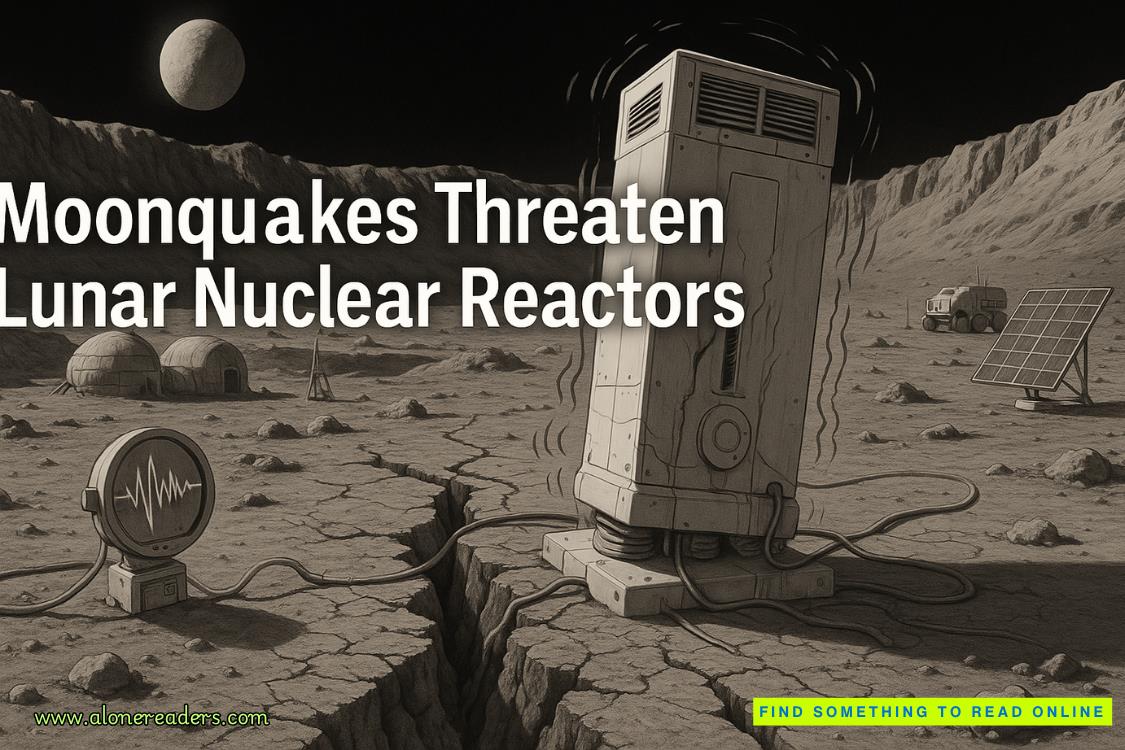
The Moon has no atmosphere, no weather systems, and no tectonic plates—but it does have quakes. And unlike Earth, where most tremors last mere seconds, lunar moonquakes can rumble on for hours. As NASA prepares to build long-term Artemis habitats powered by 40-kilowatt nuclear fission reactors, a new concern is emerging: prolonged seismic shaking that could quietly cripple critical components designed to run for decades. Engineers have warned that while the daily odds of a major moonquake affecting a single site may be extremely low, the cumulative risk over a ten-year mission is far from negligible. For the first time in lunar exploration history, humanity is planning large, rigid, power-generating infrastructure—and the Moon’s unexpectedly powerful quakes pose a direct threat.
Unlike the gentle swaying associated with buildings on Earth, lunar quakes deliver sharp, unfiltered acceleration. The Moon’s regolith is bone-dry and lacks the natural damping found in Earth’s soils. This means vibrations travel farther, strike harder, and persist longer. Engineers have long understood that the Moon shrinks a few millimeters every year as its interior cools, creating thrust faults and ridges across the surface. These faults, some of which lie near proposed landing sites for Artemis missions, can generate shallow moonquakes strong enough to register up to magnitude 5.0. In terrestrial terms, this is moderate—but on the Moon, shaking of this magnitude can continue for hours with little attenuation. The threat is not dramatic collapse but the slow, relentless buildup of structural fatigue.
Nuclear fission reactors planned for Artemis bases are not tiny experimental boxes. They are tall, complex systems with heat exchangers, coolant pipes, power converters, and control electronics stacked vertically within their housings. Their height, while necessary for thermal radiation and system efficiency, makes them more vulnerable to long-duration oscillation. Engineers compare the risk to holding a narrow pole and shaking its base. Even gentle movement at the bottom amplifies at the top. A reactor tower built on stiff lunar regolith could experience intensified swaying, increasing the chance of fractures in coolant lines or misalignment of critical control rods. Repeated moonquake cycles—sometimes lasting half a day—are enough to induce microscopic cracks that worsen over time.
NASA’s historical experience offers little guidance because Apollo hardware was small, lightweight, and squat. Lunar landers and seismometers were close to the ground and had no tall vertical structures. Today’s proposed systems, including reactor towers and Starship-derived habitats, stand multiple meters above the surface. Their increased aspect ratio directly translates into increased seismic amplification. An impact that would have been inconsequential for an Apollo lander becomes a potential hazard for a modern vertical reactor assembly.
The situation is further complicated by the Moon’s unpredictable fault zones. While daily odds of a moonquake occurring directly beneath a base might be as low as one in twenty million, long-term exposure multiplies the probability. A reactor expected to operate for ten years has a dramatically higher chance of encountering at least one significant shaking event. And because shallow quakes originate close to the surface, they produce much stronger local acceleration than deep seismic activity. The ground does not merely vibrate; it flexes, jerks, and resonates in ways that challenge traditional structural models developed for Earth.
The most severe risks involve three potential failure modes. First, structural deformation: the reactor’s outer housing or internal frames may crack or warp due to prolonged lateral movement. Second, coolant leaks: tiny breaches in circulation lines could lead to overheating, reduced power output, or shutdown. Third, control system disruptions: sensitive instrumentation that regulates fission reactions may lose calibration or become damaged, triggering emergency failsafes. While none of these scenarios would result in the type of radioactive fallout seen in terrestrial nuclear disasters—the Moon has no wind, water, or biosphere to carry contaminants—they could nonetheless render a costly reactor unusable.
Engineers are responding with innovative design strategies that adapt seismic principles for a world without water or atmosphere. One leading approach involves flexible or semi-floating foundations that allow the reactor to move with the ground instead of resisting it. By distributing load across engineered layers of compacted regolith, sintered tiles, or regolith-derived concrete, designers hope to mimic the shock-absorbing qualities found naturally on Earth. Another recommendation is strict fault avoidance. Lunar geologists have already identified hazardous thrust faults and scarps—including the well-studied Lee-Lincoln scarp near the Apollo 17 landing site—that should be considered exclusion zones. A minimum distance of ten miles from major fault scarps is becoming a proposed guideline for reactor placement.
But selecting safe terrain on the Moon is not simple. NASA’s upcoming Lunar Environment Monitoring Station (LEMS), scheduled for deployment on Artemis III, will be the first system to map seismic hazards in high resolution. Unlike Apollo-era seismometers, LEMS instruments will be partially buried, allowing far more accurate readings of shallow quakes. The data gathered will help engineers model ground motion under different regolith depths, slopes, and fault geometries. Over time, these maps will guide where reactors, habitats, fuel depots, and landing pads should be placed to minimize exposure to intense shaking. Lunar bases may ultimately resemble earthquake-informed cities on Earth, where zoning and soil studies quietly dictate the placement of critical infrastructure.
In the meantime, mission planners are revisiting assumptions about how long lunar systems should operate before replacement. A reactor originally expected to run for a decade might need to be inspected or swapped sooner if deployed in a region with higher seismic activity than anticipated. Even more critically, the design of reactor support frames, coolant manifolds, and control housings is being reconsidered to prioritize flexibility over rigidity. The traditional engineering instinct—build strong, stiff, and unmoving—may be counterproductive on a world where structures must vibrate to survive.
The Moon is teaching us a paradox: stability comes from movement, not stubborn resistance. Long-lived lunar bases must treat seismic design not as an afterthought, but as a defining architectural principle. As Artemis-era systems push the boundaries of verticality and complexity, the Moon’s silent, hours-long quakes emerge as a powerful reminder that even in an airless world, the ground beneath us is alive.
Looking ahead, the stakes extend far beyond engineering. Reliable lunar reactors are the key to sustaining science outposts, resource extraction operations, night-time heating, oxygen production, and future human expansion deeper into space. Power failures could delay missions, jeopardize habitat safety, or undermine ambitious projects such as lunar manufacturing and deep-space fuel production. Ensuring seismic resilience is therefore as essential as radiation shielding or dust mitigation. The Moon’s quakes will not stop—but with the right preparation, they do not have to stop us either.
Humanity is on the verge of becoming a multi-world species. As plans shift from brief visits to permanent presence, the Moon’s hidden dynamism becomes one of the most important environmental factors we must understand. Long-duration moonquakes are not dramatic or catastrophic, but they are persistent, insidious, and technically challenging. They shake slowly, silently, and relentlessly. And in the decades to come, they may become one of the defining engineering problems of lunar civilization.
The challenge is clear: build reactors and habitats that can sway, flex, and adapt—or risk watching our most crucial power systems falter in the very environment they were meant to conquer.



 Château de Vincennes: France’s Forgotten Royal Fortress and Medieval Stronghold
 Château de Carcassonne: Europe’s Greatest Medieval Citadel and Fortress
 Château de Chenonceau: The Castle Built by Remarkable Women
 Château de Chambord: France’s Magnificent Renaissance Castle and Architectural Wonder
 Tehri Dam: India's Tallest Dam and the Debate Behind It
 Bhakra Nangal Dam: India's Temple of Modern Development