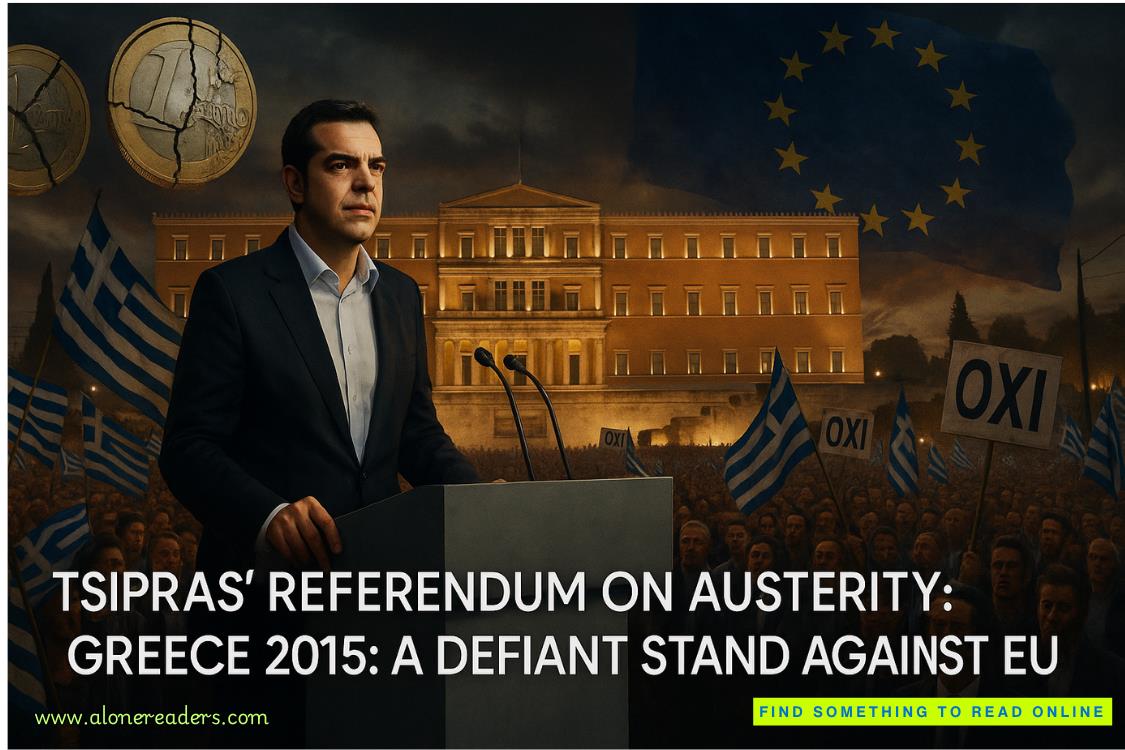
When Greece plunged deeper into economic collapse in 2015, its new prime minister, Alexis Tsipras, made a decision that stunned Europe: he called a national referendum on whether Greeks should accept the stringent austerity measures demanded by international creditors. This vote was not just a fiscal matter—it was a symbolic act of resistance, a challenge to the European Union’s economic orthodoxy, and a moment that tested the limits of democracy under financial stress. The referendum became one of the most dramatic political confrontations in Europe’s modern history, exposing the clash between national sovereignty and supranational financial power. Tsipras did not simply present a policy question to the public; he put Greece’s dignity, future, and identity on the ballot.
By 2015, Greece had been suffocating under five years of severe austerity imposed by the EU, the European Central Bank, and the International Monetary Fund—the so-called “Troika.” Public wages had been slashed, pensions reduced, taxes raised dramatically, and unemployment soared beyond 25 percent. Greece’s economy shrank by a quarter, an economic contraction comparable to wartime depression. For ordinary Greeks, life became a daily struggle for survival. As pharmacies ran out of medicine and families lived on shrinking incomes, austerity became a national trauma. Against this backdrop, Tsipras and his left-wing Syriza party rose to power promising a different path: no more humiliation, no more imposed suffering, and certainly no more unquestioned obedience to Brussels.
To secure desperately needed bailout funds, Greece was required to commit to strict measures: steep tax increases, pension cuts, labor-market overhauls, and deeper privatization of national assets. From the EU’s perspective, these conditions were necessary to stabilize Greece’s budget and prevent another spiraling debt crisis. From the Greek perspective, it felt like punishment—measures imposed by wealthier northern European nations with little understanding of the human cost within Greece. This tension—economic rationality versus social survival—set the stage for Tsipras’ dramatic political gamble.
Instead of quietly negotiating or reluctantly submitting to further demands, Tsipras chose a radically different strategy: he would let the Greek people decide. The referendum question was simple on paper but seismic in implication—should Greece accept the EU’s new bailout terms, or reject them? Calling the referendum was an act of political defiance. No EU leader expected a member state to put a bailout package to a public vote. The European technocratic system was built on the assumption that such decisions were too complex, too sensitive, and too economically dangerous for direct democracy. But Tsipras believed that legitimacy could only come from the people who were living through austerity, not from distant institutions analyzing spreadsheets.
European leaders were furious. Many saw Tsipras’ move as reckless, irresponsible, and even blackmailing. Financial markets panicked. Greek banks closed temporarily as capital controls were put in place to prevent a massive run on deposits. Creditors warned that a “No” vote could lead to Greece’s expulsion from the eurozone, an economic catastrophe that could send shockwaves across the continent. The EU was now in a high-stakes standoff with a country too economically weak to fight but politically unwilling to submit. The days leading up to the vote became a battle for public opinion, with international leaders warning of doom and Greek officials urging courage and defiance.
Despite fear, uncertainty, and intense pressure, 61 percent of Greeks voted against accepting the EU’s terms. It was a moment of national pride and cathartic resistance. Millions of Greeks felt they had reclaimed their voice after years of economic despair. The vote symbolized a collective scream against austerity, inequality, and the feeling of being dictated to by foreign institutions. In European political history, few democratic moments were as emotionally charged. Streets across Athens filled with people celebrating as if they had won their independence again. For a fleeting moment, it appeared as though Tsipras had pulled off an extraordinary victory—not only resisting the EU but rallying an entire population behind him.
Yet within days, the reality of the situation crushed the celebratory mood. Greece was still on the brink of financial collapse. Banks were running out of cash. The economy was paralyzed. And the EU, rather than offering better terms after the referendum, hardened its position even further. Tsipras found himself in an impossible situation. With no ability to print its own currency and no access to external funding, Greece was cornered. Eventually, despite the dramatic “No” vote, Tsipras returned to Brussels and agreed to an even harsher bailout package. Many Greeks saw this as betrayal. Others recognized it was the only realistic option to prevent total economic collapse. The dramatic contradiction—that the referendum empowered the public but ultimately changed very little—became a painful part of the national memory.
To understand why Tsipras conceded, one must analyze the power dynamics of the eurozone. Greece had moral leverage but lacked structural power. The EU’s institutions were built to enforce fiscal discipline, not accommodate democratic rebellion. Tsipras faced three choices: accept the terms, let the banks collapse, or abandon the euro entirely. Exiting the euro sounded theoretically liberating but would have triggered economic chaos, hyperinflation, and immediate impoverishment. Tsipras ultimately decided that protecting Greece from total devastation mattered more than ideological purity. His referendum, though emotionally powerful, proved insufficient as a bargaining tool against an economic system designed to prioritize stability over democratic expression.
Despite its contradictory outcome, the 2015 referendum left a profound legacy. It exposed the deep tensions between democratic decision-making and supranational financial governance. It highlighted how small states within the eurozone could be politically trapped—unable to control their own monetary policy yet legally bound to austerity measures they opposed. The vote also reshaped political discourse across Europe. It energized anti-establishment movements, triggered discussions about the democratic deficit within the EU, and forced European leaders to confront uncomfortable truths about inequality between member states.
In the years following the referendum, Greece slowly stabilized but continued bearing the scars of austerity. Unemployment declined but remained high. Public services, weakened by years of cuts, struggled to recover. Many young Greeks emigrated in search of better opportunities. Yet the country also demonstrated resilience. Tourism rebounded, entrepreneurship grew, and political polarization gradually eased. Greece did not collapse. Instead, it survived an ordeal that exposed the vulnerabilities of European integration. Tsipras himself evolved, shifting from a fiery anti-austerity rebel to a pragmatic leader navigating political realities.
In hindsight, Tsipras’ referendum stands as one of the most dramatic acts of political defiance in modern European history. It was bold, courageous, and deeply human—a leader placing trust in his people at a moment of national desperation. Yet it also illustrated the limits of democratic choice when financial constraints override political will. Greece’s struggle in 2015 remains a cautionary tale about the fragility of sovereignty in a globalized economy. Tsipras asked his people to choose, and they did. But the power to act on that choice ultimately lay elsewhere.
The referendum may not have reshaped Greece’s economic future as intended, but it reshaped Europe’s political imagination. It showed that even small nations can challenge powerful institutions, that ordinary citizens can defy expert forecasts, and that dignity can be as important as economics. In a world increasingly defined by financial pressures, Tsipras’ stand in 2015 remains a stunning reminder of the costs—and the courage—of democratic defiance.



 Top 10 Highest-Paid Professions in the United States (2025): Salaries, Roles, and Career Paths
 Top 10 Largest U.S. Companies by Revenue in 2025 (Fortune 500 Analysis)
 Top 10 Highest-Earning Global Tech Companies in 2025: Revenue, Strategy, and Market Power
 Top 10 Highest-Earning Mobile Apps in 2025: Revenue, Monetization, and Market Dominance
 ZombieAgent: Inside the Zero-Click AI Attack That Turns ChatGPT Agents into Persistent Data-Leaking Zombies
 China’s Urban Air Is a Hidden Plastic Reservoir: Inside the Microplastic Clouds Over Megacities