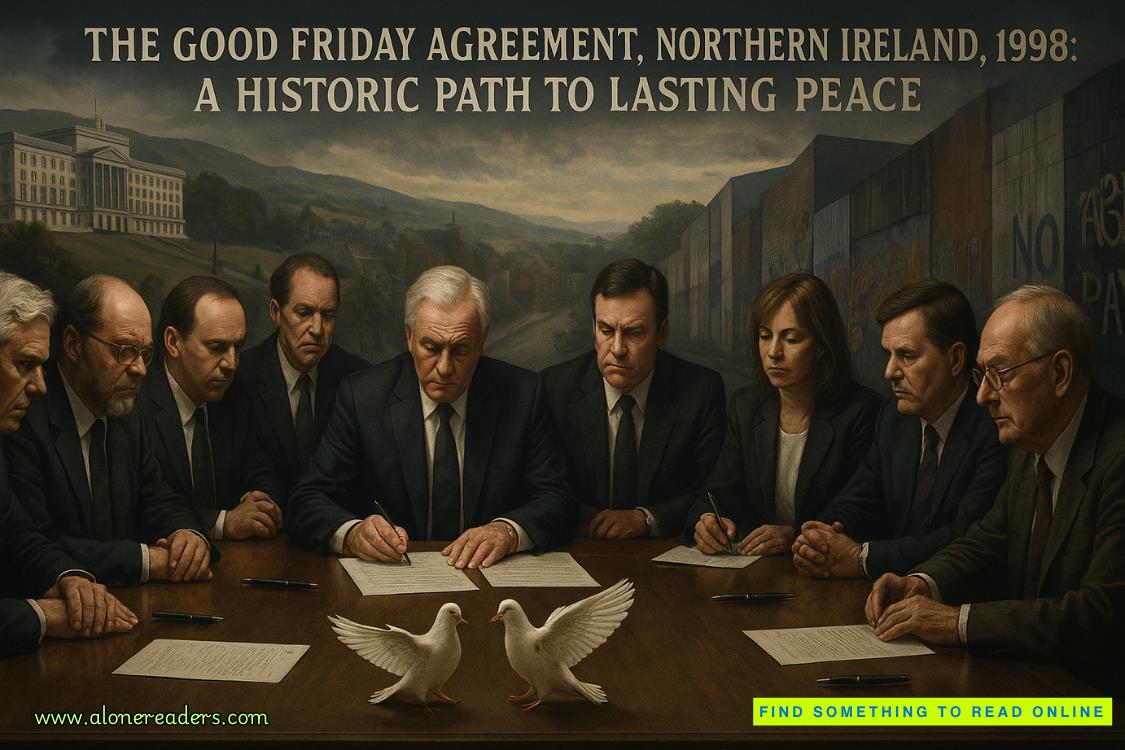
The Good Friday Agreement of 1998 stands as one of the most significant diplomatic achievements of the late twentieth century, marking a turning point in the long and painful history of conflict in Northern Ireland. For nearly three decades, the region was engulfed in an era known as the Troubles, a period defined by sectarian violence, political deadlock, and fractured identities. The Agreement, reached on April 10, 1998, did not magically erase centuries of tension, yet it created a durable foundation on which peace, political cooperation, and shared governance could be built. It is widely regarded as a sophisticated blueprint for conflict resolution, demonstrating how complex historical grievances can be transformed into frameworks for coexistence when political will, international partnership, and public courage align.
The Troubles, which began in the late 1960s, were rooted in deep-seated disputes about national identity, sovereignty, and civil rights. Nationalists, who were predominantly Catholic, sought a united Ireland; unionists, largely Protestant, wanted Northern Ireland to remain within the United Kingdom. Over 3,500 people were killed across these decades, and tens of thousands were injured. Communities became physically and psychologically divided, with peace walls, segregated neighbourhoods, and mutual distrust shaping everyday life. The struggle was not only political; it was deeply personal, shaping the identity and memory of entire generations. Understanding this context is crucial to appreciating why the Good Friday Agreement was not simply a document but a transformational social contract.
Negotiations leading to the Agreement were extraordinarily complex. They involved multiple political parties within Northern Ireland, including long-opposed groups such as the Ulster Unionist Party (UUP), the Social Democratic and Labour Party (SDLP), and Sinn Féin, as well as the British and Irish governments. The presence of international actors, particularly U.S. Senator George Mitchell as the chair of the talks, added credibility, patience, and an unwavering insistence on constructive dialogue. The negotiations required participants to engage with long-standing grievances, violent histories, and emotionally charged demands, while also envisioning a future in which compromise was not a betrayal but a path to collective survival.
One of the most significant achievements of the Good Friday Agreement was its ability to redefine political structures in a way that acknowledged competing identities without demanding that one side surrender its aspirations. The Agreement established a new devolved government based on power-sharing, meaning that leaders from both unionist and nationalist communities were required to govern side by side. This ensured that no single group could dominate the political agenda or impose unilateral decisions. Instead, governance became a shared responsibility—a revolutionary idea in a region historically marked by political exclusion.
Equally important was the Agreement’s recognition of the principle of consent. This principle stated that Northern Ireland would remain part of the United Kingdom unless a majority of its citizens voted otherwise, while also acknowledging the legitimacy of the aspiration for a united Ireland. By framing political identity as a matter of democratic choice rather than violent struggle, the Agreement defused one of the core sources of conflict. People could maintain their British identity, Irish identity, or feel both without the threat of forced assimilation or exclusion. This acknowledgment of dual identities transformed politics from a zero-sum contest into a long-term process of balancing rights and aspirations.
The Agreement also created important cross-border institutions intended to foster cooperation between Northern Ireland and the Republic of Ireland. These bodies focused on practical issues such as health, transportation, environment, and culture, illustrating that peace was not only about ending violence but about building shared interests that could outlast political disagreements. At the same time, new East–West institutions strengthened cooperation between Ireland and the United Kingdom, ensuring that both governments maintained joint responsibility for sustaining peace.
Another major dimension of the Good Friday Agreement was its emphasis on human rights and equality. During the Troubles, Catholic and nationalist communities experienced systemic discrimination in employment, housing, and policing. Addressing these injustices was essential for building durable trust. The Agreement explicitly committed to protections for civil rights, reforms in policing, and the creation of mechanisms to ensure fair treatment for all citizens regardless of religious or political affiliation. This commitment fundamentally reshaped key institutions, particularly law enforcement. The Royal Ulster Constabulary, long perceived by nationalists as biased, was reformed into the Police Service of Northern Ireland with new oversight structures and a focus on inclusivity. These reforms helped shift policing from a symbol of division into a potential bridge between communities.
Disarmament was another cornerstone of the Agreement. Paramilitary groups, both republican and loyalist, were required to decommission their weapons, a task that demanded patience, trust-building, and international verification. The Independent International Commission on Decommissioning oversaw this process, ensuring that the symbolic and practical steps toward demilitarization were credible. While disarmament did not eliminate every threat of violence, it sharply reduced the capacity for coordinated armed conflict and signaled a willingness by armed groups to embrace political rather than military strategies.
Perhaps one of the most emotionally difficult aspects of the Agreement was the early release of paramilitary prisoners. For many victims’ families, this decision felt unbearable, as individuals responsible for killings or bombings were set free within a relatively short period. Yet negotiators believed that reintegrating former combatants into society was essential for breaking the cycles of violence, ensuring that future generations would see a path toward political participation rather than armed struggle. This decision underscored the profound moral complexity of peacemaking, where justice and reconciliation must be constantly balanced.
Despite its success, the implementation of the Agreement has not been without challenges. Political institutions in Northern Ireland have collapsed several times due to disagreements between the major parties, particularly over issues like cultural identity, policing, and legacy investigations into past violence. Civic divisions remain visible in segregated housing and school systems, and there are still active dissident groups that reject the peace process. Peace, in Northern Ireland, is not a static achievement but an ongoing process requiring vigilance, compromise, and sustained investment.
Brexit introduced new uncertainties. The question of the Irish border—one of the most sensitive issues in the region’s history—returned to political prominence. Ensuring that the border remained open, as guaranteed by the Good Friday Agreement, required complex arrangements such as the Northern Ireland Protocol. While controversial, these mechanisms were necessary to prevent destabilization and protect the economic and social integration that had developed over two decades of peace.
Yet despite the complexities, the Good Friday Agreement has endured. Most importantly, it has saved lives. Younger generations have grown up without the daily fear of bombings, street barricades, or military checkpoints. Commerce, education, and cross-community initiatives have taken root. While tensions still exist, the shared memory of the Troubles serves as a powerful incentive to preserve peace. The Agreement has also become a model used internationally in conflict-resolution studies, demonstrating how acknowledging history, sharing power, addressing inequalities, and building intergovernmental partnerships can transform even the most entrenched conflicts.
Ultimately, the Good Friday Agreement is a story of political bravery and social resilience. It required leaders who were willing to speak to former enemies, communities willing to forgive without forgetting, and governments willing to share authority and responsibility. It demonstrated that peace is not the absence of conflict but the presence of structures strong enough to manage disagreements without violence. Its legacy reminds us that nations torn by division can find common ground when the future becomes more important than the past.
The success of the Agreement also highlights an often-overlooked truth: peace is built not only by political elites but by ordinary people who choose coexistence over antagonism. In 1998, the people of Northern Ireland overwhelmingly endorsed the Agreement through a referendum, demonstrating a collective desire to move beyond the trauma of the Troubles. Their vote was a mandate for hope. It signaled that everyday citizens were willing to accept compromise, power-sharing, and the hard work of reconciliation in exchange for stability and the possibility of a different future. This public endorsement remains one of the most powerful testimonies to the human capacity for renewal.
Today, more than two decades later, the Good Friday Agreement continues to shape Northern Ireland’s political landscape. Its influence extends beyond the region, serving as a global example of how divided societies can craft innovative solutions grounded in consent, shared governance, and respect for identity. It is a reminder that progress is slow, peace is fragile, and reconciliation is difficult, but the alternative—endless conflict—is far worse.
The Good Friday Agreement was not a perfect document, nor was it intended to be. Instead, it was a courageous beginning, a framework designed to evolve, adapt, and guide future generations toward something better. Its endurance, despite considerable challenges, reflects the strength of its principles and the determination of the people it serves. As Northern Ireland continues to navigate political, cultural, and economic change, the Agreement remains a beacon of what is possible when societies choose dialogue over division and hope over fear.
If the twentieth century was scarred by conflicts rooted in identity, territory, and power, then the Good Friday Agreement provided a different story—one in which compromise became a virtue, and peace became a shared responsibility. It remains a testament to the belief that even the deepest wounds can heal when courage meets opportunity, and when a society decides that the future deserves more than the past can offer.



 Top 10 Highest-Paid Professions in the United States (2025): Salaries, Roles, and Career Paths
 Top 10 Largest U.S. Companies by Revenue in 2025 (Fortune 500 Analysis)
 Top 10 Highest-Earning Global Tech Companies in 2025: Revenue, Strategy, and Market Power
 Top 10 Highest-Earning Mobile Apps in 2025: Revenue, Monetization, and Market Dominance
 ZombieAgent: Inside the Zero-Click AI Attack That Turns ChatGPT Agents into Persistent Data-Leaking Zombies
 China’s Urban Air Is a Hidden Plastic Reservoir: Inside the Microplastic Clouds Over Megacities










