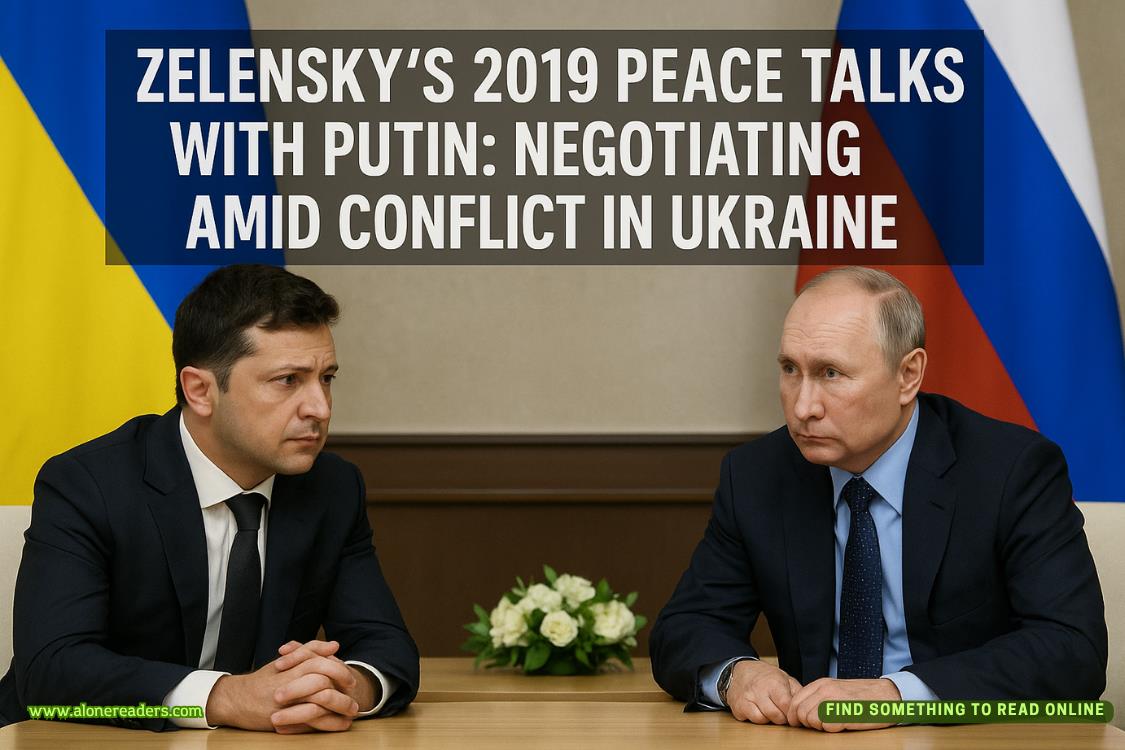
In December 2019, newly elected Ukrainian President Volodymyr Zelensky faced one of the most delicate challenges of his political career: negotiating peace with Russian President Vladimir Putin while the war in eastern Ukraine still raged. The meeting, held in Paris, was the first face-to-face encounter between the two leaders and symbolized both hope and caution for millions of Ukrainians exhausted by years of bloodshed. It was a moment charged with political risk and symbolic meaning, as Zelensky attempted to fulfill his campaign promise of ending the war through dialogue rather than escalation.
When Zelensky took office in May 2019, Ukraine had been locked in conflict for over five years. The fighting in Donbas — between Ukrainian forces and Russian-backed separatists — had claimed more than 13,000 lives, displaced millions, and devastated entire regions. The earlier Minsk I and Minsk II Agreements, signed in 2014 and 2015 respectively, had established ceasefire frameworks and political roadmaps but were never fully implemented. Ceasefires routinely broke down, and mistrust between Kyiv and Moscow remained entrenched. Zelensky, a former comedian and political outsider, had campaigned on a message of pragmatic leadership and renewal. He promised to “bring peace to Donbas” and was willing to speak directly with Putin — something his predecessor had avoided.
The Paris summit on December 9 was organized under the “Normandy Format,” a diplomatic grouping of Ukraine, Russia, France, and Germany that had mediated earlier peace efforts. French President Emmanuel Macron and German Chancellor Angela Merkel acted as facilitators, hoping to revive the stalled negotiations. For Zelensky, the meeting was an opportunity to test Putin’s willingness to compromise; for Putin, it was a chance to gauge the new Ukrainian leader’s resolve. Both sides entered the room with guarded expectations.
The agenda was ambitious but carefully structured. Zelensky aimed to secure concrete results that could demonstrate progress to the Ukrainian public: an exchange of prisoners, a reaffirmed ceasefire, troop disengagement from key frontlines, and humanitarian access to conflict-affected areas. Putin, on the other hand, sought to push for the political clauses of the Minsk Agreement — especially the holding of local elections in the separatist-controlled territories of Donetsk and Luhansk and the granting of special autonomous status to those regions.
The meeting lasted several hours and was described as intense and complex. Both leaders were acutely aware that every word could have major political implications back home. Zelensky faced a domestic audience deeply suspicious of any concessions to Russia; nationalists warned him not to “capitulate.” Putin faced his own strategic dilemma: maintaining pressure on Ukraine while presenting Russia as a legitimate mediator rather than an aggressor.
Despite their differences, the summit produced some tangible results. Both sides agreed to implement a new ceasefire by the end of 2019 and to carry out a large-scale prisoner exchange, which eventually led to the release of dozens of detainees from both sides. They also confirmed the withdrawal of troops from three key frontline areas and promised to expand humanitarian corridors. For Zelensky, these were important symbolic victories that allowed him to show his voters that dialogue could yield human results. The images of reunited families returning home after years of separation resonated deeply across Ukraine.
However, the summit also exposed the limits of diplomacy amid an active conflict. On the most crucial issues — such as the sequencing of elections, border control, and the status of Donbas — no final agreement was reached. Zelensky insisted that Ukraine must regain full control of its eastern border before any elections could be held in separatist-controlled territories. Putin argued the opposite: that elections should precede border restoration, consistent with Russia’s interpretation of the Minsk framework. The stalemate reflected the fundamental divergence between the two countries’ positions — Kyiv emphasizing sovereignty and territorial integrity, Moscow emphasizing political decentralization that would give the separatists permanent leverage within Ukraine’s political system.
The tone of the talks alternated between cautious optimism and strategic skepticism. Zelensky later admitted that speaking with Putin was “difficult but necessary.” He described the atmosphere as pragmatic rather than cordial, a test of wills more than a meeting of minds. Putin, meanwhile, portrayed himself as patient and willing to continue discussions — but without signaling any readiness to alter Russia’s military or political posture in eastern Ukraine.
Following the summit, Ukrainian society was divided in its assessment. Supporters of Zelensky praised his courage for engaging directly with Russia and achieving a humanitarian breakthrough with the prisoner swap. Critics accused him of being too conciliatory and warned that any political compromise might legitimize Russian influence in Ukraine’s internal affairs. Nevertheless, Zelensky’s approval ratings temporarily improved, boosted by the sense that peace was at least being actively pursued rather than indefinitely postponed.
For the international community, the meeting was viewed as a cautious step forward but not a breakthrough. France and Germany, both mediators, welcomed the new momentum but recognized that deeper issues remained unresolved. Western analysts noted that the talks revealed not only diplomatic fatigue but also structural limitations: neither side trusted the other enough to make bold concessions. The conflict had hardened into a political and psychological stalemate.
Over the following months, small steps were taken to uphold the Paris agreements. Troop withdrawals occurred in limited areas, and further prisoner exchanges were discussed. Yet ceasefire violations continued, and the frontlines remained volatile. By mid-2020, hopes of significant progress had faded. Russia maintained its political and military influence over the separatist territories, while Ukraine refused to endorse any constitutional changes that could undermine its sovereignty.
The 2019 Paris summit thus stands as both a diplomatic achievement and a sobering lesson. Zelensky’s decision to engage directly with Putin was bold — a gesture of openness that few expected from a leader so new to power. But it also underscored the profound difficulty of negotiating with an adversary whose strategic objectives were incompatible with Ukraine’s national interests. The limited progress achieved — mainly humanitarian measures — could not offset the broader failure to secure lasting peace.
For Zelensky, the experience reshaped his understanding of Russia’s intentions. The optimism of 2019 gave way to a more hardened view in later years, as Moscow continued to manipulate the situation in Donbas and resist meaningful compromise. By 2021, with Russian troops massing along Ukraine’s borders, it became clear that the diplomatic path pursued in 2019 had reached its limits. The invasion of February 2022 confirmed the fragility of those earlier efforts, turning what had once been a tense but negotiable conflict into a full-scale war.
Looking back, the 2019 peace talks serve as a vivid illustration of negotiation amid conflict — a moment when diplomacy was still possible, even if improbable. They highlight the dual realities of war and politics: that peace requires both courage and leverage, and that dialogue alone cannot overcome deeply rooted geopolitical ambitions. Zelensky entered the talks with sincerity and political risk; Putin entered with calculation and strategic patience. The resulting compromise was partial and temporary, but historically significant as the last formal attempt to end the conflict before it escalated into something far greater.
In the end, Zelensky’s Paris meeting with Putin in 2019 did not bring peace to Ukraine, but it revealed much about the limits of diplomacy when mutual trust has eroded. It showed the world a leader willing to try negotiation before escalation, a reflection of Ukraine’s hope that reason could prevail over force. And though the talks ultimately failed to stop the war, they remain an enduring chapter in Ukraine’s struggle — a chapter defined not by surrender, but by the effort to seek peace amid the shadow of war.



 Top 10 Highest-Paid Professions in the United States (2025): Salaries, Roles, and Career Paths
 Top 10 Largest U.S. Companies by Revenue in 2025 (Fortune 500 Analysis)
 Top 10 Highest-Earning Global Tech Companies in 2025: Revenue, Strategy, and Market Power
 Top 10 Highest-Earning Mobile Apps in 2025: Revenue, Monetization, and Market Dominance
 ZombieAgent: Inside the Zero-Click AI Attack That Turns ChatGPT Agents into Persistent Data-Leaking Zombies
 China’s Urban Air Is a Hidden Plastic Reservoir: Inside the Microplastic Clouds Over Megacities