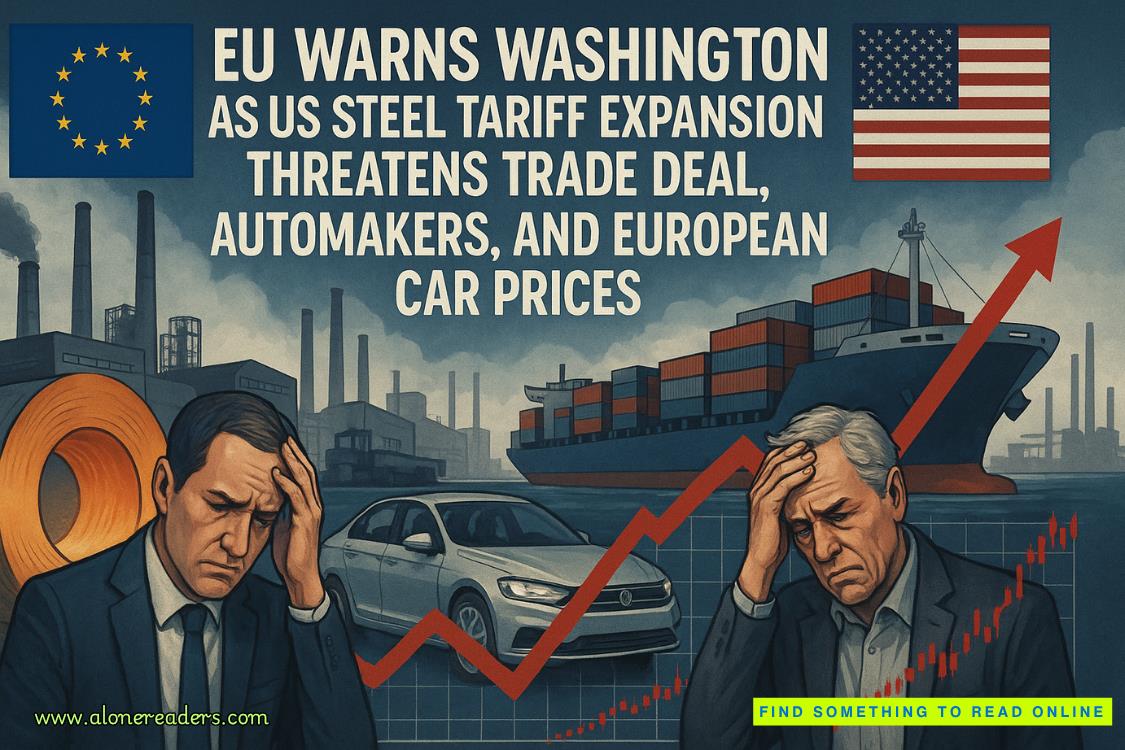
The European Union’s latest warning to the United States marks a significant escalation in transatlantic trade tensions, centered on Washington’s plan to widen its steel and aluminum tariffs. What began as a controlled dispute governed by a negotiated tariff cap is now threatening to spill into a broader conflict with political, industrial, and consumer-level consequences. Brussels has made it explicitly clear that the proposed expansion—now expected to cover more than 400 product categories—would not only breach the spirit of the EU-US trade agreement but could directly destabilize the fragile diplomatic balance both sides have maintained over the past year. European officials fear that the United States’ move to widen the scope of tariffed goods risks undermining the agreed 15% tariff ceiling and could reignite a retaliatory cycle reminiscent of earlier trade disputes.
At the core of the dispute lies Washington’s insistence on maintaining—and now expanding—its existing 50% tariff on steel and aluminum imports from the EU. This rate is already significantly higher than what is typically seen in transatlantic trade and has forced several European manufacturers, particularly automakers, to rethink long-term pricing and production strategies. Although the EU temporarily suspended its counter-tariffs to allow negotiations to continue, it has been unequivocal about its readiness to reinstate retaliatory measures should the United States proceed with widening its tariff list. The upcoming Brussels meeting with US Commerce Secretary Howard Lutnick is expected to be decisive, as European negotiators intend to press for clarity on Washington’s true intentions.
Behind the diplomatic maneuvers lies a harsher economic reality: the current tariffs have already inflicted substantial financial damage on Europe’s automotive sector. As the world’s second-largest exporter of vehicles, Europe depends heavily on predictable, low-friction access to global markets. The 50% tariff on metals entering the US—and the 15% tariff applied to cars and parts—creates a price distortion that undermines competitiveness on every level. Automakers such as Stellantis and BMW have already reported hundreds of millions of dollars in losses, directly linked to the inflated cost of steel and aluminum used in their vehicles. These losses have translated into profit warnings, production delays, and strategic uncertainty at a time when European manufacturers are simultaneously managing slowed demand in China, rising energy prices, and the expensive transition to electric mobility.
The impact goes far beyond raw cost increases. Steel and aluminum are fundamental commodities in vehicle manufacturing, and their prices ripple through every layer of the supply chain. Suppliers responsible for chassis components, body panels, engine housings, and electric battery enclosures face additional administrative burdens as they navigate trade compliance across expanded tariff categories. This adds operational friction, leading to higher overhead costs and reduced margins. With suppliers squeezed, automakers are forced to absorb higher component prices while attempting to maintain competitive pricing in the US market—an increasingly difficult task amid intensifying global competition.
Furthermore, the possibility of tariffs expanding to over 400 product lines creates a climate of strategic confusion. Every additional tariff category introduces new variables into sourcing decisions. Some European manufacturers may accelerate plans to shift production to North America to bypass import barriers entirely. Others may refine their supply chain structure to prioritize intra-EU suppliers, reducing reliance on global networks. The cumulative effect is a costly restructuring process at a time when capital reserves are already stretched thin.
Investors have reacted predictably, with the stock prices of major European automakers experiencing bouts of volatility as news of tariff expansions circulates. The uncertainty affects long-term investment planning, particularly in emerging technologies such as autonomous driving and next-generation electric drivetrains. Companies faced with thinner margins and fluctuating market access often deprioritize risk-heavy innovations, slowing the broader progress of the sector.
One of the most consequential downstream effects relates to consumer prices in the EU. While the United States is the party imposing tariffs, the financial repercussions are increasingly being felt in European showrooms. The dramatically higher cost of steel and aluminum squeezes automakers from both sides: exports to the US become less profitable, while domestic manufacturing costs rise due to global inflationary pressure on raw materials. Automakers that have attempted to shield customers from these costs are reaching the limits of what they can absorb. As a result, European car prices are expected to rise, potentially sharply, over the coming year.
Price adjustments are already being discussed internally within automaker strategy teams. Research suggests that higher exports costs to the US—and shrinking export margins—reduce the economic incentive for automakers to maintain lower prices within Europe. This effect is amplified by internal EU steel price inflation, as Europe’s own counter-tariffs and trade defensive measures tighten supplies and elevate baseline metal prices. Under these conditions, maintaining current pricing becomes unsustainable for most manufacturers.
Consumers should therefore expect several tangible outcomes. First, prices for new vehicles—both combustion and electric—are likely to increase. Even modest price rises can significantly affect demand in a market still recovering from post-pandemic inflation and supply chain shortages. Second, new model launches may face delays or be produced in smaller quantities. Automakers confronted with rising production costs will prioritize models that promise the highest margins, potentially sidelining midsize or budget-oriented vehicles. Third, buyers may increasingly shift to used vehicles or lower-cost brands, reshaping demand patterns across the EU.
The tariff escalation could also distort competition within the European market itself. Automakers with existing US manufacturing capacity, such as BMW in South Carolina, may be better shielded from cost shocks and therefore able to maintain more stable pricing. Meanwhile, manufacturers relying exclusively on European production will face steeper cost curves and greater pressure to adjust retail prices upward. This uneven playing field could influence long-term investment decisions and may encourage more European firms to expand US-based production to hedge against future tariff risks.
Beyond the auto sector, the widening tariff list poses broader strategic questions for EU-US relations. The transatlantic economic partnership has historically been built on predictability, shared interests, and tightly integrated industrial cooperation. A significant breach in the tariff agreement would signal a shift towards a more confrontational trade posture, with implications for industries ranging from machinery to chemicals to renewable energy components. For the EU, the expansion represents not only an economic threat but also a political challenge: allowing the US to widen tariffs unilaterally would set a dangerous precedent for future trade negotiations.
The EU’s insistence on preparedness for retaliation reflects its desire to avoid repeating past mistakes, when delayed responses to protectionist policies weakened its negotiating position. Countermeasures could include targeted tariffs designed to pressure politically sensitive sectors in the United States. Such moves, however, risk escalating the dispute into a broader trade war, with far-reaching consequences for global supply chains.
As both sides prepare for the Brussels meeting, the stakes are high. The EU wants to reaffirm the integrity of the recently negotiated tariff cap and avoid instability in its industrial base. The United States, under pressure to protect domestic metal producers, appears reluctant to scale back. The outcome will shape not only the economic outlook for European automakers but potentially the direction of transatlantic trade relations for years to come.
In the meantime, European consumers, automakers, and suppliers must brace for an environment defined by rising costs, shifting strategies, and heightened uncertainty. If Washington proceeds with its tariff expansion, the effects will cascade through the European economy—raising prices, constraining innovation, and reshaping the competitive landscape across one of Europe’s most vital industries.
Europe’s message is clear: expanding the tariff scope will destabilize the trade framework, strain industries on both sides of the Atlantic, and ultimately force Brussels to retaliate. Whether Washington will reconsider remains uncertain, but the consequences of escalation are already visible—in factory balance sheets, stock market fluctuations, and the increasingly expensive cars rolling off Europe’s production lines.



 Top 10 Highest-Paid Professions in the United States (2025): Salaries, Roles, and Career Paths
 Top 10 Largest U.S. Companies by Revenue in 2025 (Fortune 500 Analysis)
 Top 10 Highest-Earning Global Tech Companies in 2025: Revenue, Strategy, and Market Power
 Top 10 Highest-Earning Mobile Apps in 2025: Revenue, Monetization, and Market Dominance
 ZombieAgent: Inside the Zero-Click AI Attack That Turns ChatGPT Agents into Persistent Data-Leaking Zombies
 China’s Urban Air Is a Hidden Plastic Reservoir: Inside the Microplastic Clouds Over Megacities