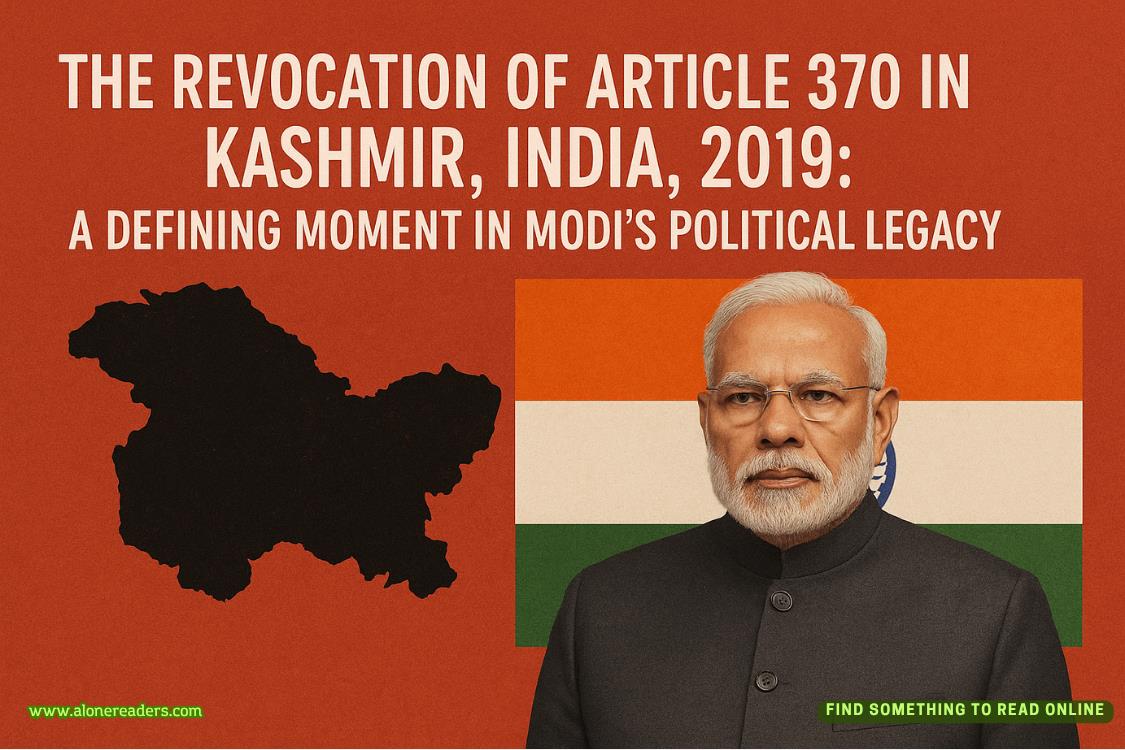
The decision to revoke Article 370 of the Indian Constitution on August 5, 2019, was one of the most consequential and controversial political moves in modern Indian history. Announced by Home Minister Amit Shah and executed under the leadership of Prime Minister Narendra Modi, this decision fundamentally altered the constitutional status of Jammu and Kashmir. It stripped the region of its autonomy, dissolved its separate constitution, and bifurcated the state into two union territories: Jammu & Kashmir, and Ladakh. The move was hailed by many as a long-overdue step toward national integration, while critics condemned it as unconstitutional, coercive, and detrimental to democratic principles.
The Origins of the Special Status
Article 370 originated from the unique circumstances surrounding Jammu and Kashmir’s accession to India in 1947. When the princely state was invaded by Pakistani tribal militias, Maharaja Hari Singh sought India’s military assistance. In exchange, he signed the Instrument of Accession, granting India control over defense, foreign affairs, and communications, while retaining autonomy over other internal matters.
Temporary but Deeply Entrenched
The article was introduced as a “temporary provision” in the Constitution in 1949. However, over time, it became deeply entrenched in the political and emotional identity of the state. Article 35A, introduced through a presidential order in 1954, further solidified Kashmir’s special privileges by allowing the state to define “permanent residents” and provide them exclusive rights to property and government jobs.
Political Symbolism
For decades, Article 370 symbolized Kashmir’s distinct identity within the Indian Union. The ruling parties in the state—particularly the National Conference—used it as a political instrument to maintain autonomy and negotiate power with New Delhi. Conversely, the Bharatiya Janata Party (BJP) and its ideological parent, the Rashtriya Swayamsevak Sangh (RSS), viewed the article as an impediment to national unity and a source of separatism.
A Sudden and Secrecy-Driven Operation
The revocation of Article 370 was not a spontaneous move but the culmination of years of ideological commitment and political planning by the Modi government. In early August 2019, thousands of additional troops were deployed to the Kashmir Valley, tourists were evacuated, and communication lines were cut. This created an atmosphere of uncertainty and fear. On August 5, Amit Shah tabled the presidential order and the Jammu and Kashmir Reorganization Bill in Parliament. The constitutional mechanism used was unprecedented: the government invoked Article 370(3), which allowed the President to abrogate the article with the recommendation of the “Constituent Assembly” of Jammu and Kashmir—an institution that had ceased to exist since 1957.
To circumvent this, the Modi administration interpreted “Constituent Assembly” as “Legislative Assembly” and substituted the authority with that of the Governor—who was under the control of the central government. Legally intricate and politically forceful, this maneuver effectively dismantled Article 370 overnight.
Parliamentary and Political Response
The move passed in both houses of Parliament with overwhelming support—125 votes in favor in the Rajya Sabha and 370 in the Lok Sabha. The BJP framed it as the fulfillment of a long-standing promise to integrate Kashmir completely into India. Opposition parties, including the Congress, Trinamool Congress, and the Communist parties, called it unconstitutional and warned of dangerous repercussions.
Loss of Autonomy
The immediate consequence was the dissolution of Jammu and Kashmir’s semi-autonomous status. The state’s separate constitution was nullified, and Indian laws now extended fully to the region. Property and job protections for locals vanished, opening the door for outsiders to purchase land and settle in the region.
Administrative Reorganization
The state was bifurcated into two union territories—Jammu and Kashmir (with a legislative assembly) and Ladakh (without one). This reorganization allowed the central government to exercise greater control through the Lieutenant Governors.
Security and Communication Lockdown
To prevent unrest, the government imposed a strict communication blackout, detained political leaders (including three former chief ministers), and enforced curfews. For months, internet services remained suspended, making Kashmir one of the most heavily restricted regions in the world. The government justified this as a temporary measure to maintain law and order, though critics viewed it as a violation of civil liberties and human rights.
Domestic Support and Opposition
Within India, public opinion was sharply divided. The BJP and its supporters celebrated the abrogation as a historic corrective measure to decades of separatism and political favoritism. For them, this was the “final integration” of Kashmir into India, ensuring equality with other states.
Opposition parties, however, criticized both the substance and method of the move. They argued that the revocation bypassed democratic procedures and federal principles, since no elected state government or assembly consented to the change.
International Response
Globally, reactions were cautious but significant. Pakistan strongly condemned the move, downgrading diplomatic ties and suspending trade with India. China objected to the formation of the Ladakh Union Territory, citing territorial concerns. The United Nations expressed concern over the communication blackout and the detention of political leaders, urging respect for human rights. Western nations such as the United States and the European Union called for restraint but largely viewed the issue as India’s internal matter.
Promises of Development
The Modi government justified the abrogation by promising that full integration would unlock economic growth, investment, and infrastructure development in the region. Without the restrictions of Article 35A, industries and private investors would be free to enter the region.
Challenges on the Ground
However, the ground reality has been complex. The prolonged internet shutdown and heightened militarization disrupted local businesses, tourism, and education. Although the government later announced large-scale infrastructure projects and investment summits, skepticism persists about whether these measures can compensate for the political and emotional alienation felt by the local population.
Employment and Land Ownership
One of the most controversial outcomes has been the change in property rights and domicile rules. In 2020, the new domicile law allowed anyone who had lived in Jammu and Kashmir for over 15 years—or studied there for seven years—to apply for residency. While the government presented this as inclusive, critics saw it as an attempt to alter the region’s demographic composition.
Pending Supreme Court Challenges
Several petitions were filed in India’s Supreme Court challenging the constitutional validity of the revocation. Petitioners argued that Article 370 could not be abrogated unilaterally since it represented a constitutional compact between Jammu and Kashmir and the Union of India. The government countered that the provision was temporary and that the Constituent Assembly’s dissolution made its continuation meaningless.
Federalism and Precedent
The case raises profound questions about Indian federalism. If the central government can unilaterally alter a state’s constitutional status without its consent, it sets a precedent for future central overreach. Legal scholars and political scientists continue to debate whether this strengthens the idea of “one India” or erodes the federal spirit enshrined in the Constitution.
Modi’s Political Capital
Politically, the abrogation of Article 370 solidified Narendra Modi’s image as a decisive leader willing to confront long-standing national issues head-on. It fulfilled a core ideological goal of the BJP and galvanized its voter base nationwide. The move was projected as a bold assertion of sovereignty and nationalism.
Regional Fallout
However, in Kashmir, the abrogation deepened political alienation. Mainstream political parties such as the National Conference and the People’s Democratic Party (PDP) lost much of their legitimacy. New political entities emerged under central patronage, but popular trust in democratic institutions eroded significantly.
Security Landscape
While large-scale violence was contained due to strict curfews and detentions, militancy and civilian resentment remain persistent challenges. The region’s militarized environment and restricted political space continue to fuel tensions.
The revocation of Article 370 stands as one of the most transformative events in India’s post-independence history. It redefined the relationship between the Union and its states, reshaped the constitutional architecture, and symbolized a shift toward centralized governance. For Modi, it was a political triumph—a demonstration of resolve, control, and ideological clarity.
Yet, the story of Kashmir after 2019 is far from settled. The real test of this decision lies not in symbolism but in tangible peace, prosperity, and political reconciliation. Whether the abrogation of Article 370 becomes a cornerstone of integration or a chapter of discontent will depend on how India manages the delicate balance between national unity and regional dignity in the years to come.



 Top 10 Highest-Paid Professions in the United States (2025): Salaries, Roles, and Career Paths
 Top 10 Largest U.S. Companies by Revenue in 2025 (Fortune 500 Analysis)
 Top 10 Highest-Earning Global Tech Companies in 2025: Revenue, Strategy, and Market Power
 Top 10 Highest-Earning Mobile Apps in 2025: Revenue, Monetization, and Market Dominance
 ZombieAgent: Inside the Zero-Click AI Attack That Turns ChatGPT Agents into Persistent Data-Leaking Zombies
 China’s Urban Air Is a Hidden Plastic Reservoir: Inside the Microplastic Clouds Over Megacities