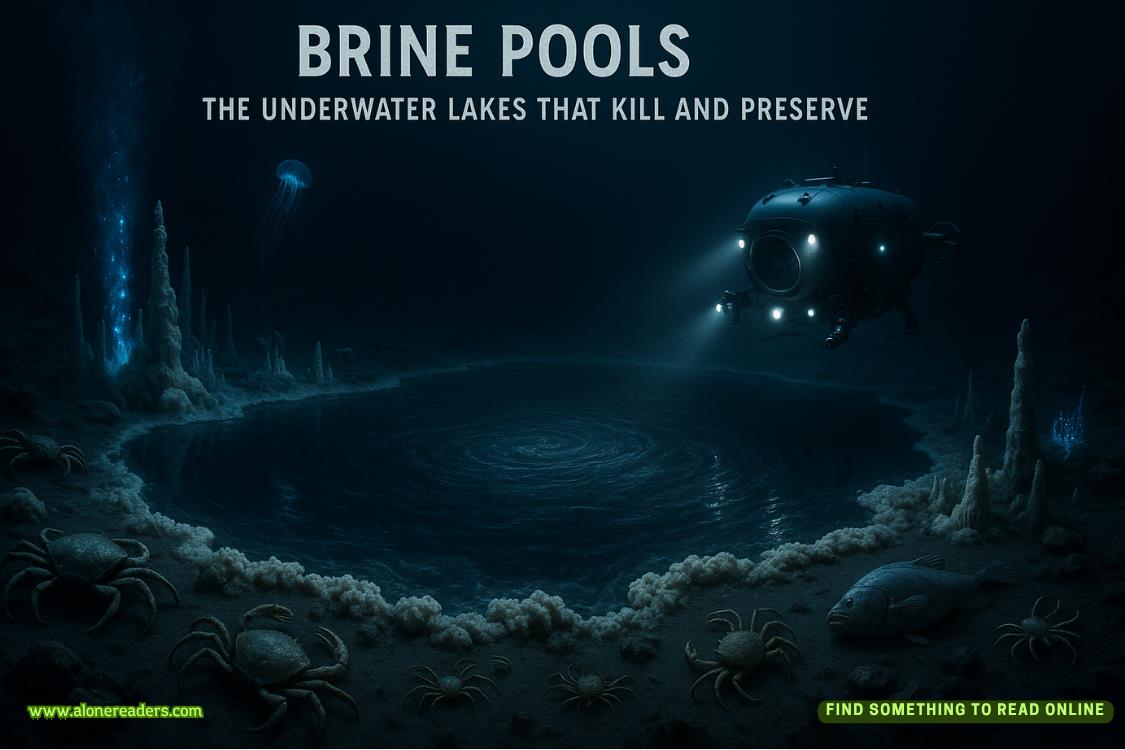
Brine pools are among the most haunting and scientifically fascinating features hidden within the deep ocean. These underwater lakes, formed from hypersaline, mineral-rich brine trapped in seafloor depressions, create environments so hostile that any living creature that touches them dies almost instantly. Yet, paradoxically, these same conditions possess remarkable preservation powers, keeping bodies and biological materials intact for astonishingly long periods. Unlike ordinary seawater, which circulates constantly, brine pools form still, dense basins separated by sharp, visible boundaries where life ends and a strange kind of timelessness begins.
Brine pools typically arise in regions where ancient salt deposits, buried beneath thick layers of sediment, interact with ruptures in the seafloor caused by tectonic activity. When these deposits dissolve or when super-salty fluids seep upward, they collect in natural depressions and create lakes whose salinity may reach eight times that of ordinary seawater. These extreme levels of salt drastically increase water density, causing the brine to settle and resist mixing with the surrounding ocean—similar to oil and water, but far more scientifically dramatic.
The sharp boundary created is called the halocline, a physical interface so pronounced that submersibles appear to “float” on the lake surface. This illusion is so powerful that remotely operated vehicles often struggle to descend into the brine, bouncing off the dense fluid as if touching a solid surface.
The most infamous fact about brine pools is their ability to kill instantly. Any creature—fish, crab, or octopus—that ventures into the brine becomes overwhelmed by the extreme salinity and lack of oxygen. The brine contains almost zero dissolved oxygen, preventing respiration entirely.
The water’s chemistry is equally deadly. Many brine pools also contain:
These toxic compounds create a chemical cocktail so hostile that even deep-sea species adapted to extreme pressure and cold cannot survive.
Around the pool edges lies a ring of death known as the “kill zone.” Here, animals attracted by food or curiosity collapse at the boundary, leaving behind eerily preserved corpses that scientists use to understand deep-sea life and decomposition processes.
One of the most extraordinary aspects of brine pools is their ability to preserve dead organisms. This phenomenon occurs due to a combination of extreme factors:
The result is a natural preservation chamber where bodies remain recognizable for years, possibly decades. Marine biologists have discovered crabs, fish, and even soft-tissue organisms laid out on the brine pool floor in a state far more intact than would ever be possible in normal seawater.
Brine pools function like powerful biological “pickling” chambers. Their hypersaline environment creates:
These conditions mimic ancient environments where exceptional fossil preservation occurred, offering modern scientists a rare window into how past mass-preservation events may have unfolded.
Many brine pools occur near methane seeps, where gas from deep underground escapes through seafloor cracks. Methane hydrates—ice-like structures containing trapped methane—often border these pools. As they dissolve, they contribute to brine formation and create bizarre geological shapes, including:
These methane-rich environments also attract unique microbial ecosystems that thrive on chemical energy instead of sunlight, forming an entire community of chemosynthetic life at the pool perimeters even as the brine itself remains utterly deadly.
While the pool interior is completely lethal, the edges of brine pools support unusual and diverse ecosystems. Here, life adapts not to survive inside the brine, but to live just outside it, relying on chemical gradients and nutrient availability.
Some of the organisms found at brine pool boundaries include:
These microbial mats, often white or yellow, feed on sulfur compounds and help detoxify the environment slightly—just enough to allow other organisms to survive at the very edge of death.
Deep-sea explorers describe brine pools as one of the most surreal sights on Earth. The shimmering lake surfaces resemble metallic mirrors or liquid mercury. The halocline boundary distorts light, making submersibles appear to melt as they descend.
Surrounding the lake is a stark contrast:
Few natural phenomena combine beauty, mystery, and lethal power so dramatically.
Due to the pools’ instability and density, exploring them is technologically challenging. Remotely operated vehicles (ROVs) must be equipped with:
Even then, attempting to penetrate the brine often results in ROVs being pushed back to the surface like repelling magnets. Specialized sensors measure salinity, methane concentration, and temperature, allowing scientists to map the chemical layers without contaminating the pool.
Collecting biological samples is even more complex. Any creature retrieved from within or near the brine needs to be carefully preserved to avoid rapid decomposition once exposed to normal seawater and atmospheric conditions.
Brine pools offer insights into:
Studying brine pools also helps understand how ancient seas formed large deposits of:
The bizarre ecosystems near brine pools are crucial analogs for environments on other worlds. For example:
The fact that life thrives right outside an environment that is utterly lethal hints at the resilience and adaptability life could exhibit elsewhere in the universe.
Brine pools tap into an ancient human fascination: places where life ends instantly yet bodies remain untouched by time. The underwater lakes evoke imagery of mythological rivers of death, silent and shimmering. They challenge our understanding of what is alive, what is dead, and what can remain preserved indefinitely under the right conditions.
Their existence reminds us that Earth still holds mysteries comparable to alien worlds—right in the deep blue below.
Brine pools are one of the ocean’s most extraordinary natural wonders—underwater lakes that kill with deadly precision yet preserve with almost sacred stillness. They embody contradiction: destruction and preservation, danger and beauty, death and scientific discovery. For researchers, these pools offer a rare laboratory for studying ancient Earth conditions, deep-sea ecosystems, and the chemical boundaries of life itself. For the rest of us, they remain haunting reminders of how much mystery still lies hidden beneath the waves.



 Château de Vincennes: France’s Forgotten Royal Fortress and Medieval Stronghold
 Château de Carcassonne: Europe’s Greatest Medieval Citadel and Fortress
 Château de Chenonceau: The Castle Built by Remarkable Women
 Château de Chambord: France’s Magnificent Renaissance Castle and Architectural Wonder
 Tehri Dam: India's Tallest Dam and the Debate Behind It
 Bhakra Nangal Dam: India's Temple of Modern Development










